
DOI: 10.3726/9781916704206.003.0003
As I set out to conduct fieldwork, I did not anticipate that a ghost would be one of the most influential artists I would encounter. I did not imagine that women would be at the center of the creation and adaptation of male-style dances, or that female beauty and sexuality would emanate from male veneers. While in retrospect I see that many of my assumptions about what I might find in Malang reveal more about my own ignorance than anything else, the excitement and wonder I experienced as I encountered more and more about the histories of cross-gender performance pushed me to keep learning, keep listening.
This chapter centers the lives and careers of three women dancers, Muskayah (deceased at the time of my fieldwork), Tri Wahyuningtyas, and Sri Handayani, who produced complex senses of gender through the performance of male-style dance, both challenging and reinforcing dominant constructions of masculinity and femininity through their gender fluidity as they contributed to place-based senses of identity and gender pluralism through the course of the twentieth century (perhaps as early as the late 1890s) and into the twenty-first. Building from my earlier work (Sunardi, 2009, pp. 468–469, 478–480, 485–488; 2013, pp. 148–151; 2015, pp. 33–62, 96–126; 2022, pp. 291–294), I show that in performing male-style dance Muskayah, Tri, and Sri have produced, represented, embodied, and disseminated senses of female masculinity—distinct senses of masculinity produced by females, a concept introduced in Chapter 1 (Halberstam, 1998, pp. 1–2, 15; Blackwood and Wieringa, 2007, pp. 9, 14–15; Blackwood, 2010, p. 29; Sunardi, 2013, p. 141; 2015, p. 11; 2022, p. 290).
The particular senses of female masculinity that Muskayah, Tri, and Sri produced entailed keeping their femaleness visible and/or audible. Halberstam has helped me to understand such approaches as forms of “layering”, a theatrical strategy in which a performed gendered role is noticeably superimposed—layered—onto an actor’s own gendered self (1998, pp. 260–261). One form of layering occurs “[w]hen a drag king performs as a recognizable male persona” and “choose[s] to allow her femaleness to peek through” (ibid., p. 260). As I show, Muskayah, Tri, and Sri “layered” masculinity onto their female bodies when performing the recognizable male personas portrayed through male-style dances, allowing their femaleness to “peek through” a male veneer. This womanliness in the context of a male-style dance supports Halberstam’s point that layering—making visible both the performer’s femaleness and the role’s maleness—“reveals the permeable boundaries between acting and being” as well as “the artificiality of conventional gender roles” (1998, p. 261). In other words, the concepts of female masculinity and layering offer means to explore how Muskayah, Tri Wahyuningtyas, and Sri Handayani complicated boundaries between their on- and offstage selves and showed how gender roles are performed cultural constructions.
Paralleling the learning objectives of the previous chapter, by the end of this chapter, my hope is that you will be able to identify ways in which Muskayah, Tri Wahyuningtyas, and Sri Handayani:
1. Challenged and reinforced norms of gender and sexuality on- and offstage;
2. Navigated gender and social pressures (including religious pressures) from the communities in which they lived; and
3. Contributed to the production of local east Javanese identities through their lives and careers as artists.
As you read this chapter, take note of similarities and differences in males’ embodiments of femaleness discussed in the previous chapter and females’ embodiment of maleness discussed below, a matter I return to at the end of this chapter and in the closing words of this book.
The spirit of Muskayah, grandmother of the master dancer Djupri who you met in Chapter 2, seemed to be ever present. Djupri and other artists frequently talked about her, referring to stories attributing the creation of Malangan dances to her through spiritual experiences (even if there were various opinions about those stories), her abilities to perform male- and female-style dance, her wide-reaching and impactful career, her skill and knowledge as a musician, and her spiritual power. I was particularly taken with the ways she was remembered to have in effect challenged dominant notions of gender, in part by excelling in realms typically dominated by males, such as playing the drum. I recognize that memories of Muskayah tell us about what was on the rememberer’s mind at the time of the conversation, as discussed in Chapter 2 (Neuman, 1993, p. 276; Stoler with Strassler, 2002, p. 170; Zurbuchen, 2005, p. 7; Sunardi, 2015, pp. 25–28). I nonetheless value what we can learn about ways a woman of past times was remembered to have lived her life as an artist and contributed to a legacy of female masculinity and female creativity in Malang and Malangan dances.
As I learned from Djupri over the course of many conversations (who himself learned from Muskayah and other elders as much of what he related occurred well before his birth), Muskayah was born in the 1890s, and given the name Sukanthi. At the age of nine, she fell ill, slipping into a dreamlike trance state. While in this state, the spirit of a legendary princess or noblewoman came to her, calling upon her to heal people by becoming a dancer. This spirit instructed Sukanthi to perform andhong , a type of itinerant performance introduced in the previous chapter, and gave her Beskalan in the female style, Beskalan Putri. This dance, the spirit explained to Sukanthi, existed in the past but had been lost when the last of the great courts of east Java fell hundreds of years ago. Sukanthi recovered briefly before falling ill again. During this second bout, she spoke in a man’s voice and received the music and movements of Beskalan in the male style, Beskalan Lanang.
Upon awakening a few days later, Sukanthi had the ability to perform Beskalan Putri and Beskalan Lanang, their songs, and the accompanying music. She trained a gamelan ensemble and began to perform, changing her name to Muskayah as a reflection of her new identity as a dancer and healer. (Changing or altering one’s name to mark a change in status or stage in life is not unusual in Java.) Initially performing as an andhong, Muskayah became famous for her beauty, grace, difficult movements, and efficacious spiritual power to heal through performance. She became particularly known for Beskalan Putri because she was so beautiful that people thought it would be a shame if she performed male-style dance. She was asked to perform at events, indicating that her status as a dancer increased as she moved from itinerant to invited performer. While Beskalan Lanang ultimately declined in popularity—later to be adapted and popularized in Malang in the 2000s, which I discuss below—she spread Beskalan Putri throughout Malang and other parts of Java through her many students and her many performances, including performances in sacred or ritual contexts such as exorcisms, vow fulfillment ceremonies, and village purification ceremonies. Beskalan Putri has come to be recognized in and beyond Malang as an iconic Malangan dance, making Muskayah’s activity as an artist critical to the production and representation of place-based culture, identity, and senses of femininity through dance performance.
As Djupri explained proudly, Muskayah performed at increasingly prestigious venues as she was hired by the subdistrict in which she lived, the regency, and went all the way to Banyuwangi at the eastern tip of Java and to Yogyakarta in central Java. The sultans of Yogyakarta hired her for her spiritual knowledge, including her abilities to exorcise and make offerings. The Dutch hired her, too, and she performed abroad in the Netherlands, China, and Japan. In addition to performing Beskalan Putri and Beskalan Lanang, she performed Ngremo Lanang, Ngremo in the male style. From Djupri’s narratives, it seems that Muskayah healed, entertained, and taught many during her long career as an artist, the height of which likely spanned from sometime between 1899 and 1908 to the 1940s, before she passed away in the late 1980s or mid-1990s (Sunardi, 2015, pp. 96–97).
Although Muskayah seems to have been most well known for her performances of Beskalan Putri, I focus on narratives of her embodiments of masculinity to explore how she was remembered to have produced female masculinity. For one, Djupri’s narrative about Beskalan Lanang’s origins points to uses of spiritual beliefs and practices as a means of challenging dominant constructions of gender at the time I consulted him in 2005–2006. In telling the narrative of Beskalan Lanang ’s origins, Djupri connected the senses of female masculinity that Muskayah came to embody as a performer of male-style dance to a spiritual experience she had as a child. The image of a little girl speaking in a man’s voice suggests a remarkable and powerful manifestation and production of female masculinity (Sunardi, 2015, p. 118).
Muskayah reinforced and subverted gender norms through her performances of male-style dance, or at least gender norms that had become normalized to those remembering her such as Djupri at the time he talked to me. Given that the height of her career likely preceded Indonesian independence (1945), notions of womanhood and social roles women could assume may have been quite different. Responding to my question of whether Muskayah could dance Ngremo Lanang like a man, Djupri confirmed,
Yes. Yes, like a man—it was just her voice. Her voice was a woman’s voice, but she imitated a man precisely. It was just that the tones were female tones, but the melody was like a man’s.
Iya. Ya, seperti laki-laki. Hanya suaranya. Suara wanita, tapi meniru orang pria, ya, précis. Hanya nadanya itu, nadanya wanita, tapi lagunya ya, seperti orang laki-laki. (personal communication, Djupri, January 6, 2006)
In identifying the “male” melodies she sang with her female voice in the course of performing Ngremo Lanang , Djupri spoke to how through the use of her voice Muskayah maintained her femaleness and identity as a woman even as she embodied maleness. While reinforcing constructions of masculinity in some ways—such as dancing a male-style dance like a man and singing melodies associated with maleness—she also subverted dominant gender ideologies that separated maleness and femaleness and mapped these constructs to male and female bodies in a one-to-one relationship. She in effect layered maleness over her female body, allowing some of her femaleness to “peek through” as she embodied and produced female masculinity (Halberstam, 1998, p. 260; Sunardi, 2009, pp. 468–469; 2015, pp. 44, 52).
Although she lived as a woman, marrying and becoming a mother and later a grandmother, by Djupri’s accounts Muskayah’s embodiment of maleness through dance performance was evident in other realms of her life as she participated in activities typically associated with men in Java, including martial arts, drumming, and spiritual teaching. Expressing his admiration and wonder, Djupri praised her looking strong in a manly way (gagah) when she did a form of martial arts called pencak silat, recalling:
Even though Mak Mus was a woman, when she did pencak silat she was like this [holds a thumb up]. She was thin, but yes, like this [holds up a thumb]. She looked strong. How could that be?
Mak Mus dulu itu meskipun wanita, kalau pencak silat, ya gini. Orangnya kecil tugu tapi ya gini. Ya ketoké itu gagah. Kok bisa? (personal communication, January 6, 2006)
He also remembered her drumming being like a man’s and her own goal to be like a man:
Her drum strokes were distinct, pleasant to listen to—like a man’s. “Oh, I have to be like a man”, [she said]. She had to be like a man, using whatever way worked. Indeed, when she played “tak” it was like a man, just the same. That was the strange thing, but there was indeed, as it may be called, a sacred aspect, ilmu.
Ngendhang ya teges, ya enak, kalau ngendhang. Ya, seperti orang laki. “O aku kudu kaya wong lanang”. Harus seperti orang laki‐laki, ya opo carané. Ya memang kalau ngetaké ya seperti orang laki‐laki. Sama aja. Itu anehnya, tapi memang ada, kalau boleh dikatakan sakral, ilmu. (personal communication, Djupri, January 6, 2006)
Tak is the name of a drum stroke that is usually quite loud and sharp. Speaking from my own experiences learning to play the drum, it demands a particular strength in the form of a focused energy to execute. By attributing her abilities and physical strength as a drummer and as a dancer to her ilmu , Djupri underlined the possession of spiritual knowledge as a strategy of gender transgression in different realms of activity, a strategy we encountered for male performers, including Djupri, embodying femaleness in the previous chapter.
Muskayah also assumed a “male” role as spiritual teacher. While women have been recognized for their spiritual potency and potential, and sometimes have achieved high positions in mystic sects (Geertz, 1960, pp. 328–329; Beatty, 1999, p. 202), the role of teacher or master is typically gendered male as a father figure, and men have usually taken leading roles (Geertz, 1960, p. 329; Beatty, 1999, p. 202; Mulder, 2005, p. 55). In talking about Muskayah as a master of spiritual knowledge as well as her abilities in martial arts and drumming, Djupri remembered and portrayed her as one who pushed at dominant ideas about what women’s activities and behaviors should entail. He praised Muskayah, a woman he idolized, not in post-Indonesian independence state‐sanctioned terms as a submissive wife and mother, but on her own terms as a dancer, drummer, martial arts expert, spiritually potent person, and spiritual teacher, thereby also subverting post-Indonesian independence ideology about womanhood with which he had grown up. I find the discrepancies between official ideas and social realities, and between official ideas and valued memories of a revered family member, to be striking, showing that the act of remembering can be a form of cultural work and resistance (Sunardi, 2009, pp. 468–469; 2015, p. 58). Indeed, I saw a legacy of female masculinity very much alive in living dancers I came to know directly, including Tri Wahyuningtyas and Sri Handayani.
Tri Wahyuningtyas (b. 1973) started to dance when she was four years old. She fondly recalled performing for a competition when she was in kindergarten and wanting to know right away how she placed. Although her mother was a dancer and ran her own arts studio, Tri preferred to learn from other people, including her uncle M. Soleh Adi Pramono (b. 1951), a dancer, puppeteer, masked dance narrator, musician, and arts organization director, with whom she often studied. When Tri was in elementary, junior high, and high school, she developed other interests and approached dance more as a hobby than as a serious career path, participating when she felt like it or was asked. After she graduated from high school in 1991, however, she taught dance in junior high and high schools for a couple of years, and M. Soleh Adi Pramono, who believed in her gift for dance, encouraged her to pursue a college degree in the arts. She did so, focusing on dance education. After earning her undergraduate degree in 1997, she taught dance in junior high and high schools, started a master’s program, started a family, and in 2004, started teaching dance education at Universitas Negeri Malang (State University of Malang) (personal communication, Tri Wahyuningtyas, July 1, 2006).
While highly skilled in both female and male styles of dance, and an experienced choreographer, Tri explained her specialization in and preference for male-style dance for its strength and for the greater freedom and flexibility permitted by the movement and costume:
My specialization, I prefer male movement. So that which is strong [in a manly way], rather than performing dance that is for women, girls. As for [names some female-style dances including Beskalan Putri], I like them, but just in the sense of “yeah, okay, I can dance them”. However, in the sense of total understanding, right, the totality of what I want is to appear strong [in a manly way], to appear with … I am actually more inclined to male style—that which is looser, more pleasant, and the flexibility of the clothing [i.e., costume] that is also male.
Saya itu spesializasi, lebih suka pada gerakan putra. Jadi yang gagah gitu, daripadi saya menari tari untuk yang perempuan, nanti cewek gitu—seakan Tari Gambyong, [?], Beskalan, itu suka, tetapi dalam pengertian hanya sebatas y’s [ya wis] bisa menarinya, tetapi dalam pengertian secara totalitas ya, totalitas ingin apa, yang tampil gagah, tampil dengan ke … itu malah lebih condong ke gaya putra gitu lho, yang lebih los gitu, ya, lebih los, lebih enak gitu, dan flexibilitas apa, pakaian itu juga putra gitu lho. (personal communication, July 1, 2006)
Tri lived as a woman, but attributed her affinity for male-style dance to her strong personality, further noting that she preferred male-style dance (such as Beskalan Lanang and Ngremo Lanang) to female-style dance because of its strength and freer movements, reinforcing her point above about its less restrictive clothing (see Figure 4 in Chapter 1):
Perhaps it is the character, too, the character from the movement that is stronger, also wider and more open. I just feel more comfortable performing it … When I think of female [movement], it is smaller, more, I don’t know, one has to—ah, too much! I think it’s more intricate than male movement, which is freer and has strength.
Mungkin karakter juga, ya, karakter dari gerak itu yang lebih keras, kemudian lebih lebar dan lebih terbuka begitu, saya lebih enak membawakannya itu lho … Kalau saya mikirnya putri, itu lebih kecil, lebih anuh harus—aduh, wis! Saya pikir lebih rumit gitu lho, daripada gerak putra yang lebih bebas dan punya kekuatan gitu lho. (personal communication, Tri Wahyuningtyas, July 1, 2006)
For Tri, the stage was a space to move and act in ways that felt true to her own self, including ways that were associated with maleness. I believe, too, that the stage was a space wherein she could rehearse and formulate ways of moving and acting that she could take to varying extents into her daily life—that is, being freer in her physical movements and taking on roles of strength and leadership. As a lecturer in the Dance and Music Education Program in the Art and Design Department at State University of Malang, a position she continues to hold at the time of this writing, Tri certainly has been an active career woman and in a position of leadership in the arts community.
In addition to teaching and performing, Tri has expressed her gift for dance through choreography. For example, in 1998, she choreographed Cucak Ijo, named for the bird it portrays. Tri created this dance on the request of the regency of Malang to make a dance that represents its mascot, the cucak ijo bird, for its anniversary. In the process of choreographing Cucak Ijo, Tri consulted with M. Soleh Adi Pramono who gave her some suggestions, the musician Kusnadi who created the accompanying gamelan music, and the dancer Buari who designed the costumes. Believing it important to document that the dance is her creation she had it copyrighted.
Choreographing Cucak Ijo demonstrates not only her creativity as an artist, but her work creating a Malangan dance to celebrate the place of Malang and one of the animals that represents it. In other words, she has contributed to the construction of place-based identity. And in having her dance copyrighted, she recognized, claimed, and documented ownership of her intellectual property, asserting herself as a creative agent. The accompanying music for Cucak Ijo is featured on the commercial cassette Aneka
Gending Tari Malangan, Volume 2 (A Variety of Malangan Dance Compositions, Volume 2). That Tri is listed as the choreographer for Cucak Ijo on this cassette further cements her as its creator and her roles as a creator of Malangan performing arts and artistic leader.
Tri and other women dancers played important roles in the revival and adaptation of the male-style dance Beskalan Lanang—a project led by M. Soleh Adi Pramono—making the articulation and production of female masculinity critical in this creative process. As Tri, Soleh, and other artists explained, Soleh initially adapted Beskalan Lanang for a folk-dance festival and competition held in Malang in about 2000. During the adaptation process for this festival, Soleh needed a group of five dancers. Since not enough male dancers were active at Soleh’s art center, Padepokan Seni Mangun Dharma (PSMD), he selected females, one of whom was Tri (personal communication, Tri Wahyuningtyas, July 3, 2006; M. Soleh Adi Pramono, July 27, 2006).
Believing that Muskayah created Beskalan Lanang and that Djupri was heir to her creation after her passing, Soleh brought Djupri to PSMD to teach the dance and its music to the dancers and musicians there; Soleh adapted it by shortening it, adjusting the movements, incorporating influences from other Malangan dances, and developing a floor plan for a group dance (personal communication, Warananingtyas Palupi, November 15, 2005; Djupri, 2006; Tri Wahyuningtyas, July 3, 2006; Kusnadi, July 24, 2006; M. Soleh Adi Pramono, July 27, 2006; Witanto, July 30, 2006; Mujiati, 2004, p. 73). While I have provided more details about how the dance was adapted elsewhere (Sunardi, 2015, pp. 121–125), here I emphasize that it initially was women’s bodies, including Tri’s, that were vessels and agents for the revival of this Malangan dance and the representation of maleness therein. Given that it was a woman who Djupri and Soleh credited with Beskalan Lanang’s creation, I find female masculinity central to its history.
From my own experiences studying and observing this dance, I came to learn that Beskalan Lanang is a lively male-style dance portraying a strong male character with a wide leg stance and large arm movements (Figure 4 in Chapter 1). Djupri explained that the dance portrays a man from hundreds of years ago named Djaka Umbaran who has been separated from his true love, Prabaretna (the young woman or girl portrayed in Beskalan Putri), by their parents who forbade their romance. A strong, agile fighter, and a friendly, outgoing youth, the undeterred Djaka Umbaran spends years searching for Prabaretna through the forests with his bow and arrow. Incidentally, Beskalan Putri portrays Prabaretna’s search for Djaka Umbaran (personal communication, Djupri, February 7, 2006; August 7, 2006; Sunardi, 2015, pp. 98–99). Representations of male handsomeness, physical strength, agility, martial skills, and confidence in Beskalan Lanang reinforce dominant Indonesian constructions of masculinity.
Strikingly, given that women have played such important roles in the production and dissemination of Beskalan Lanang, sometimes the articulation of masculinity has been inflected with a femaleness that female performers such as Tri have brought to the dance. For example, Tri talked about her conscious decision to do her makeup for male-style dance in a feminine way, generally speaking. During a video session I sponsored to document her performing Beskalan Lanang , she explained that she does her makeup “beautifully” for male-style dance. When I asked her why she did this, she said that she did not know; it was normal for her to do so (personal communication, Tri Wahyuningtyas, July 10, 2006). The “beautiful” approach she took for that recording session is evident in Figure 9 in the lines of the eye shadow and liner as well as the “feminine” style of blush. This “beautiful” approach along with the carefully drawn mustache, facial hair below the lower lip, masculine eyebrows, and sideburns makes for a striking juxtaposition of masculinity and femininity that allows her femininity to “peek through” a male veneer, another example of layering that can be an aspect of female masculinity (Halberstam, 1998, pp. 260–261; Sunardi, 2009, pp. 486, 488; 2015, p. 46).

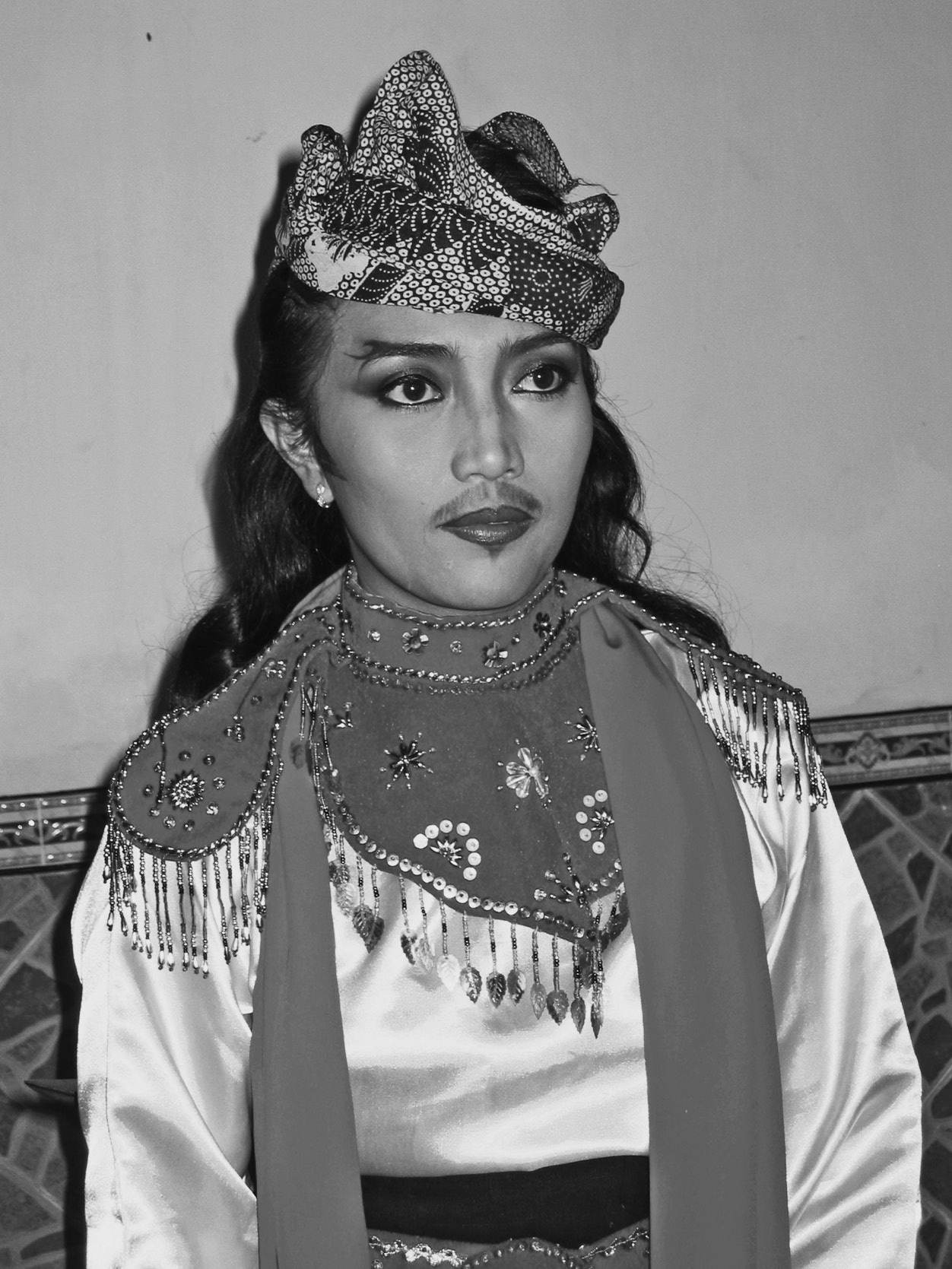
Tri Wahyuningtyas in costume for Beskalan Lanang. Photograph taken by the author, 2006.
Around 2002, Beskalan Lanang began to be taught in the elementary and junior high schools as part of government-sponsored dance education programs (personal communication, Karen Elizabeth Sekararum, January 6, 2006; Tri Wahyuningtyas, July 3, 2006; Sunardi, 2015, p. 124). Tri played a key role in the dissemination of this dance as one of the dancers who trained elementary and junior high school teachers, who would then teach the dance to the children in the schools of Malang (personal communication, Tri Wahyuningtyas, July 3, 2006; M. Soleh Adi Pramono, July 27, 2006; Witanto, July 30, 2006). Tri reported that the dance was again simplified for mass dissemination to make it easier to teach and learn (personal communication, July 3, 2006). She thus played a key role in the proliferation of Beskalan Lanang through her embodiment of female masculinity; when teaching women dancers who would go on to teach girls, she was in effect disseminating female masculinity. For male teachers who would teach girls, female masculinity was also spread as the girls embodied and produced masculinity. I wonder to what extent boys learning the dance from women teachers also learned to embody a certain femininity in their approach—a question for future research.
One of the results of these education efforts was a performance in 2004 by over 1,000 children as a welcoming dance to formally open a stadium in southern Malang, an event attended by the Indonesian President Megawati Sukarnoputri (personal communication, M. Soleh Adi Pramono, July 27, 2006; Witanto, July 30, 2006). It is noteworthy that a male-style dance so influenced by females and female masculinity was performed at an opening ceremony attended by the first female president of Indonesia, another woman taking on a role largely gendered as male.
As an aid for dance teachers in the schools, Soleh included Beskalan Lanang on a VCD of Malangan dances released by PSMD in 2003, Tari Tradisional Malangan (Traditional Malangan Dance ). Notably, all male dancers were used for the video, including dancers Soleh recruited and trained for the project (personal communication, Witanto, July 30, 2006). By making such a concerted effort to recruit men to dance for the video, a more permanent artifact and reference material—whereas he did not do so for the festival performance, a more ephemeral presentation of the dance—Soleh revealed his preference for the dance as a male-style dance performed by men and his belief that it should be represented as such, rather than as a cross-gender dance inflected with female masculinity. He in effect reinforced dominant Indonesian notions of gender that map masculinity to men’s bodies for the video, contributing to productions and representations of male masculinity (Sunardi, 2015, p. 124).
At the time of my fieldwork spanning 2005–2007, although both men and women performed Beskalan Lanang (and to my knowledge still do), when the dance was performed by a group of teenagers and/or adults, it seemed to most often be performed by groups of the same gender. Tri explained that when she performed in a group, it was always with other women. She said that she had heard about a performance that was mixed, but she did not participate in it. She explained that women and men dancing the same dance as a group would not look balanced on stage in terms of their body height and strength of movement (personal communication, July 3, 2006). I have come to understand the differences that Tri identified as differences between articulations of male masculinity and female masculinity, reinforcing Halberstam’s point that female and male masculinity are distinct (1998). The dancer B. Supriono Hadi Prasetya explained that when he performed the dance in a group, he always performed with other men. He did not recall seeing a mixed gender performance, although he had heard about the 2004 mass performance by children, which involved both boys and girls (personal communication, June 27, 2006). This suggests a certain flexibility or allowance for children, who have not yet gone through puberty, to represent masculinity together as a mixed group.
In performing male-style dance, Tri internalized the maleness of the characters she portrayed, contributing to the production of female masculinity, and, I suggest, a form of internal gender crossing. She embodied maleness by concentrating from the heart. She talked about the importance of becoming the character from the dancer’s heart or soul, explaining that if there were no disturbances, she felt like the male character she was portraying and no longer herself. As a dancer, she expounded, one must be able to feel the character and have enthusiasm from the inside, otherwise the dance will not have form. In speaking about feeling like the male character in the context of performance, Tri was also speaking about the contingency of taking on masculinity (Sunardi, 2009, p. 488; 2015, pp. 59–60).
As I have argued elsewhere, in making her womanliness obvious in her articulation of female masculinity, Tri was making it obvious that she was a woman even as she performed male-style dance. This, I suggest, was to show that as a woman she could be like a man—she could demonstrate physical strength, she could move freely, she could be a creative agent and she could and did take leading roles in the arts community of which she was part (Sunardi, 2015, pp. 61–62). The projection of femininity through a male-style dance was all the more obvious in the dance Ngremo Tayub, as exemplified by Sri Handayani, to whom I turn next.
When I interviewed Sri Handayani (b. 1982) in 2006 she was quite in demand as a singer and dancer, frequently performing for tayub dance events and frequently performing the dance Ngremo Tayub. She came from a family of artists and as a young girl started to study dance with her mother. She recalled going with her mother to performances, seeing her mother perform Ngremo, and practicing at home. By the time Sri was in junior high, she was performing as well, but with her mother, following her mother’s lead as Sri did not yet feel ready to perform on her own. Her mother would dance behind the stage and cue Sri. Or, for shadow puppet theater performances in which Sri sang, her mother would sing in her ear and Sri would sing out loud. Sri felt ready to perform as an independent artist toward the end of junior high, and she ended up leaving school because she became so busy as a performer. She performed mostly for tayub dance events, but also for shadow puppet theater and the popular music form campur sari (personal communication, Sri Handayani, March 29, 2006). I found Sri a beautiful singer and dancer, and was most taken with her activity performing the male-style dance Ngremo Tayub.
Ngremo Tayub ’s history is strongly connected to the creativity of women dancers and the articulation of female masculinity (Sunardi, 2009, p. 485; 2015, pp. 54–55). Ngremo Tayub is a variation of the iconic east Javanese dance Ngremo Lanang (Ngremo in the male style) that women dancers created in the context of tayub dance events. These events, also called tayuban , feature professional female entertainers who are hired to sing and dance for a host’s guests and are accompanied by a gamelan ensemble (Hefner, 1987; Hughes-Freeland, 1993; Widodo, 1995). Performers recalled that by the late 1970s to mid-1980s, a section in which viewers could tip the performers, request a song, and dance with the dancers was incorporated into Ngremo Lanang, which female singer-dancers performed as an opening dance (personal communication, Kusnadi, November 17, 2005; Anik Nurdjanah, February 9, 2006, February 21, 2006; Achmad Suwarno, April 3, 2006; Asbari, June 29, 2006; Sri Utami, August 3, 2006; Ngatmuji, August 12, 2006). By the 1990s, a distinct substyle that came to be called Ngremo Tayub had emerged. Although this style was named for tayub, it is performed for a variety of types of performances, not just for tayub, and may be performed with or without a tipping section. Some performers called Ngremo performed with a tipping section Ngremo Tembel or Ngremo Tembelan. Some referred to Ngremo Tayub as Ngremo Tembel as well.
Ngremo Tayub offers one of the most obvious examples of the ways women layered maleness onto their femaleness to produce female masculinity, which I focus on in this and the next three sections (Sunardi, 2009, pp. 485–486; 2013, pp. 149–151; 2015, pp. 43–55; 2022, pp. 291–294). I learned from Sri and other performers that movements associated with masculinity—higher arm positions, wider leg stances, and larger head movements—included those drawn from various male-style dances and from pencak silat martial arts (personal communication, Karen Elizabeth Sekararum, November 29, 2005, January 6, 2006; Madya, December 17, 2005; Cuci Indrawati, December 21, 2005; Sri Handayani, March 29, 2006; Sri Utami, August 3, 2006; Kusnadi, 2005–2006). Females, however, tended to articulate these movements in a more supple manner than males did for male-style dances and martial arts, allowing a certain grace and fluidity that are associated with female-style dances (and femaleness more broadly) to permeate the execution of their movements. Other movements were associated more directly with femaleness, such as movements drawn from aerobics—typically a woman’s activity—and from “pat-a-cake” hand games—movements associated with children’s activities. Movements associated with femaleness juxtaposed with those associated with maleness but executed in a more supple manner in the context of a male-style dance performed by female bodies contributed to the production of a complex sense of gender.
The feminization of the movements of male-style dance in Ngremo Tayub was not always valued, however, as evident in some performers’ critiques of Ngremo Tayub for looking too feminine. One dancer and vocalist, a woman born in the 1950s, criticized Ngremo Tayub dancers “nowadays” (at the time I consulted her in 2006) for executing a head roll inappropriately for male-style dance. She found that their head movements were not sharp or clearly articulated enough—too supple—for male-style dance, declaring that the movement was from Ngremo Putri (Ngremo in the female style). Another dancer, a man born in the 1960s, commented that the movements did not fit the knightly character being portrayed and made the dance too coquettish. In critiquing the ways in which female dancers combined masculinity and femininity, these artists in effect expressed their discomfort with the ways dancers were disrupting separations of maleness and femaleness that they had come to accept as normal and fitting for male and female styles of Ngremo. Indeed, when women performed other male-style dances, such as Ngremo Lanang, Beskalan Lanang , and male-style masked dances, they tended to execute the movements more fluidly than male dancers, similarly allowing their femaleness to “peek through” (Halberstam, 1998, pp. 260–261).
When women performed male-style dance, in most cases, but not all, performers and audiences were aware that dancers were female. Paradoxically, this awareness reinforced the separation of maleness and femaleness in dominant Indonesian gender ideologies even as performers like Sri Handayani performed gender fluidity as they produced female masculinity. For the most part, performing male-style dance did not detract from the performers’ womanhood because usually the femaleness of the dancer’s biological sex had a stronger impact on those watching than the maleness of the dance style—although this could depend on the dance and the dancer. One musician generalized that when he sees women perform male-style dance, the feminine aspects of the dancer and the dance affect him, and he finds the dancer beautiful, not handsome (personal communication, July 31, 2006).
Another musician, born in the mid-1940s, articulated his discomfort with one of the movements that has become characteristic of Ngremo Tayub —lifting the fist above the head. He repeatedly explained that according to traditional conventions, lifting the hand above the head was impolite because this movement displayed the armpit. He implied that it was inappropriate for women to display their armpits—which were clearly visible when the arms were lifted high because the costume was sleeveless (Figure 10). His comment indicated that he was seeing the dancers’ femaleness first and foremost. He saw that the maleness was layered onto the dancers’ female bodies, but he still held the dancers to dominant standards of “polite” womanhood, thereby reinforcing a separation between maleness and femaleness while also speaking to the dancers’ femaleness. Despite critiques from some performers, the ways in which females pushed at assumptions about gender—in effect combining maleness and femaleness—made their performances of male-style dance interesting for many viewers. The dancer and vocalist Karen Elizabeth Sekararum interpreted the subversion of gender in Ngremo Tayub as part of the dance’s appeal (personal communication, November 29, 2005).
In addition to the dance movements, the subversion of gender can be understood in the ways Sri Handayani and other dancers highlighted their femininity through the costume and makeup for Ngremo Tayub. Karen Elizabeth Sekararum explained that the womanhood of the dancer is emphasized through the costume, jewelry, and makeup, despite the mustache that is penciled on and the maleness of the dance style (personal communication, November 29, 2005). The femininity that Karen Elizabeth drew my attention to, and that I observed in performances of Ngremo Tayub, can be seen by comparing photographs of Sri modeling a Ngremo Tayub costume (Figure 10) and male Ngremo Lanang dancers performing in ludruk theater (Figure 11).
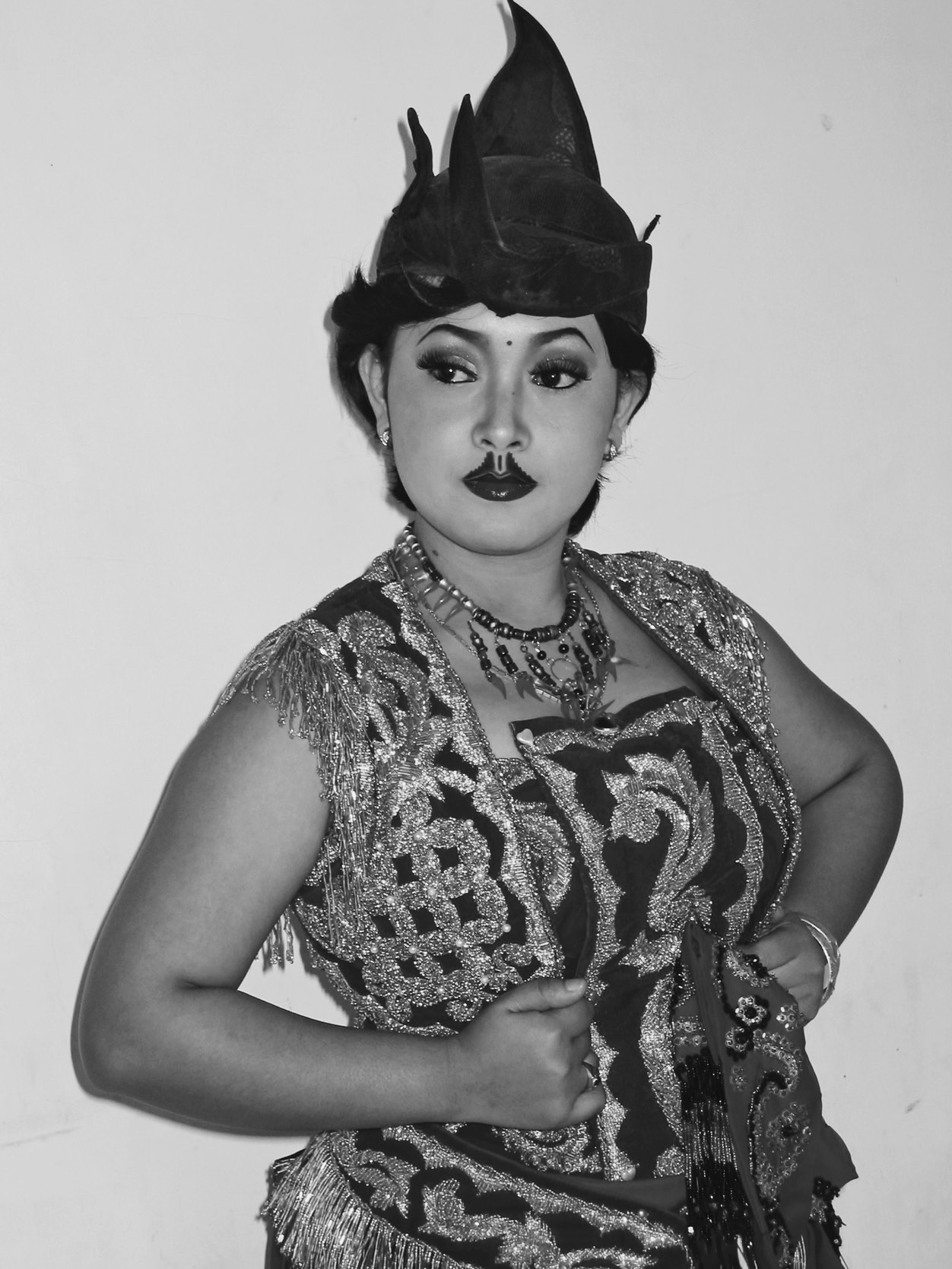
Sri Handayani (a female) models a costume and makeup for Ngremo Tayub. Photograph taken by the author, 2006.
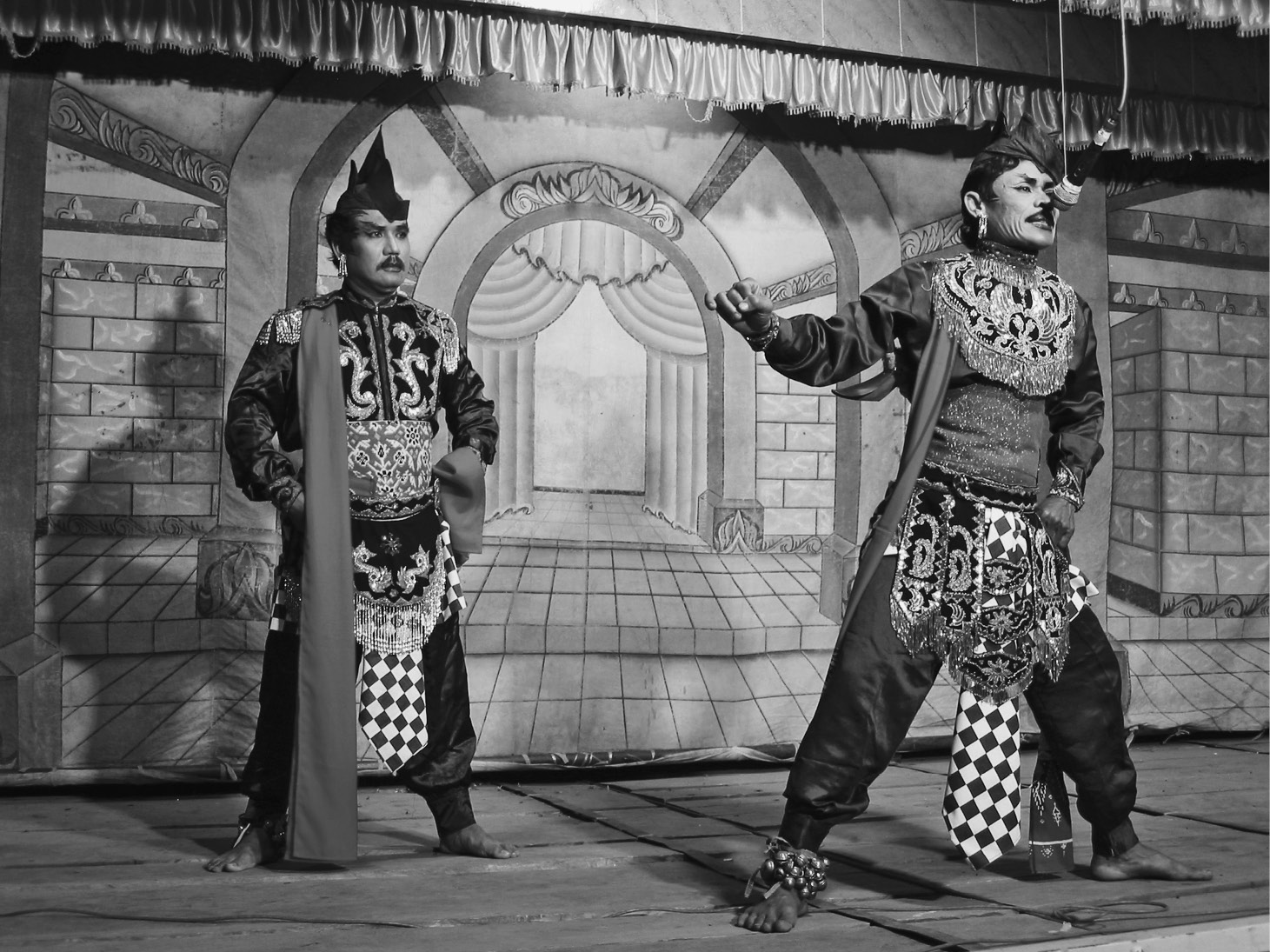
Males perform Ngremo Lanang for a performance of ludruk. Photograph taken by the author, 2006.
As seen in Figure 10, Sri Handayani does not look like a biological male, but instead looks like a woman trying to look sort of like a man. Sri’s costume, with its strapless top and vest, differs from the males’ long-sleeved shirts, and her female figure is enhanced through the cut of the top and the way she has fastened it. Sri’s bare arms reinforce her womanliness and are rather erotic in a Muslim context in which many women cover their shoulders and the top part of their arms, if not most or all of their arms, in public. She has on a wig of short hair, and a male-style head cloth. Makeup was another means by which Sri and other Ngremo Tayub dancers undermined ideological separations between maleness and femaleness. Sri used cosmetics to make her femaleness apparent. The false eyelashes and the pink and purple colors of the eye makeup are recognizably feminine according to conventions of east Javanese dance makeup. The blush on her cheeks is softer than the blush on the male dancers in Figure 11. Although not clearly visible in this photograph, she has not used a pencil to thicken the fine hairs on the side of her face to create thick, more “manly” sideburns.
While some Ngremo Tayub dancers were producing a sense of female masculinity by doing their makeup in a more “feminine” manner, one reason they did so was practical, related to the convention of changing gendered outfits during a performance event. In many cases, after the dancer(s) performed Ngremo Tayub , she or they left the stage and changed into feminine attire of a long batik cloth wrapped tightly around the lower body and tightly fitting blouse, often made of lace. They redid their hair, replacing their male-style wig with a large bun, and adjusted their makeup to appear like Sri in Figure 12. Returning to the stage, they performed as female vocalists seated with the gamelan (e.g., for shadow puppet performances) or female singer-dancers (e.g., for tayub or campur sari). By doing their makeup in a more feminine manner for Ngremo Tayub, the dancers could more quickly change from their Ngremo costume and makeup to female-style dress.
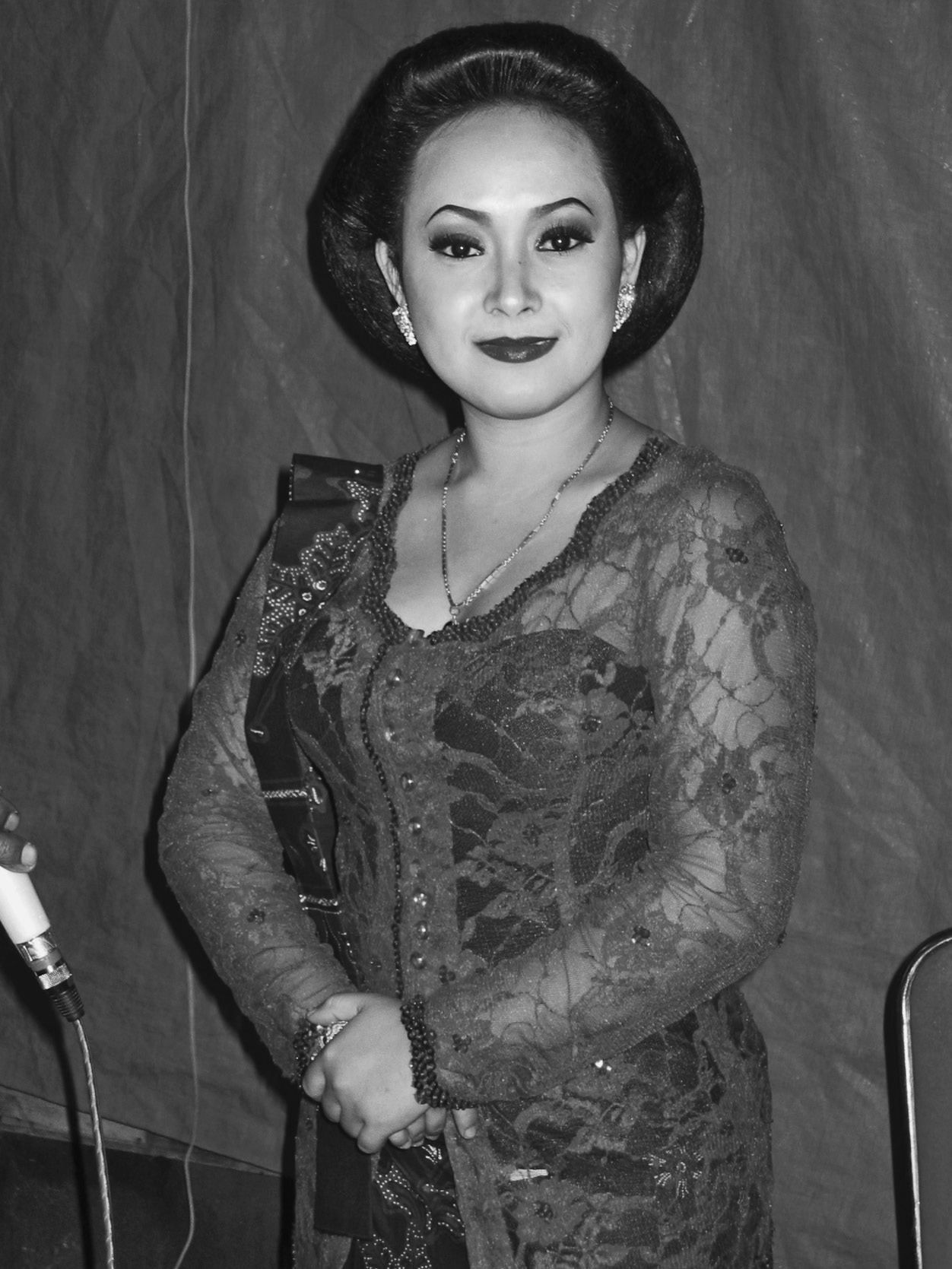
Sri Handayani, performing as a singer-dancer for a tayub event, wears feminine attire. Photograph taken by the author, 2006.
Speaking further to practical considerations and also to economic ones, Sri explained that changing quickly for tayub is necessary; otherwise, the guests will go home and the dancers will not earn as much money (personal communication, March 29, 2006). Sometimes other women who had not performed Ngremo were already dressed in female attire and performed while the Ngremo dancer(s) changed outfits. Once changed, the Ngremo dancers joined these women—although sometimes a dancer was hired just to perform Ngremo, as Sri sometimes was (personal communication, March 29, 2006).
The convention of changing gendered outfits was another means by and through which Sri and other Ngremo Tayub dancers subverted separations of maleness from femaleness, as well as performed contingent senses of gender and gender fluidity. Women embodied different gendered personas during different points in the performance, showing that masculinity and femininity were, in part, the product of makeup and dress—not fixed, inherent aspects of the anatomy—and were contingent upon context (Blackwood, 2010). Through the transformation in the dressing room, the dancers—displaying gender fluidity—were able to reemerge in all of their feminine glory, assuming a hyperfeminine persona characteristic of the stage image cultivated by female singers and dancers in many parts of Java (Spiller, 2007, p. 41).
Furthermore, Ngremo Tayub dancers including Sri, as have other cross-dressed performers, played with dominant expectations about gender. Writing about drag kinging in the United States (with some reference to London), Judith Halberstam observes that “mainstream coverage of the scene tends to evince the sincere hope that even though girls will be boys, they will eventually return to being very attractive girls” (1998, p. 261). Likewise, I suggest that viewers in Java imagined the attractive femininity that lay under the “surface” of the Ngremo Tayub costume. The contrast of the dancers’ appearance in the Ngremo costume and in female attire ultimately enhanced the dancers’ beauty when they reappeared in female dress, reinforcing both the dancers’ womanhood as well as the contingent female masculinity of Ngremo Tayub . At the same time, returning to Judith Butler’s points presented in Chapter 1 (1990; 1993; 1999), it showed that gender is very much a product of “doing”, making more transparent that an individual can fluidly move between “doing” gender or genders in different ways.
Ngremo Tayub dancers’ appearance reinforced and undermined dominant norms as dancers interacted with guests (usually male) during the tembelan (tipping) section. As mentioned, this section—in which viewers may tip the performers, request a song, and dance with the dancers—may be inserted into Ngremo Tayub. The tembelan section reinforced heterosexuality and allowed space for homoerotic imaginations. Usually those who requested songs were men. The interaction of these men and the dancers’ quasi-male-looking bodies in the performance space displayed a type of male homoeroticism, but one tempered by the knowledge that the dancers were female and, in many cases, would reappear later in the evening in feminine attire. This homoeroticism was permissible because the representation of a heterosexual relationship underlay the interaction. In cases where a woman danced with the Ngremo Tayub dancers (which I observed only once), a female homoeroticism was evoked as most—if not everyone—present knew the Ngremo Tayub dancers were women, too. Complicating matters, women dancing with female dancers in male-style costumes reinforced representations of heterosexuality. This cultural space for the simultaneous imagination of both homoeroticism and heterosexuality was another way participants in the performance event (including dancers, musicians, hosts, and guests) pushed at dominant social norms that insisted on the normalcy of heterosexuality and made space for gender pluralism and fluidity within the dominant framework of gender dualism (Peletz, 2006).
Ngremo Tayub dancers usually sing in the course of performing, as did Sri. As in other styles of Ngremo, dancers typically sing welcoming texts and a form of poetry called parikan, among other texts (Sunardi, 2015, pp. 51–54; 2023). As indicated, they also sing requested songs during the tembelan section when tembelan is included. I suggest that the sound of a recognizably female voice emanating from a female body in the Ngremo costume and makeup—with its juxtapositions of maleness and femaleness—further contributed to the pleasure and disruption of this dance. Although the Ngremo Tayub dancers did not appear as hyperfeminine figures when in the Ngremo costume, their singing reminded viewers that hyperfeminine women lay under the “surface” of masculinity.
Writing about Sundanese dance events in West Java that feature female entertainers, the ethnomusicologist Henry Spiller has argued that the image of the hyperfeminine singer-dancer “brings the imagined oppositions of masculine and feminine, so vital to gender ideology, into sharp relief” (2007, p. 41). In many performances featuring Ngremo Tayub, the “imagined oppositions” of maleness and femaleness were brought into “sharp relief”, too, albeit in some different ways. These ways included the “feminine-masculine” appearance of Ngremo Tayub dancers such as Sri; participants’ knowledge that, in many cases, the Ngremo Tayub dancer would reappear as a hyperfeminine woman; and the sound of a female voice emanating from the dancer’s quasi-male-looking body when the dancers sing.
The ways performers talked about Ngremo Tayub’s history also has implications related to women’s power and their singing. The incorporation of the tembelan section, in which guests could request a song, inspired a bit of controversy among performers. Some (who were primarily male) said almost with disgust that this was just a way for the dancers to make more money. They seemed to be implying that this innovation to Ngremo was economically driven and had little artistic merit, suggesting that they were interpreting this change through the lens of the dominant, aristocratic, male-oriented Javanese ideology of power that links concerns with money to crudeness (Djajadiningrat-Nieuwenhuis, 1987; Anderson, 1990; Keeler, 1990; Brenner, 1995; 1998; Weiss, 2006, pp. 55–56; Sears, 2007, pp. 54–58; Sunardi, 2015, p. 3; 2022, pp. 290–291). Performers may have also internalized official views that the presence of “desire and cash” is what makes female singer-dancers and their performances “deemed unsuitable as approved national culture” (Hughes-Freeland, 2008c, p. 144). In the eyes of some, inserting a tipping section was inappropriate for the brave, proud, knightly male character of Ngremo Lanang, a dance that was usually performed to welcome and honor guests; a tipping section, in the eyes of some performers, effectively degraded the dance into a display of money.
I cannot help but speculate that the ambivalence about the tipping innovation was also connected to women’s control of the money. Significantly more tip money went to the female dancers, rather than to the male musicians, and it was largely a dancer’s decision as to whether she would share her tips and how much she would share with the musicians (usually with the drummer). In other words, females made an innovation that augmented women’s economic power, even though it may not have augmented their status. Similarly, Susan Browne found that the tip money earned by female dangdut singers in nightclubs, although providing a means of giving them economic status, “does not enhance their social status” (2000, p. 16). Guests’ requests for songs and paying tips did, however, give women a certain economic authority to “rule the roost” as they performed Ngremo , as many women have done in the home despite dominant Indonesian ideologies that women should be subservient wives (Brenner, 1995).
Performing male-style dance was also a means by and through which Sri and other women negotiated Islamic orthodoxy and piety (Sunardi, 2013, p. 148; 2015, pp. 60–61). “Because Islam has comprehensive teachings about women’s role and place in society”, Susan Blackburn instructively writes, “almost anything women do can be seen to be political in the sense of either accepting, supporting or challenging religious practices and beliefs” (2008, p. 84). Sri, who identified as Muslim, responded to my question as to whether she ever felt any incompatibility with her religious beliefs by explaining,
No, that is our work, you know. Why should we feel ashamed, why? It is our work, right, our work in order to eat, right? As far as religious matters, that is between us and the one above. Yes, so [work and religion] cannot be all mixed up. The important thing is that we are right, yes?—Work a job that is halal.
Nggak, kita kan ya ‘is, perkerjaan itu, mbak. Kenapa harus opo ya, malu, kenapa? Kita kan, kerja kan, kerja to, untuk makan? Kalau, kalau urusan agama kita ya sama yang di atas gini. Ya, jadi nggak boleh dicampur aduk. Yang penting kita benar gitu aja, ya? Kerjaé halal gitu. (personal communication, Sri Handayani, March 29, 2006)
In using the word “halal”—what is permitted or allowed by Islam—Sri evoked the religion to legitimize her profession as an artist, in some ways a striking assertion given the immoral, licentious stereotype of female singer-dancers in Java, as well as her activity performing male-style dance. Invoking Islamic discourse, she was insisting on the “rightness” of her profession.
Other Muslim female performers have drawn on religious discourse to legitimize their professions, offering additional examples of “women shaping Islam” (van Doorn-Harder, 2006). Such performers have included other East Javanese female singer-dancers that Robert Hefner encountered who performed in tayub dance events, including female singer-dancers from Malang; he found that “[v]irtually all … claim to be Muslim, some insisting quite strenuously that they are good Muslims” (1987, p. 77). Female dangdut singers—including the infamous Inul Daratista who was at the center of national controversy in the early 2000s for a style of dancing that some Indonesians found to be too sexually provocative—have also positioned themselves as Muslims, maintaining that their art and their religion were separate matters (Daniels, 2009, pp. 88–89; 2013, pp. 169–170; Bader, 2011, p. 346). Other dangdut singers negotiated Islam and their profession through their belief that the money earned as an entertainer at a place where alcohol was consumed was halal as long as they did not drink the alcohol themselves (Browne, 2000, p. 29).
As they negotiated Islam, Sri and other female performers were subverting dominant Indonesian gender ideologies that insisted that women be “proper wives and mothers”, making cultural space for women—including Muslim women—to publicly assert other roles (e.g., as artists) as well as their sexuality (Browne, 2000, pp. 2, 30), while also countering negative stereotypes of women performers. Doing so through the performance of male-style dances, as Sri did when she performed Ngremo Tayub , made such negotiations of gender and religion all the more complex (Sunardi, 2013).
In exploring the lives and careers of Muskayah, Tri Wahyuningtas, and Sri Handayani, this chapter has offered sketches of three women who have produced complex senses of gender through the performance of male-style dance over the course of the twentieth century (perhaps since the late 1890s) and into the twenty-first. All three women contributed to the production, representation, and continuity of female masculinity, and senses of female masculinity that entailed keeping their femaleness visible and/or audible, exemplifying Halberstam’s concept of “layering” as a theatrical strategy in which a performed gendered role is noticeably superimposed—layered—onto an actor’s own gendered self (1998, pp. 260–261). Muskayah, Tri, and Sri have thereby made it more visible that masculinity and femininity are constructions and performed identities—that is, they are “done” rather than inherent to biological sex and that people can move between them, contributing to gender fluidity and pluralism. While Muskayah, Tri, and Sri lived as women in their offstage lives—all three had married men and were mothers—the roles of wife and mother were certainly not the only aspects of their rich identities and lives as artists and as women.
As we saw with Djupri, Muliono, and Mama Samsu in the previous chapter, Muskayah, Tri, and Sri negotiated gender representation and identity in Malang on- and offstage. In doing so, all six dancers reinforced gender pluralism and contributed to the production of place-based identities as Malangan people. Stepping back to further reflect on the ways Djupri, Muliono, Mama Samsu, Muskayah, Tri, and Sri navigated and negotiated dominant gender ideologies through their lived experiences as dancers brings me to the closing words in the next chapter that conclude this book.
1. How did Muskayah, Tri Wahyuningtyas, and Sri Handayani challenge and reinforce norms of gender and sexuality on- and offstage?
2. How did Muskayah, Tri Wahyuningtyas, and Sri Handayani navigate gender and social pressures (including religious pressures) from the communities in which they lived?
3. How did Muskayah, Tri Wahyuningtyas, and Sri Handayani contribute to the production of local east Javanese identities through their lives and careers as artists?
4. What similarities and differences do you notice in males’ embodiments of femaleness discussed in the previous chapter and in females’ embodiment of maleness discussed in this chapter?
 Fashioning Femininities, Making Masculinities
 Twitter
 Facebook
 WhatsApp
 LinkedIn


