
DOI: 10.3726/9781916704206.003.0002
A man posing as another man’s second wife to see how a first wife would react? The use of spiritual knowledge to embody femaleness through a male body? Insistence upon modeling respectable images of womanhood? These were some of the images that captured my attention as the dancers Djupri and Muliono, who lived as men, and Mama Samsu, who lived as a waria (a male who dresses and lives as female), shared aspects of their lives and careers.
Through their stories about their lived experiences in on- and offstage realms drawn from my earlier work (Sunardi, 2009; 2013; 2015), I show that while Djupri, Muliono, and Mama Samsu challenged assumptions in dominant Indonesian gender ideologies about what types of bodies could and should produce and embody femaleness as they produced male femininity, they also reinforced dominant representations of ideal womanhood through their onstage performances of traditional female-style dance, complicating the representation and cultural production of gender in Malang. I show, too, different ways they related to male femininity in offstage realms. As a reminder, the concept of male femininity was presented in the previous chapter and is femininity that is produced and embodied by males (Boellstorff; 2004b; 2005b, pp. 169, 171, 175; 2007, pp. 82, 99, 108; Sunardi, 2013, p. 141; 2015, p. 11; 2022, p. 290). In producing, embodying, and representing various gender identities—reinforcing gender pluralism—as they navigated expectations of gender and social pressures from the community, Djupri, Muliono, and Mama Samsu contributed to the production of east Javanese, and more specifically Malangan, place-based identities through the course of the mid-twentieth century and into the twenty-first.
It is my hope that by the end of this chapter you will be able to identify ways in which Djupri, Muliono, and Mama Samsu:
1. Challenged and reinforced norms of gender and sexuality on- and offstage;
2. Navigated gender and social pressures (including religious pressures) from the communities in which they lived; and
3. Contributed to the production of local east Javanese identities through their lives and careers as artists.
Djupri (b. 1939), who performed female and male-style dances over the course of his long career, was one of my most influential dance teachers. I studied the dances Beskalan Putri (Beskalan in the female style) and Beskalan Lanang (Beskalan in the male style) with him over the course of many months, going by motorbike—often taken by my husband or one of my other teachers—to his home in the village of Ngadireso in the subdistrict of Poncokusuma multiple times a week for hours-long lessons (Figure 2 in Chapter 1). During lesson breaks and more formal interviews, Djupri shared stories about his life, including riveting ways he challenged gender norms on- and offstage in the 1950s and 1960s when he was frequently performing female-style dance. He continued to perform female roles, including female-style dance, in ludruk theater until 1993. Ludruk is a form of east Javanese theater that historically featured all male casts, with males performing both male and female roles. Ludruk troupes from Malang at the time of my fieldwork continued this practice for the most part. Djupri performed both male and female roles in ludruk between 1979 and 1993, and just male roles, including male-style dance, since 1993 (personal communication, Djupri, January 6, 2006).
I recognize that Djupri’s stories were filtered through memory and shaped by the points he was making to me in 2005–2006—sometimes decades after their occurrence (Neuman, 1993, p. 276; Stoler with Strassler, 2002, p. 170; Zurbuchen, 2005, p. 7; Sunardi, 2015, pp. 25–28). I nonetheless value his recollections as evidence of gender fluidity, pluralism, and nonconformity in the 1950s, 1960s, and beyond—post-independence (post-1945) times when the Indonesian state was making an effort to shape masculinity and femininity in particular ways by mapping biological sex to gender in a one-to-one ratio and privileging heterosexuality, as outlined in the previous chapter (Blackwood, 2005, pp. 866, 869–871; 2007, pp. 185–188; Sunardi, 2009; 2013; 2015; 2022). That observational evidence from anthropologists Clifford Geertz’s and James Peacock’s fieldwork during the 1950s and 1960s in Java support Djupri’s points, as do memories of other performers I consulted, indicates that the gender crossings Djupri related were not isolated incidents. Djupri’s memories of his experiences provide a window into ways one person embodied different gender identities and produced contingent senses of gender. Impressed by the ways Djupri moved between femaleness and maleness depending on the dance he was teaching me, I was fascinated by the ways he described his gender fluidity in the past, including internally, externally, as well as onstage and offstage (Sunardi, 2009, pp. 463–468; 2015, pp. 63–93).
On an internal level, Djupri used ilmu (spiritual knowledge, often of a secretive nature) to embody femaleness. In talking about his experiences performing female roles including Ngremo Putri (Ngremo in the female style) for ludruk, which he did from 1958 to 1993, Djupri explained that he could dance and feel like a woman on stage because of his ilmu, which he took from a heavenly nymph (dewi widadari). Responding to my question about whether he felt like a real woman when dancing Ngremo Putri, he said yes, explaining that his transformation was so complete that,
[M]y feeling was that, with women, it was yeah, rather, like a feeling of hate … in fact hate. My favorites were instead handsome people [men]. That was when … performing ludruk, though, yeah. I liked wome- handsome men, instead I yeah, yes, I liked them. Indeed. A recollection of ludruk.
[P]erasaan saya itu, dengan orang wanita, itu ya, agak, seperti rasa benci itu … malah benci. Senangannya malah orang yang ganteng-ganteng itu. Itu kalau … waktu ludrukan lho ya. Dengan orang wanit- orang pria yang ganteng itu malah saya iya, ya senang. Memang. Kenangan ludruk. (personal communication, Djupri, January 6, 2006)
In talking about his preference for and attraction to handsome men (while in the mindset of a female), Djupri reinforced heterosexual norms even as he articulated what could also be understood as a homosexual desire.
At the same time, he distanced feelings of hating women and preferring handsome men from his genuine self by specifying that it was his use of ilmu for the purpose and moment of performance that made him feel this way. He also clarified that he was entered by a heavenly nymph, that is, a spirit, when performing Ngremo Putri . In other words, feeling like a woman in the sense of being attracted to men and repulsed by women was temporary, contingent on the context of performance, and a result of being entered by a feminine spirit (Sunardi, 2009, p. 464; 2015, pp. 79–80). His slippage between liking women vs. men toward the end of the quote is also noteworthy as on some level it further shows the fluidity of his sexual desire as he moved in and out of performing Ngremo Putri, which I understand as another manifestation of gender fluidity as he moved between the femaleness of the performed persona and the maleness of his own self.
Reinforcing heterosexual norms, he also described using ilmu when performing male-style dance to look handsome and attractive to women, giving the example of using ilmu from the god Arjuna when performing Ngremo Lanang (Ngremo in the male style), and being entered by Arjuna (Sunardi, 2015, p. 187n9). Using ilmu was thus one strategy Djupri employed to perform femaleness and maleness, as well as to move between femaleness and maleness—that is, to move from the maleness of his own self to the femaleness he embodied on stage, and to move from the femaleness of female-style dances to the maleness of male-style dances.
As a male who performed female-style dance, Djupri also had to contend with contradictory expectations about gender, including social needs and desires for male femininity despite dominant expectations that mapped masculinity to male bodies and femininity to female bodies. For example, when audiences knew that a performer who was performing female-style dance or performing as a female singer-dancer was male, they could respond to the performer’s femaleness more freely than would be socially acceptable with a woman or girl. Djupri said that when he was performing as an itinerant female singer-dancer, or andhong, in the mid-1950s to early 1960s, people in Malang knew that he was male because they knew him personally. When Djupri performed as an andhong, he shared with pride in his voice, viewers preferred him to a female because they could dance more freely with him and even kiss him, behaviors that social norms prevented them from indulging in if the dancer were a woman or girl (personal communication, June 15, 2006).
In the andhong tradition, professional female performers sing and dance for audience members who pay to request a song. Andhong was the term for both the professional dancer and the group. A group usually included one or two dancers, who were usually women, although, as Djupri’s experience indicates, male dancers also dressed as females. The person who requests a song also dances with the professional dancer. As itinerant performers, andhong wandered from village to village looking for places to perform. According to performers I talked to, the andhong tradition was practiced from the early twentieth century until about 1965, although traditions in which female entertainers sing and dance for people who request songs very much continue to the present in other forms such as tayub dance events, discussed in the next chapter (personal communication, Kusnadi, November 17, 2005; Supatman, December 6, 2005; Madya, December 17, 2005; Tri Wahyuningtyas, December 17, 2005; Chattam Amat Redjo, April 14, 2006; Panoto, May 16, 2006; Sutanu, June 7, 2006; Djupri, June 15, 2006; Asbari, June 29, 2006; Timan, July 4, 2006; and Satupah, July 7, 2006). The anthropologist Clifford Geertz also observed such groups in the 1950s; he referred to the dancers as klèdek or tandhak . He reported that such groups included as many as two or three dancers (1960, pp. 296–300).
Despite social norms that may have inhibited similar indulgences with female performers, the sexual desires for Djupri—and the acting upon those desires—when he was dressed as a female while known to be male suggests sexual desire specifically for male femininity and for gender fluidity. On one level, such desires reinforce heterosexual desire promulgated as normative in dominant gender ideologies because the dancer is dressed as female, and viewers would be interacting with what they were allowing themselves to perceive as a woman or girl, at least in the moment of performance. On another level, such desires express a same-sex desire when viewers knew that Djupri was a male cross-dressed as a female. In some cases, by Djupri’s own account explored below, he did also pass as female.
Men’s obsession with male singer-dancers dressed as females, and the use of esoteric forces, was not unique to Djupri’s experience in the 1950s and 1960s. Clifford Geertz and James Peacock observed similar kinds of reactions among audiences in their research on ludruk. Geertz, describing ludruk in the early 1950s in the town of Modjukuto (a pseudonym), writes that the males who performed female roles activated a sense of wonder (1960, p. 295). Peacock also found in his research on ludruk theater in Surabaya during the 1960s that sometimes male audience members became so sexually drawn to a male performing a female role that the audience member would try “to marry” the performer, and that it was believed that performers had “magical power” to arouse such desires (Peacock, 1978, p. 218; Sunardi, 2015, pp. 77–78). Speaking to further back in the past, the drummer Sutanu (1935–2008) recalled that in the 1940s and 1950s, men often fell in love with males who performed female roles in ludruk and that performers used magic so that audiences would fall in love with them; he and the drummer Kusnadi (1944–2016)—my principle gamelan teacher in Malang—said that sometimes a man would call a particular performer his wife and become jealous if the performer was approached by another man (personal communication, June 7, 2006).
Sexual and romantic desires for males who performed female roles onstage had offstage implications. Speaking further to his ability to sexually arouse those who saw him perform female-style dance, Djupri recounted an instance when a man—a retired military officer who had seen Djupri perform at an event for retired military officers–became so obsessed after seeing him perform that he followed Djupri to Djupri’s home and other gigs. Djupri recalled this retired officer as being “crazy” (gila) and forgetting about his own family (personal communication, June 15, 2006).
Djupri himself took the femaleness he performed as a dancer into his daily life in several ways when he was young and frequently performing female-style dance, embodying and producing male femininity in different realms of culture. Sometimes doing so was a practical matter. For example, recalling his activities in the 1960s, Djupri talked about items he used to transform his appearance, including wigs with real hair that could be glued on to the head and used to make a large bun. Specifying that these wigs were from Japan, he implied their high quality and expense as well as his intentionality and care to look like he naturally had long hair. He explained that sometimes he kept the wig on in his offstage daily life because it was easier than removing and reattaching it every day (personal communication, June 15, 2006; Sunardi, 2009, p. 464; 2015, pp. 79–80).
Although Djupri couched his wearing of the wig offstage in terms of practicality, he was nonetheless subverting dominant ideologies of gender and resisting social pressures to conform to dominant ideologies of manhood. James Peacock points to the impact that dominant discourses had on performers’ behavior and lifestyles in 1960s Surabaya, noting that after the Indonesian revolution (1945–1949), it was considered more progressive and modern for males who performed female roles to live as men. He cites two who had cut their long hair because of “progress”, which was distressing because, as a natural part of the body, long hair was a special symbol of a male performer’s commitment to womanhood offstage as well as on (1987, p. 207). They were discouraged from taking gender transgression into their daily lives as they were encouraged to be modern, Indonesian men—to have short hair, wear pants, and be heads of households (Peacock, 1987, pp. 206–207; see also Boellstorff, 2007, pp. 86–87; Sunardi, 2015, pp. 64–65). In other words, the performers’ male femininity was expected to be contingent, limited to the context of performance. As we have seen, though, sexual desires for offstage male femininity were aroused and sometimes acted upon. In leaving his wig on in between performances, Djupri undermined dominant norms and expectations as he produced and embodied male femininity on- as well as offstage.
Further taking gender transgression into his daily life, Djupri recounted proudly that he was able to fool people into believing that he was a girl when in female attire. On one occasion in about 1966 or 1967, a man who had seen Djupri perform female-style dance asked him to remain in female dress and pose as his second wife so that the man could see how his current wife would react. Djupri and this man challenged the mapping of femininity to female bodies in dominant Indonesian discourses. While they reinforced the appearance of a heterosexual relationship, they were enacting a same-sex relationship, albeit temporarily (and Djupri gave no indication that it was sexually consummated). Djupri did not specify how long he posed as the man’s second wife, but it was long enough to wear women’s clothes in public and go to a market—the idea being that he would shop and the first wife would cook as a test to see if the first wife could get along with a second wife as they divided the labor of running a household (personal communication, June 15, 2006).
Highlighting his ability to pass as a girl and trick people about his identity, Djupri related that his uncle, who had been looking for Djupri, saw him at the market when Djupri was dressed in women’s clothes, uncertain whether it was actually Djupri. The uncle followed him around the market, but it was not until Djupri said hello to him that his uncle recognized him. The uncle followed Djupri to the man’s house. Djupri went in, put the vegetables he had bought away in the kitchen, and then went into a room to change clothes. He remembered still having glue on his forehead from the wig when he came out to where his uncle was waiting in the front room with the man’s wife. She kept looking at Djupri and said something about who was this and why did he look like the girl her husband had brought home? The situation was clarified and Djupri went home with his uncle (personal communication, June 15, 2006). That Djupri exuded pride and pleasure in his tone of voice and smiles as he shared these memories of being able to pass so convincingly as a female in daily life suggests his delight in subverting dominant gender norms and expectations through cross-gender performance offstage as well as on.
Performance provided cultural space for gender transgression that bled into daily life for other individuals in the 1960s, providing a bigger picture of gender pluralism in Java during this time period. Observing masked dance in Malang in 1963, the historian Onghokham mentions the role of a waria as an artistic aid to a troupe leader (1972, p. 119). That this person was a “well-situated villager” indicates that this individual, in some ways at least, did not occupy a completely marginalized position within the community (Onghokham, 1972, p. 119). Despite the social pressures James Peacock identified for males who performed female roles to live as men in Surabaya, he also writes that nearly all of the males who performed as females he consulted in the early 1960s embodied femininity in their offstage lives, refusing to conform to dominant expectations and social pressures: they wore women’s clothes when at home and sometimes out in public and worked jobs associated with women such as tailoring women’s clothing. Many, however, had to deal with their “parents’ discomfort and strangers’ taunts” (Peacock, 1987, p. 207; Sunardi, 2015, pp. 65–66).
Speaking to onstage–offstage gender transgression when talking about the tricks of the trade that he and other ludruk performers used to look as convincingly female as possible when performing, Djupri talked about the use of a type of body suit (Sunardi, 2009, pp. 463–464; 2015, pp. 80–81). This suit, he related, was also from Japan (like his wig)—again implying its expense and high quality, as well as the economic investment to look as female as possible on the part of a performer who purchased one. He described the body suit as a sort of outer skin complete with pores that made it look more realistic and allowed the wearer’s skin to breathe. It also featured body hair and padding for breasts, hips, and buttocks. The suits came in different colors and models; his covered his upper arms and thighs, and went up the neck with padding to smooth over an Adam’s apple. Some, which were more expensive, covered the entire arm and leg. Some also went up the face (personal communication, Djupri, June 15, 2006).
Overcoming his initial shyness with laughs and smiles as he talked to me—his female student in a daughterly relation to him—and my husband, whose presence likely made him feel more at liberty to discuss sexual matters, Djupri explained that the body suit made the genital area look convincingly female as well. Not only was the front of the crotch area smoothed over, a pocket was included to contain a man’s genitals. The suit also contained a hole and pubic hair designed to resemble female genitalia. Referring to the use of this suit in private activity, he said that a man could have sex without the suit being taken off, reporting that it was said that sex was more pleasurable with the suit than with a female. He was quick to restate that that was what people said, emphasizing that he did not really know because he had never done this (personal communication, June 15, 2006).
Djupri’s emphasis that he had never used the body suit in offstage sexual encounters was one way that despite his gender fluidity in on- and offstage realms, he asserted that he lived as a man. He introduced me to his wife and grown children when they were at his home, thereby positioning himself as a husband and father, as heterosexual, and as household head. He also distanced himself from a waria identity by expressing an ambivalent attitude toward waria. On the one hand, he linked waria to a form of magic that had connections to the sacred. He said that because of ilmu, the spirit or soul (kejiwaan) of a man was a woman’s spirit or soul (jiwa wanita). On the other hand, he said that waria’s ilmu was not the person’s own, implying that it was bought from sorcerers, and thus assumed to be temporary and less valued in Java than ilmu gained via spiritual pursuits and ascetic practices (Keeler, 1987, p. 236; Sunardi, 2015, pp. 147, 191n10; in press). He underscored that he did not want that kind of ilmu (personal communication, January 6, 2006).
Identifying familial and religious pressures to conform to dominant ideologies of gender, Djupri referenced his grandmother’s religiously inspired instruction to become a woman only when he performed, but not in daily life because God had made him a man. While Djupri’s grandmother sanctioned his gender nonconformity despite some aspects of dominant religious ideology—such as not to cross-dress at all—she insisted that he conform to others—such as not to cross-dress in his offstage life. This suggests her own conflicted relationship with the religious convictions circulating in their community, the limits of gender transgression she approved, and her concern for Djupri to be socially accepted, particularly as she may have heard of Djupri’s activities posing as a female offstage or men who had fallen for him following him around (Sunardi, 2015, p. 88).
Djupri continued to hold himself to high standards of being able to pass as female in his performances of female-style dance to the point that he declined my requests to videotape him performing Beskalan Putri . He believed he was no longer slim, young, pretty (when in costume with makeup), or graceful enough, and he felt stiff because he had not performed female-style dance for over ten years at the time I made the requests (personal communication, Djupri, December 1, 2005; January 6, 2006; March 27, 2006; Sunardi, 2015, p. 88). He did let me document him performing the male-style dances Ngremo Lanang and Beskalan Lanang, and he let me record him playing the drum for Beskalan Putri. Despite his reluctance to perform female-style dance at the time of my fieldwork, his lived experiences including his activities as an artist from the 1950s, 1960s, and into the 1990s point to ways he contributed to the production of male femininity and what it meant to be male and female in different ways in the Malang area, thereby contributing to the production of local culture—including performing arts—and identity through his gender fluidity and articulations of gender pluralism. I wonder to what extent, in teaching me Beskalan Putri in the early 2000s, he was continuing to produce male femininity as he taught me to embody and perform femaleness.
Muliono (b. 1976–1977?), or Mul for short, entranced me with his powerful performances of strong male-style masked dance. I was astonished, then, to learn from him that he used to perform female characters in masked dance drama when he was younger and smaller in build. I was delightfully shocked that a man that I had thought of as so masculine and manly—onstage as well as offstage—had contributed to the production of male femininity. As we saw with Djupri, Muliono’s performances of femaleness onstage had offstage implications, and like Djupri, Muliono chose ultimately to live as a man. Muliono, however, drew a clearer line between his onstage performance of femininity and the masculinity of his offstage self (Sunardi, 2015, pp. 67–70).
Muliono emphasized that his embodiment of femininity was contingent on the context of performance. He performed female characters out of necessity to the performance, he explained, because female dancers in his community at that time (likely the 1980s and into the early 1990s) were shy about performing masked dance, and because the other male masked dancers could not perform female-style dance (personal communication, January 3, 2006). Distancing the femininity he projected onstage from his own character, demeanor, internal feelings and sense of self, he talked about embodying femaleness through his ability and skill as a dancer. He specified that he became “female” through the dance movement, saying that it had to be supple, like a woman, and through the costume. That masks were used, I believe, also helped him not only to take on and articulate the femininity of the female character he was portraying for the performance, but also to distance his own self from femaleness as he was literally putting on the face of a character he was portraying. Reiterating the contingency of the femininity he was performing, he explained that he felt the coquettishness of the female character he was dancing when he came out on to the stage, but the feeling of becoming a woman disappeared when he was finished performing (personal communication, Muliono, January 3, 2006). In other words, offstage he felt like himself—male.
Another strategy Mul used to perform female characters, like Djupri, was spiritual. In Mul’s case, the way he talked about using spiritual practices reinforced the contingency of his embodiment of femaleness and was a way of distancing the femaleness from his own self as a male. For example, he asked for a mantra or magic words from his teacher, which he likened to meditating, so that the character could enter. He said that he truly felt like the female character he was portraying to the point of not remembering dancing—indicating that he was in a trancelike state as a spirit possessed his body. His performances of femaleness impacted audiences, as he recalled that after he performed, his friends asked with amazement, “How was it that you were like a real woman?” (personal communication, January 3, 2006). The femaleness he embodied was not his own, he implied, but that of an outside entity, as we also saw with Djupri. Being entered by a character or spirit gave Mul—and others—a way to make sense of his gender identity as male even as he had the ability to perform femaleness so convincingly. Embodying a character or spirit so completely also reinforced his ability as a dancer as many artists in different regions of Java value performances given by dancers believed to be entered in these ways and serve as vessels for spiritual beings, characters, spiritual power, and/or ilmu (Foley, 1985, p. 36; Schrieber, 1991, p. 26; Weiss, 2003, pp. 37, 42; Sunardi, 2015, p. 68; in press).
While Mul separated his onstage and offstage embodiments of gender, his cultural work producing male femininity nonetheless was significant as it still undermined the mapping of male bodies to masculinity and female bodies to femininity in dominant discourses, still ultimately showing gender to be fluid, crossable, and plural. He spoke to further crossings of gender within one performance, relating that he performed a female role and then played the male character Gunung Sari (personal communication, January 3, 2006). Such a transformation likely entailed a costume change, a change in masks, as well as a change in demeanor—that is, a sartorial and character-based gender crossing. Given the spiritual dimensions discussed above, it may have also entailed allowing the spirit of the female character to leave his body and the spirit of a male one to enter. Interestingly, Gunung Sari is a male character with feminine aspects. The dance Gunung Sari, which presents the character of Gunung Sari, incorporates what dancers recognize as male and female movement styles, making Gunung Sari an interesting representation of masculinity imbued with femininity, which I analyze in more depth elsewhere (Sunardi, 2020).
Muliono related how he moved away from performing female roles as he matured into a man and assumed the roles of husband and household head, thus conforming to dominant Indonesian expectations of being a man that were reinforced in his local community and family. One of the reasons he moved away from performing female roles, it seemed, was because in his offstage life he became associated with the femaleness of the character(s) he was portraying. He recalled that his friends in one neighborhood often jokingly called him “sister/miss” (mbak ) (personal communication, January 3, 2006). Muliono’s association with femaleness offstage corroborates Karen Elizabeth Schrieber’s findings that masked dancers tend to become connected to the spirit associated with a mask (1991, p. 26). Over time, Muliono did not want to be associated with the femininity of the female characters he was portraying—perhaps the joking from his friends felt like taunting—and he turned his attention to male roles.
Muliono explained that he did not want to perform female roles after he married (in about 1995) in part because his wife Ning (a pseudonym) joined the masked dance group in his hamlet of Dampul and performed those roles. One implication is that since a woman was available and trained to perform female roles, he was no longer needed in that capacity. Furthermore, since performed characters tended to be associated with a performer’s lived identity, if both he and his wife performed female roles in the same troupe, it could ultimately emasculate him as a husband, father (or future father), and household head in relation to his wife. On some level it could also undermine perceptions of a heterosexual relationship between him and his wife by sparking homoerotic imaginations.
Muliono spoke further about concerns pertaining to the perceptions of his masculinity in relation to his marriage—again, a time when he was expected to conform to dominant expectations of being a man. Prior to his marriage, he explained, he often performed female roles, although up in the Tengger mountains, which was away from his home community. He did not want to perform female roles in his home area because Ning’s parents were there, and he was malu—an Indonesian word that can be roughly translated as shy or embarrassed—in front of them, especially Ning’s father. He said that her parents liked it when he performed Klana (personal communication, January 3, 2006). It is important to understand that Klana is a strong male-style masked dance, and as such, features a wide stance, high arm positions, and large movement volumes (as compared to Gunung Sari with its narrower stance, lower arm positions and feminine aspects) (Figures 6 and 7). Muliono thus felt encouraged to embody a “manly” (hypermasculine, one might say) sense of masculinity, perhaps a gendered quality parents-in-law or potential parents-in-law would tend to find more appealing than feminine qualities in a son-in-law or potential son-in-law. Mul, too, may have wished to demonstrate that he was manly and capable, or had the potential, of being a worthy husband, household head, and father.
In other contexts, too, Mul reinforced and articulated his heterosexual, “manly” sense of masculinity. He explained that he did not want to perform female roles at a particular art center because he had lots of female friends there (personal communication, Muliono, January 3, 2006). In short, when he wished to be perceived as a heterosexual, “manly” male, he avoided performing female-style dance.

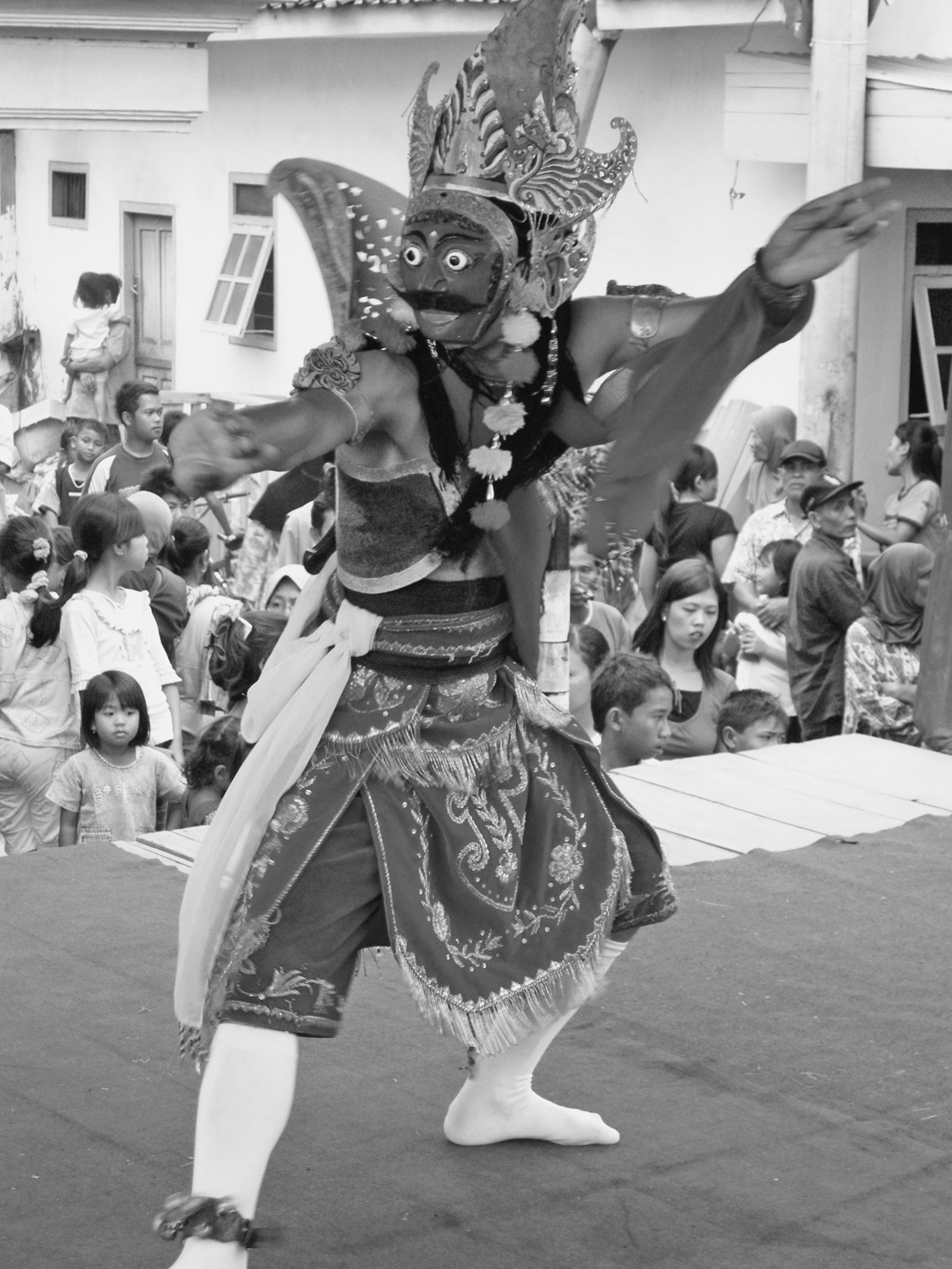
A dancer performs the masked dance Klana . Photograph taken by Mr. Sunardi, 2009.
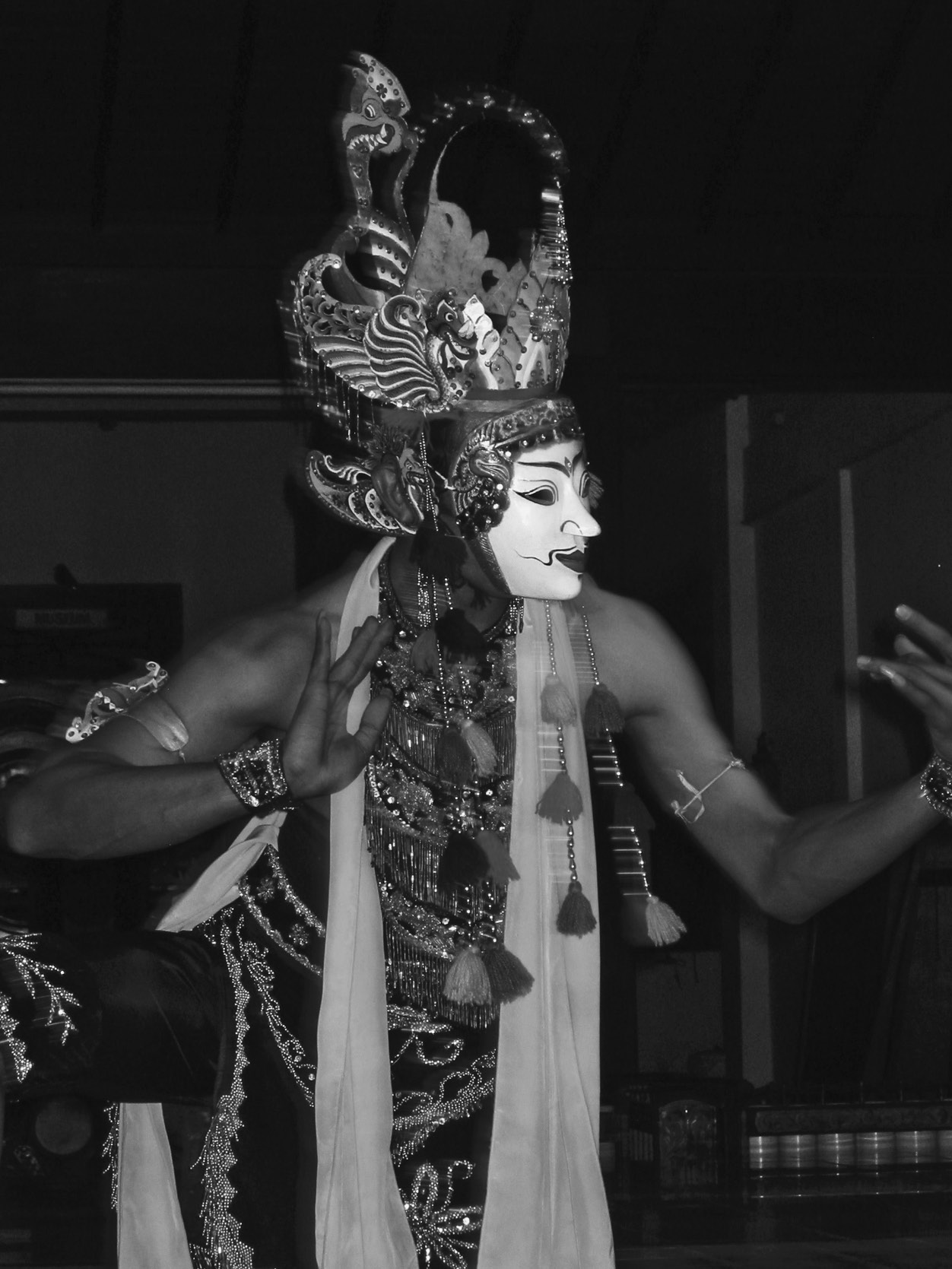
A dancer performs the masked dance Gunung Sari. The dancer is in a kneeling position, but the lower arm position and smaller movement volume compared to Klana in Figure 6 can be seen. Photograph by Mr. Sunardi, 2006.
Muliono is not the only male performer who avoided performing female roles in his home community out of concerns that doing so would compromise perceptions of his manliness. The anthropologist Ward Keeler gives an example of a Javanese man who performed the comic maidservant role in ketoprak, a type of central Javanese theater. After this man became a grandfather, he no longer wished to perform near his home because “he would feel isin [Javanese for shy, embarrassed] to be seen performing by his own neighbors and kin” (Keeler, 1983, p. 163). In addition to concerns about being seen performing a comic role, he may have been concerned that his embodiment of femaleness would compromise his status and reputation as a senior, male figure in his community whose seniority rested in part on the perception of his grandfatherhood, and by extension, his fatherhood and heterosexuality.
Mul and the ketoprak actor’s concerns contrast with Djupri’s pride in the ways he could fool people on- and offstage. Djupri, too, however, did ultimately live as a man in his offstage life and did also specify ways his transformations to femaleness were contingent, temporary, and done for specific reasons, such as to perform (and earn a livelihood), the practicalities of leaving on a difficult-to-remove wig in between performances, and because he was asked to pose as a second wife. These examples contrast with the example of Mama Samsu, introduced next, who embodied femaleness onstage and confidently lived as a waria.
Mama Samsu (Samsuarto, 1955–2018) was an important figure in the ludruk and waria communities in Malang at the time of my fieldwork (Sunardi, 2009, pp. 477–478, 482–483; 2013, pp. 154–157; 2015, pp. 66–67, 72–75, 91). She began to study the arts as a child and actively performed in ludruk from 1978–1991. I use female pronouns when referring to Mama Samsu since she went by the feminine term of address “mama”. In the Indonesian language, pronouns are not gendered, although terms of address are. In addition to performing, Mama Samsu worked as a beautician and as a seamstress. At the time I interviewed her in 2006 she owned a successful salon and boutique in the city of Malang. She mentored many younger waria performers and members of the waria community in general. She and her long-term partner Totok Suprapto offered critical insights into waria’s experiences and she also expressed the importance of waria taking it upon themselves to present a positive image of themselves through their work and lifestyles so that people in the community would value them and their work.
I view such activism in a marginalized community through the lens of respectability politics or the politics of respectability. As developed in African American studies, this lens has been used to analyze ways, rationales, and implications of African Americans as members of a marginalized group intentionally adopting senses of ideal, respectable behavior, manners, morals, styles of dress, and other ways of being associated with hegemonic American culture rooted in middle- and upper-class Euro-American values and norms as a means of advancing African American communities in part by proving to dominant society and to themselves that they, too, deserve respect, equality, and fair treatment (Higginbotham, 1993, pp. 14–15, 185–229; White, 2001, pp. 14, 36–37; Rabaka, 2012, pp. 42–43, 53–54, 62; Brown, 2020, pp. 2–4, 30, 69; Jefferson, 2023, pp. 1449, 1451, 1453). Similarly, Mama Samsu as a member of the waria community, a marginalized group in Java, spoke to ways waria needed to present a respectable image of themselves—to show that they are polite, well-mannered, and do good work—in order to be valued and ultimately accepted.
Although the Indonesian government reinforced heterosexuality and men’s roles as household heads of nuclear families, males who dressed and lived as female have insisted on their visibility and acceptance both socially and politically since the 1970s (Boellstorff, 2004b; 2005b, pp. 56–57; 2007), and have been, to a certain extent, tolerated and supported by the government. The culturally sensitive term many used to identify themselves at the time of my fieldwork, waria—a composite of the Indonesian words for woman (wanita) and man (pria )—is a term that dates from a 1978 government dictate (Boellstorff, 2007, p. 83; Sunardi, 2015, pp. 65–67). Furthermore, waria have received recognition and support from local governments since the second half of the 1960s (Oetomo, 2000, p. 51).
The anthropologist Tom Boellstorff notes that since the mid-1960s, waria have been working to increase their visibility and social acceptance by more openly wearing women’s clothes and establishing themselves in salon work (2004b; 2007, pp. 86–87). According to Mama Samsu and Totok, waria started to have the confidence to live openly since the 1970s as more waria started to appear nationally and internationally in events such as competitions in makeup, beauty, and fashion (personal communication, May 9 and 16, 2006). Boellstorff observes a “shift around 1980, when some people began identifying as waria on an ongoing basis in public (as opposed to more circumscribed contexts like theatrical performances)” (2005b, p. 56). Indicative of increased visibility, a waria was a contender for mayor in the city of Malang in 2003 (Boellstorff, 2004b, p. 187n19; 2007, p. 226 n15).
Work in the beauty industry has been part of waria’s larger efforts and social activism to negotiate cultural and economic space more prominently. Mama Samsu explained that these kinds of occupations appeal to waria because they can dress up and wear makeup daily. In other words, these occupations allowed waria to remain visible as waria in their working worlds, contributing to the visibility of waria in society more broadly (Boellstorff, 2005b, p. 143). These careers also provided an important source of income. Mama Samsu trained many ludruk performers who were waria as seamstresses and makeup artists so that they could supplement their earnings from performing and enter professions with steadier incomes—particularly as they aged and became less able to rely on their physical beauty. Samsu indicated that waria can make positive contributions to their communities and improve their image through good work in the beauty industry (personal communication, May 9 and 16, 2006). She voiced the responsibility that many Indonesian gay male, lesbian, and waria individuals have taken toward their acceptance in society by doing good deeds—that is, “something ‘positive’ (positip )” (Boellstorff, 2005b, p. 212).
I noticed waria’s visibility during my fieldwork and subsequent visits to Malang spanning 2005 to 2015. I saw waria working in salons, performing in ludruk shows, attending ludruk performances, and out and about in public. I noticed representations of waria on television, corroborating the visibility in mass media that other analysts have noted (Boellstorff, 2007, p. 88; Murtagh, 2011, pp. 392–393n3). Some ludruk performers identified openly as waria and went by feminine terms of address such as mama (mama), miss/sister (mbak), or missus (nyonya ) (see also Pawestri, 2006, pp. 101–109), and as highlighted by Tjundomanik Tjatur Pawestri, some went by feminine names (ibid., p. 101).
Tolerance and visibility, however, were not synonymous with acceptance, and local pressures, including familial and religious, reinforced dominant, official ideologies pushing males to live as “manly” men (Oetomo, 2000, p. 49; Boellstorff, 2005b, pp. 11–12, 57; 2007, pp. 78–113; Murtagh, 2011, pp. 392–393n3). Mama Samu and Totok talked about waria’s struggles to be accepted by their families and communities, as did the waria consulted by Tom Boellstorff (2004b; 2007). In villages, Mama Samsu said, where people tend to be more close-minded than in cities, the families of males with what she and Totok identified as women’s hearts often force them to live as men and marry women, sometimes with tragic consequences. While she recognized that people in the city tended to be more tolerant and that waria’s work in makeup, fashion, and performance was appreciated, even in the city, not all males with women’s hearts who were active in ludruk (or in general) had the confidence to live openly as waria.
For males who had women’s hearts but did not live openly as waria, performance was a critically important cultural space in which to embody womanhood, even if just for the duration of the performance (personal communication, Mama Samsu and Totok, May 9, 2006). That is, some males with women’s hearts felt safe expressing womanhood in the context of performance—another example of contingent male femininity—and lived their daily lives as men. Exuding an impressive and contagious confidence (I can understand her impact as a mentor), Mama Samsu said that she, however, does not feel freer on stage than in daily life because she already feels free to wear whatever she wants. She does not care what people say.
This confidence—and courage—has not come without cost. Discussing experiences with discrimination, Mama Samsu related that when she was in college her BA thesis was failed because she dressed like a woman. Persisting, she graduated in 1982. She also experienced discrimination from people on religious grounds, explaining that some orthodox Muslims believed that having one’s makeup done by a waria beautician was filthy (personal communication, May 9 and 16, 2006). Countering religiously inspired discriminatory discourses, she justified her male femininity in her day-to-day life by posing the question of who was judging, humans or God, answering that God is the one to judge, and that everyone is God’s creation. Referring to many waria’s and ludruk performers’ experiences of being forced to live as men and marry women, but unable to satisfy their wives (implying sexually), Mama Samsu said that they cannot help it because they were made like that by God (personal communication, May 9, 2006). In other words, God made some males feminine and sexually desire male partners, not females.
Responding to my question about her religion, Mama Samsu explained that at one time she and Totok got into an argument about religion. She questioned why one had to approach God through Islam, articulating her belief in a supreme God while also expressing reservation about choosing Islam as the way to practice monotheism. She explained that:
Pak Tot and I got into an argument in the past—oh, what year was that? Pak Tot entered Islam. Go ahead, [I said,] enter Islam, [but] approaching God does not [have to be] through Islam. As for me, every night that I can’t sleep, yes, I ask God—after all the one who made me is God, right? If I feel that I am dirty, I bathe until I am clean and change into a clean shirt. Then I pray, God, I’m asking for this and this, what way is the path? Like that, right?
[S]ama Pak Tot dulu kemarin—tahun berapa itu ya—bertongkar sama-sama Pak Tot itu. Pak Tot itu ke, masuk Islam, lho silakan, masuk Islam, pendekatan dengan Tuhan itu nggak melalui Islam. Saya itu setiap malam ndak bisa tidurnya minta kepada Tuhan, o yang, yang membuat saya kan Tuhan. Saya kalau merasakan saya itu kotor gitu, ya, mandi bersih gitu, ya wis, ganti baju bersih. Terus berdoa, Tuhan saya minta gini, gini, jalannya gi mana. Kan gitu, ya? (personal communication, Samsuarto, May 9, 2006)
Mama Samsu decided, however, to become Muslim with Totok and they went to an Islamic boarding school, consulting an Islamic teacher. Totok ended up distancing himself from Mama Samsu, which led to their temporary breakup. Relating their reunification, she explained that:
In the end he got sick, asked someone for help, and I was asked to pick him up. Now, the one to judge is God, not those people.
Akhirnya sakit, sakit minta tolong orang gitu saya suruh jemput, gitu. Sekarang yang nilai Tuhan, bukan orang itu. (personal communication, Samsuarto, May 9, 2006)
In explaining that when Totok became ill and that Mama Samsu was the one who was called to pick him up, she implied that Totok needed to be with her as his true love—he literally could not be healthy without her. She also insisted on gender inclusivity through religious discourse by emphasizing that God is the one to judge, not humans.
Mama Samsu’s insistence on inclusivity in Islam has been echoed by members of Indonesia’s gay and lesbian communities. According to Tom Boellstorff, while some males who identified as gay did find being homosexual a sin, the predominant view Boellstorff found among gay men was that being gay was either not sinful or “a minor sin easily forgiven by God” (2005a, p. 580; 2005b, p. 183; 2007, p. 151). Many of the gay Muslim men Boellstorff talked to referenced ultimate judgment by God, as did Mama Samsu. Also in the same vein as Mama Samsu, many determined that they were not sinning because God made them homosexual (Boellstorff, 2005a, p. 580; 2005b, p. 183; 2007, p. 151). The female Muslim homosexual people interviewed by the anthropologist Evelyn Blackwood recognized “that according to Islam homosexuality is a sin, but they find their own accommodations between their religious beliefs and their desires” (2010, pp. 15, 94). By making sense of Islam in their own ways to legitimize and include gender identities and sexual desires that were nonnormative by the standards of dominant Indonesian (and Islamic) gender ideology—as did Djupri and his grandmother to a certain extent—individuals such as Mama Samsu, Totok, those consulted by Boellstorff, and those consulted by Blackwood were contributing to the spectrum of beliefs, practices, and attitudes that comprise Islam in Java (Daniels, 2009).
Although Mama Samsu made sense of religion in her own way, she also recognized the importance of respect for the context, as when serving as a beautician for a wedding. She noted that when she goes to a mosque, she makes the effort to wear a headscarf. She also said that she wears appropriate attire when she goes to a church (personal communication, May 9, 2006). Mama Samsu’s decision to wear women’s attire to mosques is also significant because the issue of what waria should “wear when praying as Muslims” (Oetomo, 2000, p. 54)—male attire because they are male-bodied or were assigned male at birth, or female attire because they live as female—was unresolved within waria communities (Oetomo, 2000, pp. 54–55). By specifying women’s attire (a headscarf) to go to mosques (although not necessarily specifying to pray), Mama Samsu insisted that Muslim society recognize the femininity with which she identified. Moreover, she provided an example to other waria who felt similarly about their femininity, while also demonstrating her own respectability. In light of the anthropologist Suzanne Brenner’s point that, through veiling, some women in Java “refashion themselves to fit their image of modern Islamic womanhood” (1996, p. 691), Mama Samsu’s decision to wear a veil also suggests that she was asserting a sense of modernity as she asserted her femininity.
In talking about her propriety, piety, and long-term relationship with Totok (her partner of over 20 years at the time of my interviews with her), Mama Samsu implicitly countered negative assumptions about waria’s promiscuity and availability as prostitutes. Such assumptions contributed to teasing, taunting, sexual harassment, and belittlement that many waria endured as well as isolation, ambivalence, avoidance, and criticism. For example, because most performers knew that many ludruk performers who performed female roles at the time of my fieldwork lived as waria, their gender transgression in their daily lives was imagined when they were seen performing. One performer explained that he enjoys watching those who perform female roles in ludruk performances, including those who were waria. At the same time, he was afraid of waria and did not want to talk to them (personal communication, November 10, 2005).
Some musicians and dancers indicated that the behavior of ludruk performers who were waria went beyond propriety and that waria could not control their emotions or sexual desires. In a conversation with some dancers and a drummer, they said that having a waria as a girlfriend was dangerous because a waria’s character is “hard”, their emotions are “strong”, and that when they fall in love, it is difficult for them to let go of the person they love. They generalized that waria become jealous easily. One man said that he did not want to perform the dance Ngremo Putri (Ngremo in the female style) when he was in ludruk because of waria; he did not want to be around them (implying backstage and onstage) so he just performed Ngremo Lanang (Ngremo in the male style). A drummer agreed, saying that waria were also what made him reluctant to play for ludruk (personal communication, March 3, 2006). In a different conversation another drummer said that nowadays it is as if ludruk performers playing female roles were possessed by mischievous spirits; it was not ludruk, but waria looking for men (personal communication, June 7, 2006). Many older performers insisted that before the 1990s male ludruk performers specializing in female roles did not dress and live as women offstage (although other evidence presented earlier suggests otherwise), linking the presence of waria to the disintegration of ludruk. Several older performers pointed to the irony that most ludruk performers specializing in female roles at the time of my fieldwork could not perform female-style dance well, even though they dressed and lived as women (Sunardi, 2009, pp. 483–484; 2015, pp. 86–87).
Speaking about her own concerns about how ludruk performers at the time of my fieldwork were presenting themselves onstage, Mama Samsu further spoke to a sense of responsibility she believed ludruk performers specializing in female roles and waria must take to present positive images of themselves on- and offstage so that they would be perceived better in society. She did not care for the fashion show that was part of the opening acts of some ludruk performances, finding that it was not polite (sopan); the short skirts and tight clothing (often internationally inspired) that performers often modeled, she opined, were inappropriate. As ludruk performers and waria, she believed that they should be smooth, graceful, and well mannered (luwes ) and so should wear a long batik cloth, traditional Javanese blouse, and large hair bun (personal communication, May 9 and 16, 2006; Figure 8). This is a “classic” and “traditional” Javanese woman’s outfit and hairstyle, although subject to changing trends, too. Mama Samsu was speaking to an expectation of feminine refinement consistent with the dominant Indonesian gender ideologies with which she had grown up even as she insisted that males or individuals assigned male at birth could also embody this ideal of femininity and womanhood.
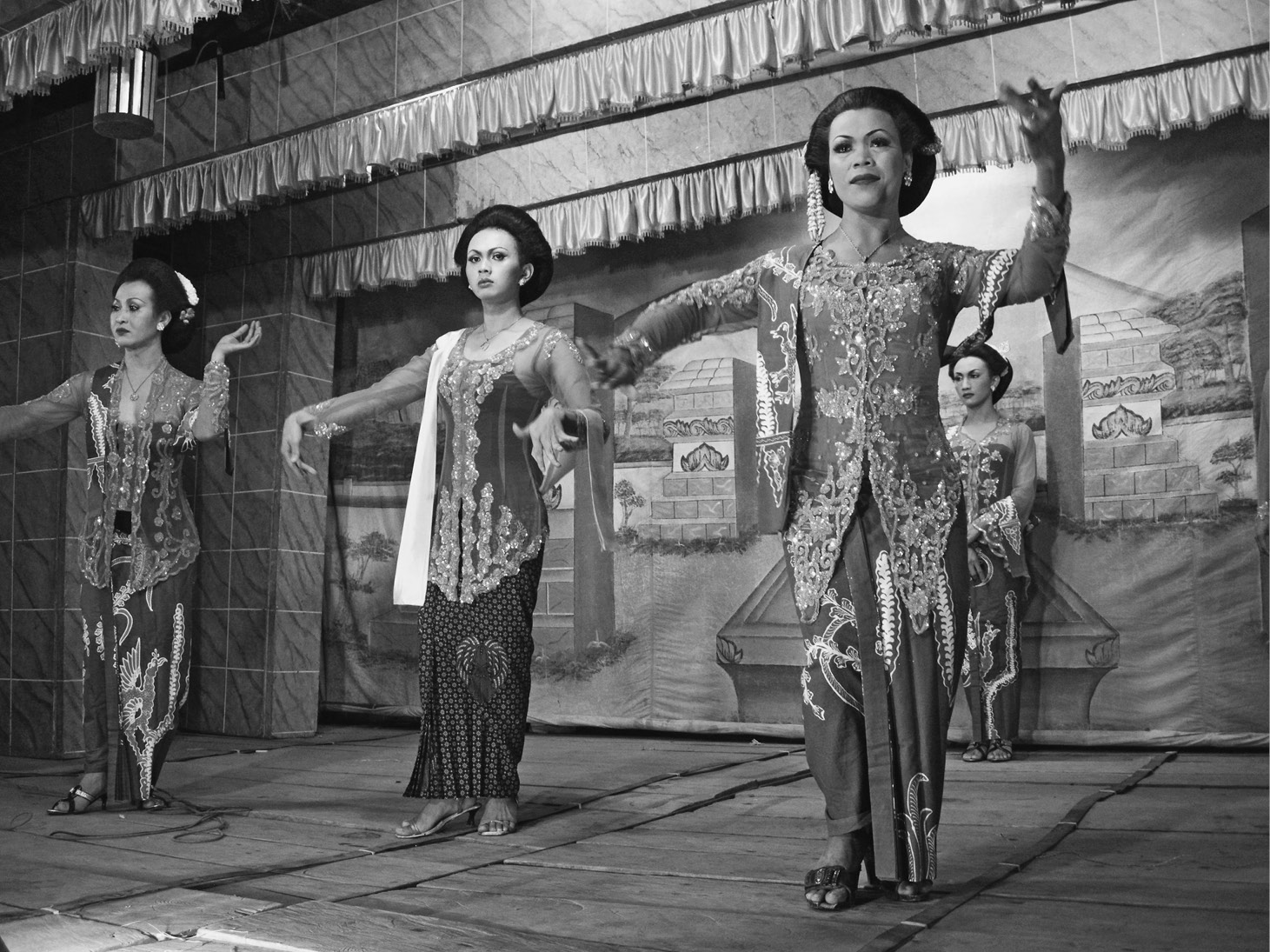
Ludruk performers dance in a traditional outfit for Javanese women. Photograph taken by the author, 2009.
Identifying offstage behavior that she did not like among younger waria active in ludruk, Mama Samsu noted that many do not “know themselves” and that they are not faithful to their partners, which can cause problems of jealousy within the ludruk community, and even within one group. She did not like the carefree lifestyle she said that many waria lead, saying that most do not think about the future and how they will earn a living after their beauty fades. Samsu’s concerns about the behavior and future of other waria were not unlike the concerns that Tom Boellstorff encountered among gay male and lesbian Indonesians who, feeling a sense of responsibility for bettering the image that larger society had of them, “would castigate each other for only caring about throwing parties, or stealing each other’s girlfriends or boyfriends, or gossiping, rather than doing something ‘positive’ (positip )” (2005b, p. 212). Mama Samsu also felt that waria needed to take responsibility for themselves and perceptions that others had of them as a strategy for their own betterment and as a strategy for the acceptance of male femininity in daily life (Sunardi, 2015, p. 91). I have come to understand Mama Samsu’s attitudes and activism through the lens of respectability politics as she spoke to ways of being—or ways one should be—a respectable waria who exudes femininity modeled on dominant constructions of respectable Javanese and Indonesian womanhood.
Despite the pressures and expectations that Djupri, Muliono, and Mama Samsu identified for males to live as men, and social expectations for male femininities to be restricted to performance, my observations during my fieldwork spanning 2005 to 2007 and subsequent visits indicated a continuity of social needs for male femininity on- and offstage—both in terms of males with women’s hearts needing an outlet in which to express and embody their gender identity, and in terms of desires for male femininity on the parts of audiences. Similar to Djupri’s experiences in the mid-twentieth century of viewers taking more license with him when they knew he was a male performing female-style dance than with female performers, in the comic routines that preceded ludruk performances that I observed, the comedians tended to be freer with their joking, which was often sexual, with males and waria performing female roles than with women performing female roles—even kissing males or waria playing female roles to the delight of the audience. The ludruk performers in female dress played along, feigning anger—anger that a woman would be expected to display if such liberties were taken with her.
These comic scenes were so funny to audiences in part because taking such liberties with women was neither humorous nor tolerated. If guests or audience members danced too closely or attempted to kiss women singer-dancers during tayub dance events, for example, the women became angered. They and the men in the group took measures to discourage this behavior from continuing. The women would move away from the man who was breaching the limits of acceptable behavior, either continuing to perform or stopping briefly, looking at the other singers or musicians with visible expressions of exasperation. In extreme cases, men who were ready as bodyguards of sorts would physically remove men behaving this way from the performing space (Sunardi, 2015, pp. 41, 82).
Indicating the ongoing sexual impact of male femininity in 2006, echoing observations from the mid-twentieth century discussed earlier in this chapter, a male musician said that when he sees a man perform female-style dance, such as Ngremo Putri, he is affected by the femininity of the dance and the dancer, not the maleness of their biological sex. When he sees men or waria performing female roles in ludruk, he finds them beautiful, not handsome, noting that they can be more beautiful than women. Admitting that his desire or lust (nafsu) cannot always be controlled, he confessed that he has fallen in love with ludruk performers who perform female roles, even though he knows they are men. He clarified that he fell in love “just in his heart”, meaning that he did not try to pursue a relationship. Asserting his assumptions about the normativity of heterosexuality and yet recognizing the sexual appeal of men or waria specializing in female roles, he said that falling in love with a male should not be allowed, but that his feelings were pushed from nafsu. He told me that he has many friends who are crazy about ludruk performers who specialize in female roles because they have large breasts and are incredibly sexy, even though they are male (personal communication, July 31, 2006; Sunardi, 2009, pp. 476–478; 2015, pp. 85–86; 2022, p. 290).
Other individuals in audiences took pleasure in the beauty of the male and/or waria performers who performed female roles. At one ludruk performance, a couple of women dancers and I talked about how pretty and feminine one performer was. One woman, who knew I was studying female-style dance, joked that this performer was more beautiful and coquettish than me (personal communication, January 1, 2006). At performances I attended, when the performers dressed as women entered the stage one by one for the bedayan chorus portion of the variety acts that preceded the play, men in the audience and running the sound system often whistled for the sexier ones, calling out remarks such as “beautiful!” (ayu) and “let’s go, beautiful!” (ayo ayu). When the performers began to sing, men continued to hoot, whistle, and make comments such as “that which is beautiful!” (sing ayu). I observed men act similarly for women singers at performances of campur sari (a form of popular music that combines gamelan, keyboard, guitars, drum set, and sometimes other instruments [Brinner, 2008, p. 19; Supanggah, 2003; Cooper, 2015]), indicating that this is one way that men reacted to femaleness regardless of the biological sex of the performer. At one ludruk performance, I overheard one man likely in his 50s saying to another man that a particular performer on stage was beautiful, but that one could not really judge from far away—indicating that he was indeed judging. Other people in the audiences of ludruk performances acknowledged and delighted in the abilities of the performers to look like beautiful women, saying that they were clever with their makeup.
Like Geertz found in 1950s Java, I encountered a sense of wonder for male and waria ludruk performers who specialized in female roles when they were performing. At the ludruk shows I attended, audience members’ comments indicated that they allowed themselves to be fooled by a good performer or actually were fooled—savoring the confusion. I often overheard men and women of all ages in the audience make comments such as “Is that really a woman?” or “That one looks like a real woman” when performers entered the stage to dance and/or sing. At another performance, a man who was probably in his 40s and I delighted in trying to determine whether one of the performers was really a woman or not. After about 15 minutes, we concluded that the performer was a man. One little girl about six years old sitting next to me at yet another performance was entranced by the female roles, asking me repeatedly if one performer in particular, who happened to be Mama Samsu, was a real woman.
Moreover, as Djupri talked about doing in the 1950s and 1960s, the men and waria performers I observed in ludruk worked hard to look as feminine as possible. Most wore figure-enhancing undergarments such as corsets. Some wore spandex or spandex-like shorts that gave their buttocks a shapelier, more feminine silhouette. Some males had full breasts, perhaps from hormone therapy or silicone injections (see Boellstorff, 2007, p. 94), indicating that they had more permanently altered the appearance of their bodies. Most spent a considerable amount of time expertly doing their makeup, and some were known to exercise to maintain their figures (personal communication, Luluk Ratna Herawati, January 4, 2006). In cultivating their soprano registers and singing in falsetto, performers took care to sound as female as possible, too. I cannot help but see parallels between what I observed and what Djupri and Mama Samsu shared about their own lives and experiences as artists (Sunardi, 2015, pp. 79–81).
In exploring Djupri’s, Muliono’s, and Mama Samsu’s lived experiences as artists, I have presented different ways individuals produced male femininity, related to male femininity in on- and offstage contexts, and navigated social pressures within their communities since the mid-twentieth century and into the twenty-first. While Djupri delighted in convincing others that he was a female on- and offstage, he insisted on his manliness in his daily life and distanced himself from a waria identity. Muliono performed female-style dance when he was younger as well, but stuck to male-style dances as he came into his own as a young man, future husband, father, and household head. Both Djupri and Muliono spoke to spiritual means that gave them the ability to temporarily embody and exude femaleness, thereby emphasizing that the femaleness was contingent upon the context of performance even as they spoke to their gender fluidity. Mama Samsu lived as a waria and used both performance and her offstage life and career to advocate for waria’s social acceptance and to model what she believed was respectable behavior and a respectable lifestyle, confidently and boldly embodying and producing male femininity on- and offstage.
While Djupri, Muliono, and Mama Samsu challenged what types of bodies could produce and embody femaleness and thereby challenged dominant Indonesian gender ideologies, they also reinforced dominant ideologies about ideal female subjects through their onstage performances of traditional female-style dance. As Djupri, Muliono, and Mama Samsu negotiated gender representation and identity in Malang on- and offstage, reinforcing gender pluralism and producing male femininity, they contributed to the production of place-based identities as Malangan people. Malangan identities also included articulations of female masculinity as women dancers performed male-style dance, produced complex senses of gender on- and offstage, and negotiated dominant gender norms, topics I explore in the next chapter.
1. How did Djupri, Muliono, and Mama Samsu undermine dominant ideologies of gender and sexuality on- and offstage? How did they reinforce dominant ideologies of gender and sexuality?
2. How did Djupri, Muliono, and Mama Samsu navigate pressures from their communities to conform to dominant ideologies of gender and sexuality? (In answering this question, you may wish to also identify what the pressures from their communities were.)
3. How did Djupri, Muliono, and Mama Samsu contribute to the production of local east Javanese identities through their lives and careers as artists? In other words, how did they contribute to what east Javanese, and more specifically, Malangan identities, include?
 Fashioning Femininities, Making Masculinities
 Twitter
 Facebook
 WhatsApp
 LinkedIn


