Possibilities of Educational Pathways to Refugee Resettlement
Table of contents
DOI: 10.3726/9781916985285.003.0003
3: How did seeking refuge and education come together
In this chapter, William shares his educational journey and the opportunities that came with it. He begins by talking about schooling in his village before the war, which he was considered too young to attend, and his first formal education experience. Following that, he will discuss his schooling in the refugee camp, his experience attending high school, and eventually finding himself in the Kakuma refugee camp in Kenya.
The place of education before the war
Traditionally, in our village, education was not a top priority, and there was no need for it other than being able to read and write a letter. A handful of people in the village had elementary-level education, but most were pre-literate. My parents’ generation had spent their childhoods in refugee camps in Uganda during the first Sudanese Civil War in the 1970s. As a result, most of them never went to school. When our parents returned home to what was then Sudan (now South Sudan), they resumed their traditional way of life.
Before the second Sudanese Civil War, our village had a primary school for children that taught grades one through six. The school was held in the afternoon, after people had finished working the land, so education could be integrated into our traditional way of life. Perhaps, after returning from Uganda, our people realised they needed a school for their children to learn to read and write, as communication through written letters was becoming common practice in the village among the refugee returnees from the camps in Uganda. Before written communication, our people relayed messages through different means, such as sending messengers, blowing horns, flutes, howling, or drumming.
Education in the village
When our village was burnt down during the second Sudanese civil war (see Chapter 2), volunteer teachers started to teach children under trees in our hideout places. During this time, my sister and brother started school. I was about six years old and was considered too young to start school. Whenever my siblings did their homework, I sat next to them, and my sister taught me how to recite the alphabet in the Acholi dialect, and to write my name on the ground. However, before I could start schooling, the volunteer teachers stopped providing education because of the constant attacks in our hideouts. My sister kept teaching me some basic numeracy skills while we were hiding in the bushes. This little and playful teaching helped me with some basic skills.
When I lived with my grandmother in 1992, she sent me to a school for unaccompanied children – children who were separated from their parents during the war and were looked after by the Sudanese Liberation Army, which was fighting the Sudanese Government. There were thousands of children who became separated from their parents and were too young to care for themselves alone. Some of these children became known as Lost Boys, and many were eventually resettled in the United States of America. The school for the unaccompanied children was located outside of the townships, and hundreds of children my age from different parts of the south lived at the school. I was placed in grade one, and most of our teachers were untrained military officers. We didn’t have any books, pencils, desks, or buildings. We were taught under the trees, and the teachers had to improvise iron sheets as boards, and writing on them with charcoal. It was a difficult, challenging environment in which to learn.
Life in the township was not easy. We were constantly under attack from Russian-made Antonov fighter jets used by the Sudanese Government, and people had to hide in temporary trenches to avoid getting bombed. The damage caused by the fighter jets was all around us: houses were burnt, and big trees scorched, branches were felled and thrown far away from their bases. The trees in the township lost all their leaves in the bombing raids. It had not occur to the rebel officers that our schools would be bombed, as they were locatedoutside the township.
Despite the constant bombing in the township, we continued to learn. However, my time at the school was short-lived, as it was bombed only two weeks after I arrived. It was around noon, and we were on a recess. I was playing with some children my age when we heard a fighter jet approaching. We immediately lay flat on the ground, and two bombs were dropped on our school. One bomb hit a building that was used as a store, and the other fell on the outskirts of the school compound. Two people were hurt, but not life-threateningly. It was a traumatic experience that I will never forget. I then realised how vulnerable we were and how difficult it was to get an education in our war-torn country. Apart from those two weeks, I do not remember attending formal school in then Sudan.
Education in the refugee camps
Once I arrived at the Agojo II refugee settlement camp in Uganda in December 1992, I was able to start my education in 1993. There were several refugee settlement camps for Sudanese refugees in the host community, some of which were established in 1989. Schooling in displacement contexts varies significantly, depending on how long a camp has existed, if/how the local community welcomes refugees, how a refugee community organises itself, where the school was located (country, camp), and school grade. When I started my education in 1993, it was common practice that the lower the grade, the fewer resources allocated to the class. It was also common practice for lower grades to be assigned less-educated teachers and have poorer facilities. Lower grade classes were held under trees with children sitting on the ground for lessons, while more senior grade classes tended to sit on wooden logs or take place in locally built shelters if they existed.
Although I couldn’t write when I arrived in the refugee camp, I had already developed good skills in basic mathematics from my sister, so I was placed in a third-grade class after the teachers found that I could solve a third grade level mathematics, which was appropriate for my age. I was thirteen years old then. I have good memories of my first teacher. He was a grade three leaver from the then-Sudan education system, who had little English, but was very caring. Every evening, he gathered the school-aged children at his home to teach them basic numeracy skills. I don’t know if he did this because there was not much to do in the refugee camp, if he really wanted to equip us with knowledge, or if he was looking for an employment opportunity by creating one. Whatever his intention was, his efforts helped to establish a school in our refugee camp. Classes were held under trees, and we sat on the ground or on rocks, as we had done in our bombed school back home. Similarly, there were no blackboards, chalk, books, pens, or pencils. Instead, every child had a section of the dusty ground to write in, copying what the teacher had written on a rock with charcoals. Our teacher taught us to use a stick for writing on the ground with the hope that if we were given the resources, we would develop the necessary skill of holding a pen or pencil.
When we finished writing and copying on the ground, he marked and commented on our schoolwork. He would write things such as “excellent, keep up the good work” next to our work on the ground if we answered all the questions right. He would then ask us to erase our work, which I found heartbreaking because I always wanted to show my good work to my grandmother, even though she couldn’t read or write. I thought seeing that I was doing well in school might give my grandmother some hope that I would grow up and become a useful person in society. But this was impossible, and we went for over a year before we had pencils or pens to write with and exercise books to write in.
As we switched from one lesson to another, the rock was wiped with a dampened cloth to remove the charcoal. We would wait for about 30 minutes for the rock to dry and then be ready for the next lesson. As time went by and services to refugees started to trickle in, the school received blackboards, exercise books, pens, and pencils. I remember my first pen was from New Zealand, which immediately became a popular country among us. We all wanted to establish contact with schoolchildren in New Zealand so that they could keep sending us things for school. As children, we treasured the pens we were given by the New Zealand people. Then, Jesuit Refugees Services (JRS) started to take over the school’s administration. JRS staffed our schools and provided teachers with resources to run the school. They paid our teachers and appointed school head teachers, all while we were still learning under trees.
Educational expectations in the camps
The developments in the school system meant that pupils were also expected to behave and meet educational standards. In the school, our home languages were not allowed, and whenever we spoke in our languages, we would get some punishment. The punishment for not speaking English was a good incentive to focus on learning the language. Each class had a tortoiseshell which was used to shame children who spoke their first language in class. Whether the teacher overheard us, or a fellow pupil accused us, if we were heard speaking a language other than English, we were forced to wear the tortoiseshell around our neck. It was passed to another child if they were later heard speaking in their first language. When the school closed for the day, whichever child was still in possession of the tortoiseshell was given five floggings.
Although not an official directive from JRS, our local teachers were attempting to ensure we became proficient in English language, because it is the formal medium of education in Uganda. I was lucky because we were given a plot next to my uncle’s, and my aunt spoke basic English. Every evening, she taught her daughter some English phrases, and I would join her in learning new English words. I only left when it was time to sleep, and I slept in a tent that had been set up on the plot next to my uncle’s.
Our teachers were happy when they heard us try to speak in English, even if it was inaccurate. It was not uncommon to hear broken English phrases, such as: “You are no good”, “You insulting me”, and “You thief my pencil”, as well as short English phrases like “Come here”, “Go there”, and many others. The only good English I remember being taught was how to greet our teachers when they entered the classroom. Whenever a teacher came in, all the students would stand up, on their feet, and the endless greetings would begin:
Teacher: Good morning, class.
Pupils: Good morning, teacher.
Teacher: How are you?
Pupils: We are very well. Thank you, teacher.
Teacher: Sit down.
Pupils: Thank you, teacher.
Very early in the morning, the school timekeeper, who was also a student, rang the school bell, which was made from an old truck rim. It was usually rung three times. On the second ring, pupils would start running to school. If a pupil arrived after the third bell had rang, the school prefects flogged that child. Male pupils were flogged on their buttocks, while female pupils were flogged on their hands. The second ring of the bell was also a signal to clean the school compound, which we swept every morning. Pupils were asked to bring brooms from home to school every two weeks. These were inspected during a school assembly, and if a pupil didn’t bring a broom, the child was flogged in front of the school assembly. Usually, such punishment carried more lashes than the usual five for coming late or speaking our language.
There were general cleanliness days in the school. On such a day, we were asked to cut the grass around the school with donated grass slashers. The slashers were double-edged, springy tools, ideal for clearing long grass and weeds, without excessive bending. Pupils in lower classes were asked to make arts and crafts as part of the end-of-year examinations. Parents were asked to construct school shelters when there were enough reeds and poles. It was a mandatory community participation event. Those who didn’t participate were fined to pay some money, or their children were kicked out of the school.
My primary schooling journey in the camps
I finished third grade at the top of the class. When I went to register for the fourth grade, a thought came to my mind that the opportunity for a scholarship to attend high school might cease if I didn’t skip a grade. I then thought that if I skipped the fourth grade, I could still have the chance to continue to high school under a scholarship, provided I performed well in my final primary school exams. I asked our headteacher if he would allow me to go directly to the fifth grade, as I performed well in the third grade. He refused, but my biology teacher advocated for me to skip the fourth grade because he felt I was ready for the fifth grade. We reached a compromise the headteacher said that if I placed among the top five students in the first term of the fourth grade, he would allow me to move up in the following term. I was keen to progress quickly because I was scared that I would miss out on the camp’s scholarship opportunity to study in high school if I didn’t jump ahead. I was convinced that this would be catastrophic to my education.
In the first term of the fourth grade, I placed first in the class. I went to the headteacher and asked him to honour our deal, and the headteacher agreed for me to join the fifth grade. In the final term of the fifth grade, I placed 14th in a class of over 80 school children, which allowed me to go to the sixth grade. However, because our camp was relatively new and lacked facilities, I decided on my own that I needed to transfer to a school in another settlement camp. The camp was located about an hour and a half walk from ours, so, I walked three hours a day to attend the sixth grade.
Due to a lack of facilities in the school I transferred to, pupils from the fifth grades to sixth grades attended school in the afternoon. I placed first in the sixth grade and was accepted into the seventh grade, which was the final year of primary school in Uganda. All seventh graders in the country sat for the same examination. Completing seventh grade with good grades was an important milestone as it determined which high school the leavers would attend after primary school.
In the camp, we had limited opportunities to compete with non-refugee students for top grades because we lacked the resources, including adequate facilities and trained teachers. Nevertheless, this was no excuse for not working hard to achieve good grades. In the final year of the seventh grade, I dedicated myself to helping my classmates do well in the national examination, which was officially called the Primary Leaving Examination. When morning school sessions ended, I stayed behind at school with an older student to coach students who needed extra help, mostly in mathematics.
A group of students started staying back after school so that they could receive this help from us. They began bringing us pastries so we would not go hungry while we tutored them. During this time, I learned that my coaching colleague had also faced many struggles in his life. Sadly, he was denied a scholarship despite performing excellently in his Primary Leaving Examination, simply because he was considered too old. I was lucky to achieve a high distinction in the seventh grade in 1996 and received a scholarship to attend a boarding high school outside the refugee camp.
High schooling
In 1997, at the age of sixteen, through the scholarship I received, I joined a boarding high school that only accepted the best and brightest students in the district. My grandmother was elated when she learned that I had passed the primary school exams and was given a scholarship to study in one of the best high schools in the district. I didn’t have much with me when I left for school, and I didn’t have any money. All I had was a tiny tuckbox, made locally, which I bought using the money I earned from selling papyrus mats. Inside, I had a blanket, a cover sheet, exercise books, a pair of flip flops, a pair of school shoes, and one set of school uniforms. I also carried a hurricane lamp to help me study at night because the school didn’t have electricity despite being the best in the district. I could see the joy and pride on my grandmother’s face, despite the limited resources I had to take to the boarding school with me.
Since I didn’t have any transportation, I had to walk on foot to the school (Figure 4). It took me an entire day to get there, and I walked nonstop until I reached the Nile crossing around noon. Luckily, a ferry was transporting World Food Program trucks across the Nile that day, and I was able to use it to cross the river. After crossing the Nile, I had to walk for another half-day to reach the school, constantly asking people for directions along the way and arriving there at around 5 p.m. that evening.

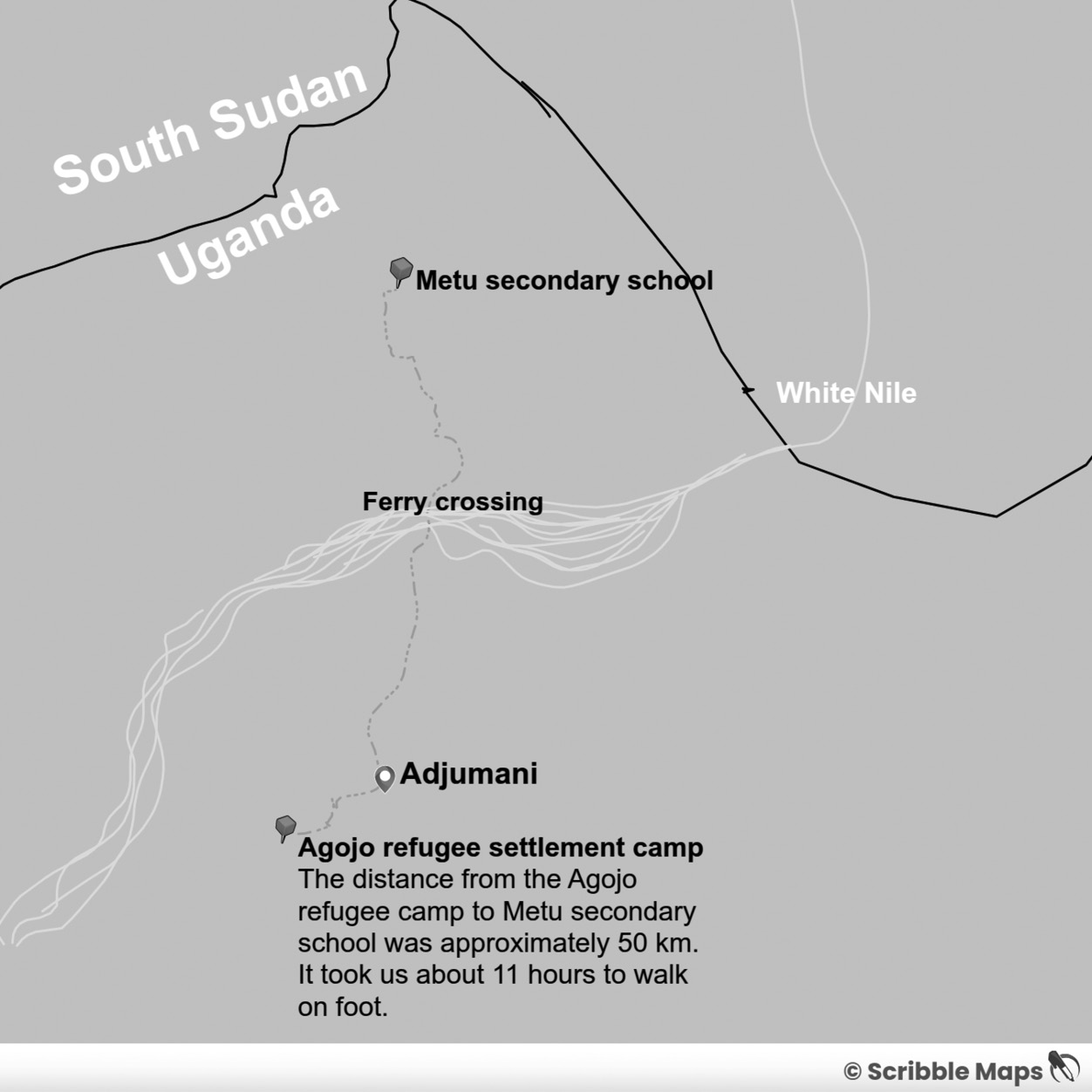
A google map showing the path I walked from the refugee camp to my boarding high school
When I arrived at the school, I didn’t know anyone. Many of the students at the school were Ugandan nationals, although there was also a relatively large number of refugee students. I was directed to a head boy, who then showed me to my dormitory house. Unfortunately, I was four weeks late, and the dormitory was full, so they showed me a space with no bed next to the door. I placed my tuckbox against the wall and spread my blankets on the floor. There was no orientation regarding food, classes, or school activities. I felt lost and confused, but I didn’t want to draw attention to myself by asking other students for help. I decided to follow the crowd and hope for the best. Despite the initial challenges, I managed to make it through the first few days until I became acquainted with the school calendar and expectations.
Bullying and other torments
During my first term at the school, I became the target of bullies. I looked poor and rugged, and I slept on a blanket on the floor while other students had beds and mattresses. Many students would wipe their feet on my blankets when it rained, and I wasn’t in the dormitory. I was called names like rat, pig, and dog, and students would make animal noises when referring to me. When I passed by, they would grunt, oink, bark, and squeak at me. I didn’t have any pocket money, and my only pair of flip-flops were stolen. When I confronted the boy who took them, many students ganged up on me. I reported the incident to the headmaster, but he didn’t take any action. I was unsure why the school headmaster did not respond to my complaint, so I decided to leave following the matter.
The bullying continued when it came to bathing. Although the school didn’t have enough water for showering, there was a nearby stream where students went to bathe. Other students would throw my shoes into the water, they would throw me back into the water while rubbing my back with stones, saying that my back was dirty. They did this because I didn’t have a towel, I had to stand on a rock to wait for my body to dry before putting my clothes on. They would also rub soap on my head, saying I hadn’t bathed properly, even after I had finished bathing. This bullying made me avoid other students whenever I went to wash.
Overcoming challenges
I had to work hard to make myself known during my first term to stop the bullying. I placed at the top of my class in my first term despite arriving four weeks late. I joined the school drama club during my second term and made friends with students from different backgrounds, including people who came from families with high-ranking positions in the local government. I joined the school charity association and began to help students who were in wheelchairs by volunteering to serve them food. Despite having nothing, I drew many students within my circle of friends and eventually got the fair treatment I deserved.
One of my best friends was a girl whose father was a senior government official. She first introduced me to her father as “the boy who helps me with my maths and chemistry.” At that time, her father had come to give her some pocket money. Although we were offered food in school, it was often infested with weevils, so some students preferred not to eat it if they could, and instead buying food from local women. The experience of meeting my friend’s father for the first time was a defining moment in my life. I felt a sense of pride that I was able to offer my help to others, and his generosity and kindness towards me touched my heart. I was grateful when he bought me a new pair of flip-flops to replace the one that had been stolen, and his encouragement to continue studying hard resonates with me to this day. The memory of this experience fills me with a deep sense of appreciation for the people who have helped me along the way and have inspired me to be a better person and to help others however I can.
Although our high school was considered one of the best schools in the district, it lacked a reliable source of electricity. The school relied on a generator that would work up until 10 p.m. every night, after which it would be turned off. This meant that students who wished to study after 10 p.m. had to use their own lamps. It was a challenging situation, especially because almost half of the students in our high school were refugees and were on scholarships. As a result, we had to work extremely hard to perform well in the Uganda Certificate of Education national examination (senior four national qualifications, also called “O-Level” or Ordinary level) to secure a scholarship for our Advanced Uganda Certificate of Education (senior six national qualifications, also called “A-Level” or “Advanced level”). Despite all the challenges, it was amazing to see how determined and hardworking we were as refugee students; we never let our circumstances get in the way of our dreams.
I used to study with my friend every evening until 10 p.m. After that, she would go to sleep, but I would continue studying until midnight. Then, I would wake up at 4 a.m. every morning to study more. Sometimes, I would struggle to stay awake due to fatigue, so I would immerse my feet in cold water to help me stay alert. It was tough, but I was driven by my desire to achieve a top grade in my O-Levels to secure a scholarship for A-Level. Despite the challenges, I was confident my hard work would pay off in the end.
Heartbreak for refugee students
During my second term at the school, I was heartbroken when all the refugee students were sent home due to a disagreement between the refugee student leadership team and the school administration. Every year, refugee students received 60,000 Uganda shillings (approximately AUD $24) as pocket money. This was back in 1997 when I joined high school. Unfortunately, the year I joined the school, the school administration decided to use all the pocket money to buy food while waiting for the refugee students’ school fees to arrive. The school consulted with the refugee student leadership body regarding the use of the money, but the local students objected. They cited instances in the past where the school had used their pocket money and failed to refund them. As first-year students, we had no say in the matter and had to follow whatever the students in higher classes decided. It was frustrating to see that we were not given a chance to express our opinions or have a say in the matter, and it felt like our voices were not being heard.
When the refugee students refused to let the school use their pocket money, we were all expelled. The police were called in to ensure that we left the school immediately with all our belongings, and we were instructed not to leave anything behind. At that time, I had some first-year friends who were training to become Catholic priests and lived in a monastery near the school. Thinking the suspension was temporary, I took my tuckbox to them. The camp commandant was furious with what the school had done. He immediately distributed notices throughout the refugee camps and called all the refugee students at the school to meet with him. In that meeting, the refugee students and the camp commandants concluded that there was a cynical jealousy about refugee students’ high performance at the school. The camp commandant gave a letter of support to each refugee student, encouraging them to seek admission to any high school in northern Uganda. However, this meant that we needed to find a school that would allow us to start our second year of secondary education despite not finishing the first year.
I didn’t want to attend school in the area where our refugee camp was located. I had a gut feeling that the local community was attempting to prevent refugees from opportunities, such as education. It appeared to me that the local high schools were attempting to undermine our top-performing school by forcing high-achieving refugee students to transfer to the nearby high schools located within the boundaries of the refugee camps. Their goal seemed to be to boost the standards and reputation of their own schools. I suspected that the headteacher expelled us to gain political support from his local community because he came from the areas around the refugee camps. My feeling was prophetic. It soon became apparent that the high-performing refugee students weren’t returning to the school they had been expelled from, and the Ugandan government immediately appointed the former headteacher as the resident district commissioner for the areas around the refugee camps.
It was disheartening to see the struggles that other refugee students faced in their pursuit of education. I was dismayed to see that some schools were unwilling to accept and support these students, but it was also inspiring to see the resilience and determination of these students to continue their education despite the obstacles in their way.
Trying again
I decided to try another district for admission. It was a difficult decision for me, but I had no other option. After searching for days, I found a school in the poorest area in that district. The school’s buildings were dilapidated, and the facilities were substandard. The buildings and dormitories were in poor condition, with broken windows, bare fluorescent tubes, and faulty electrical wiring. The school had a bad reputation within the local community and didn’t perform well in the O-Level National Examinations. As I looked around, I couldn’t help but feel a sense of despair. Nevertheless, when the school agreed to give me admission after seeing the letter of support from the camp commandant, I was overjoyed and realised how fortunate I was to have the chance to continue my secondary education because many other students didn’t have the same privilege. I felt like I had a chance at life.
When I started attending the new school, I was filled with a sense of excitement and nervousness. However, my fears quickly dissipated as I found the quality of teaching to be good. Despite the school’s reputation and lack of resources, I was determined to get an education. I knew I had to do whatever it took to succeed. I was confident that I could perform well in the O-Level National Examination with hard work. There were also other refugee students from a different region who were on the same scholarship as me. Given my experience, I was passionate about being involved in discussions with my school on anything relating to our scholarship and education. The refugee students at the school elected me as their representative leader. I communicated with the headmistress and the scholarship office on matters relating to our school fees. I held this position for three years and successfully petitioned the headmistress not to expel us despite our late fees until I completed my O-Level. I was so relieved and grateful to have a headmistress who understood our situation and always went above and beyond to support refugee students. It was such a contrast to my previous school, where I had felt like we were constantly fighting for recognition and acceptance.
I was among the top ten students in the district for the year 2000 O-Level National Examination results/Ugandan Certificate of Education (UCE). This came as a surprise to many local people and the media, who couldn’t believe that my school could produce such a high-performing student. On the day I received my results, reporters were present to capture my reaction. The headmistress greeted me with enthusiasm and took me to her office, where she congratulated me on my success and shared her pride in my accomplishment with the other teachers. The media were eager to interview me, but I declined as I didn’t want to draw more attention to my results. Despite this, my achievements and pictures still made it to the local media outlets.
Looking beyond high schooling for more educational opportunities
When I returned to the refugee camp, the camp commandant invited the top-performing refugee students, including me, to go to Kampala for an opportunity to study the international baccalaureate overseas. This opportunity was made available through the Hugh Pilkington Charitable Trust. There were 18 students from various refugee camps who attended the invitation. Four of us were Ma’di speakers, and the rest were Bari speakers, but we were all Sudanese nationals. We were all excited about the opportunity to study overseas. Sadly, the four of us who were Ma’di speakers were not selected for the international baccalaureate opportunity. As compensation, we were given 500,000 Ugandan shillings (about AUD $200) to get back to our refugee camps. It was a lot of money to give for transport to return to the camp.
I was disappointed about missing out and couldn’t help but feel that the study opportunity had been bought by powerful people for their children. Before returning to the camp, I spoke with a friend who had also been invited to Kampala. We decided to go to the Nuba Mountains, which are located in Darfur, in western Sudan, to teach in primary schools so we could save money to pay for A-Level study. To go to the Nuba Mountains, we had to go through Kenya. We had heard that there were United Nations flights from northern Kenya to the Nuba Mountains delivering humanitarian aid, and sometimes, they helped to transport people too.
Although he was keen to join me, my friend felt that his money was insufficient, and he said he was going back to the refugee camp to sell some goats to top up his money and he asked me to wait for him for two weeks. I waited, but he never came. I felt like he used the selling of goats as an excuse to not come with me. I was uncertain about what to do, but I had an instinct that told me returning to the camp would not lead to any future. Instead, I decided to leave to Kenya on my own.
Unfortunately, I didn’t know how to get to northern Kenya. I spent a day at one of the popular bus stations in Kampala, asking different people which route to take to northern Kenya. I was lucky to find a former truck driver who worked for the SPLA rebels transporting their goods from Kenya to the then Sudan. He corroborated all the information I gathered from the different people, and I felt confident to get started (Figure 5). I took a bus from Kampala to Nairobi and planned to change bus after crossing the border. I didn’t have a suitcase, but a small carry-on folded in a 1m x 1m cover sheet. I didn’t have a travel document from the refugee camp, apart from the letter from the camp commandant, which I had used to travel to Kampala. I was unsure what the customs officials would do to me without a travel document to cross the borders.
Despite my doubts, I pushed on and made it through the Uganda and Kenya customs. When I went through customs, the officers looked at me and waved me through. I was unsure why they let me go without asking for documents. Maybe they thought I was a local person in the area, or my carry-on suggested to them that I was not travelling on the Kampala to Nairobi bus. While at the border, I took the opportunity to exchange my Ugandan currency for Kenyan shillings. After passing through customs, I boarded a bus and relied on the notes I had taken to navigate my public transport options. At the time, many of the public transport vehicles in Kenya were minibuses, which had seating capacities of either eight or twelve. These minibuses were often overcrowded, as drivers struggled to make ends meet. There was little room to move around on these minibuses. I had to constantly keep track of my surroundings to ensure I got off at the right town. The Kenyan police frequently stopped our minibuses and requested identification from passengers. I didn’t have any documents to present, and each time, I had to pay a fine. This continued until I arrived at the Kakuma refugee camp. The journey lasted a gruelling two days from the Uganda–Kenya border. Beyond the Kakuma refugee camp was the Northern Kenyan town where the United Nations used to fly food to the Nuba Mountains.
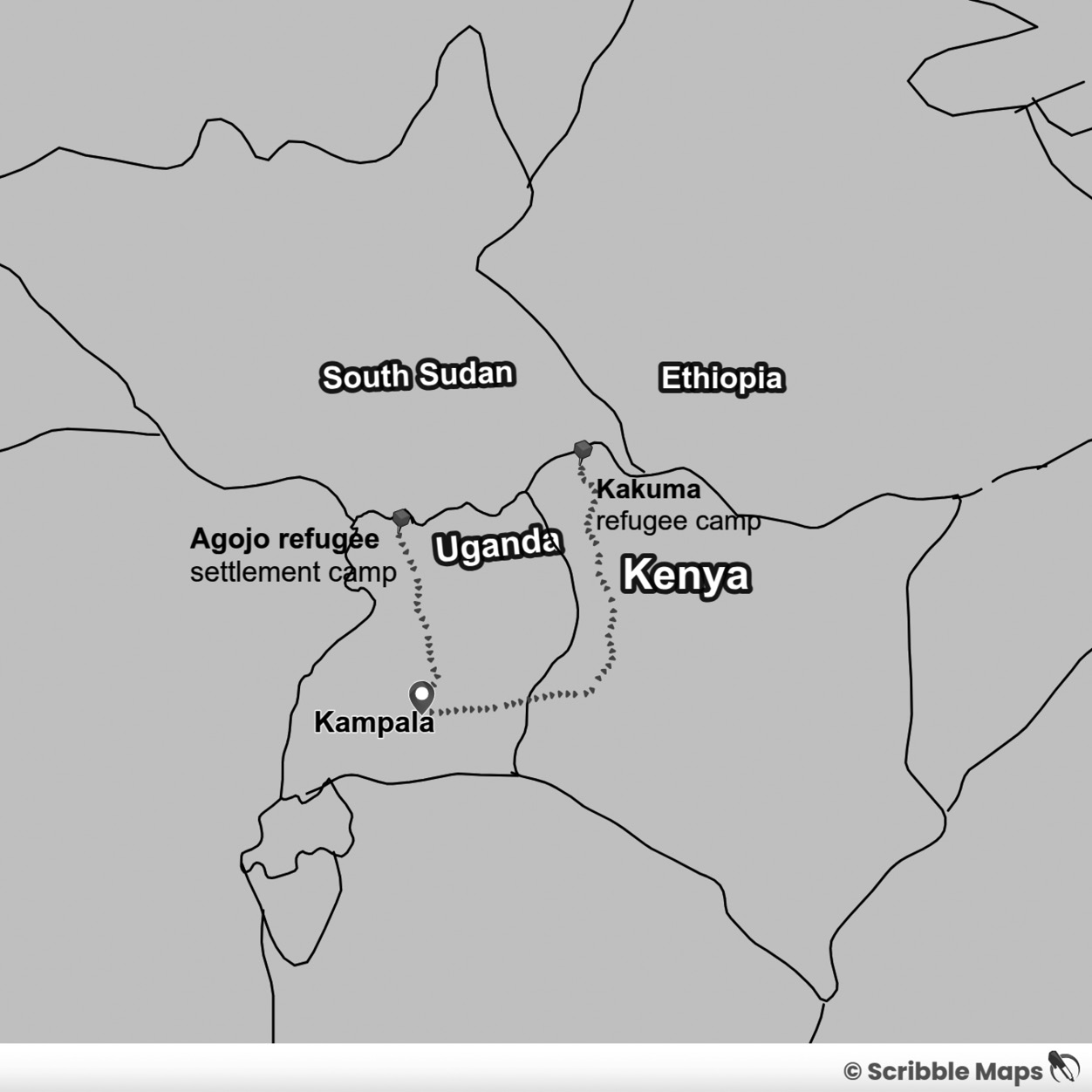
Google map showing the routes I travelled from Agojo refugee camp to Kampala and to Kakuma refugee settlement camp in Kenya
Making it to Kakuma refugee camp
Upon arrival at the Kakuma refugee camp, I experienced a mix of emotions, including relief and anxiety. I didn’t intend to stop in Kakuma, but I was fortunate enough to encounter someone from our village in the then Sudan who recognised me and informed me that my paternal uncle, along with his family, was also at the camp. I was overjoyed to hear this news and felt a sense of relief when they took me to my uncle’s house. We had a heartwarming conversation about my plans to continue my journey to the Nuba Mountains. Although my uncle seemed hesitant, I could sense his love and concern for me. Instead of discouraging me outright, he advised me to wait for a few days while he inquired about the process of booking United Nations flights.
My uncle invited community elders to his home to discuss my journey. I was initially hesitant to share my plans, but I listened respectfully as they advised me on my education and future. I explained what had happened with my education and my aspirations to teach in the Nuba Mountains so that I could earn money to help me complete my A-Level. The elders recognised my good grades and informed me about opportunities available through the WUSC SRP, which could allow me to go from the Kakuma refugee camp to study overseas. They helped me register as a refugee at the camp, and I felt grateful to have a supportive community after such a disappointing time, and difficult journey. I ended up living in the Kakuma refugee camp, in far northwestern Kenya, because of the available opportunity at the time, which was the possibility of continuing further education.
Kakuma refugee camp was established in 1992 to host the fleeing unaccompanied minors from Sudan, commonly known as the “Lost Boys”. It is located about 800 kilometres from Nairobi, and 100 kilometres from the Kenya-South Sudan border. The area experienced limited rainfall, frequent droughts, and dust storms, and was hot and dry throughout the year. The average daytime temperature was about 40 degrees Celsius (104 Fahrenheit), making Kakuma refugee camp experience extremely scorching heat during the day. Additionally, due to its desert and hot climate, the region was home to a significant number of scorpions and poisonous snakes, causing several hospitalisations and deaths.
Although initially established to host the “Lost Boys”, Kakuma refugee camp eventually became one of the largest refugee camps in the world, with over 160,000 refugees from different countries, including Sudan, Somalia, Ethiopia, Burundi, the Democratic Republic of Congo, Eritrea, Rwanda, and Uganda. Refugees were provided with tents and iron sheets to make shelters. There was no electricity or running water. People drank water from wells pumped by the United Nations to communal tap points in the refugee camp. There were numerous cases of cholera, malaria, and fluoride poisoning due to the high levels of fluoride in the well water. Additionally, there were other contributing factors, such as malnutrition, inadequate food, poor sanitation, overcrowding, and insufficient healthcare services. Moreover, in the Kakuma refugee camp, refugees did not have the freedom to move freely outside the camps. To travel outside the camp, they needed to obtain travel documents from the United Nations High Commissioner for Refugees and the Kenyan government.
We depended on food rations every month. At those food distributions, people would line up on a caged ramp used to load cattle onto a truck. The line was often crowded and hot, and people felt uncomfortable and stressed. In those conditions, people would normally wait for a long time without access to water or bathroom facilities. The experience was stressful and dehumanising, to say the least, as people were often treated like objects rather than individuals. Despite these challenges, people lined up for food as they had no other choice but to make basic ends meet.
Unlike in Uganda, where food rations were distributed in open compounds through a roll call, in Kakuma refugee camp, we had to go through an arduous process of punching the ration cards to receive our daily food supplies. The foods were distributed in a gallon, which was equivalent to about 5 kilograms by weight. The food rations we received were mostly dried corn for meals and lentils or beans. On a few rare occasions, we were fortunate enough to receive 500 ml of oil to cook our food.
During my first year at the Kakuma refugee camp in 2001, I would have been around 20 years old, I applied to become a primary school teacher at the World Food Program (WFP), which provided basic education in the camp. I worked as a teacher for middle school students, teaching maths and science to seventh and eighth graders. I was paid 3,000 Kenyan Shillings (about $35 AUD in 2024 exchange rate) a month. I also took some courses over the weekends with the United Nations to become a “Peace Facilitator”. After completing the United Nations Peace Building Course, I became a “Peace Facilitator”. In the two years I was in Kakuma, I worked as a schoolteacher during the day and attended advanced English course training provided by the Windle Charitable Trust – a branch of the Hugh Pilkington Charitable Trust in Uganda – in the evening. On weekends, I worked as a Peace Facilitator and attended computer courses delivered by Don Bosco Catholic priests. I was paid 3,000 Kenyan shillings (about AUD $34) monthly form my Peace Facilitator role, which I used to buy food to supplement my living in the Kakuma refugee camp.
As a Peace Facilitator, my role involved providing community education and workshops on the importance of harmony, tolerance, and peaceful coexistence with different communities. At the time, Kakuma refugee camp experienced frequent interethnic communal fighting. Some of the interethnic fighting was because of competition over who controlled the limited resources such as water and food. However, some of the conflicts could also be attributed to other underlying factors in which people find themselves, including, but not limited to, high unemployment, a feeling of hopelessness, disillusionment and helplessness, and the impacts of conflicts on psychological and mental well-being. I became more interested in furthering my education to make a meaningful contribution to the community, given my O-Level education was inadequate for impactful outcomes. I started saving some of the money I earned to return to do A-Level in Uganda. Before I could save enough money to return to complete A-Level, an opportunity to apply for WUSC has become available in Kakuma refugee camp. This passion for education provided me the opportunity to escape the difficult situations in the refugee camp to take charge of my own life destiny.
Applying for the World University Service Canada Student Refugee Program
The following year, in 2002, I applied for the WUSC SRP through the Windle Charitable Trust. This programwas an once-in-a-lifetime opportunity for many refugee students in the Kakuma refugee camps, as it provided a pathway to higher education. Like the refugee camps in Uganda, no scholarships were available for refugee students in Kakuma refugee camps for higher education study. More than 500 people applied for the WUSC program in my year. The selection process was perhaps the most transparent I have ever seen, given my experience in Uganda. All 500 students were screened based on several written English tests. Each time, the bottom 25 per cent of applicants with the lowest grades were eliminated. This process continued until only 47 of us were left. This screening process took about nine months (March–November 2002). We were then subjected to oral interviews that involved immigration officers and a WUSC officer from Canada. Only 25 of us were selected for the WUSC program that year. This was the proudest moment of my life as I knew I would have the opportunity to continue my education and have a shot at life. The WUSC selection process taught me the importance of hard work, perseverance, and never giving up on my dreams.
The Windle Charitable Trust was instrumental in helping us prepare for the Test of English as a Foreign Language (TOEFL) after the WUSC screening process. After six months of rigorous preparation, I was thrilled to learn that I had passed the TOEFL and was admitted to the prestigious University of Toronto to study Bachelor of Life Sciences. While I was still in Kakuma, I received a package from the university, which contained valuable information about Victoria College at the University of Toronto, and the people in the group who would support me when I arrived in Canada. I was overjoyed and couldn’t believe that my dream of pursuing higher education was finally becoming a reality. I felt a sense of awe knowing that I would be studying at such a prestigious institution, and I was grateful for the opportunity to learn and grow. Around the same time, my uncle and his family received a humanitarian visa to migrate to Australia. I was included in my uncle’s visa, but I chose not to go to Australia. Instead, I decided to pursue my university education in Canada.
Goodbye Kakuma, hello Canada
As I prepared to leave the refugee camp and embark on this new chapter of my life, I felt a mix of tensions. I knew the journey ahead would be challenging, but I was determined to make the most of this opportunity and to honour the silent wisdom of my grandmother, who was deceased in the refugee camp in Uganda. I could sense her wise words, and the wisdom of many other people who helped me along the way, urging me to embrace the opportunity. Life as a refugee student in Canada would not be easy, but it was clearly a life-changing experience. It offered a chance to break the cycle of dependence on international food rations for survival. Most importantly, I had the opportunity to take charge of my education without relying on others, so I could become someone useful to society.
I cannot express how grateful I am to have had the chance to take charge of my own education. It was an experience that filled me with a sense of independence and self-reliance that I had never felt before. I remember how scared I was when I first started this journey, but the possibility of making a difference in my life and those around me kept me going. I knew I would have to put in a lot of hard work and dedication, but it would all be worth it in the end. Now, I am proud of the person I have become, and the contribution I make to society.