by Jorik Mol
Oh hi there! Please make yourself comfortable, as I welcome you back to the 1930s. It’s like they never left. Get out the bryll cream and put on your dancing shoes, let’s lindy hop.
If you don’t know me, I’m Jorik Mol, I’m an autistic writer, activist and educator. I recently published Breaking the Boundaries with Lived Places Publishing.
Breaking the Boundaries is about lived-experience mentorship. I am an autistic mentor for autistic university students in various parts of the UK. The value of mentors’ lived experience in our capacity to support our students. That’s because I’ve been there, done that, bought the t-shirt. I know what it’s like to be a student, I know what it’s like to drop out of uni – I did so three times before finally getting a first-class degree.
Since I started writing this book in 2023, the world has gotten tenably worse, hasn’t it? America is not a free country anymore, climate collapse is accelerating, fascism has free rein, genocide is happening before our eyes and there seems to be nothing anyone can do about it, apart from make things even worse. I’ve got news for you. As a disabled person, all I can say is ‘welcome to my world’.
And yes, I am disabled. If I, as an autistic person, am distinct from neurotypicals in any way, it’s through my divergent neurology. My body works in a distinct way from that of the average human being (I hope you don’t mind calling you “average,” you’re very special in your own way), that’s what must have explained all the bullying, the exclusion, the hypersensitivities to clothing, sound and light; the hyperfocus and the physical discomforts.
Autistic, disabled, or ‘not-even-people’?
Alright, no more sarcasm (despite the many voices who deem us incapable of humour – okay, okay, I’ll let it go). For me, this is what it’s like to be autistic: to be autistic is to be stuck in a set of narratives about us, which seek to explain the empty sensation those who aren’t us feel when attempting to interact with us. You’ll notice that I didn’t mention anything to do with my divergent brain, body or sensory system. Instead, I’m looking at autism’s social construction. The key here is empathy, a concept as constructed as it is powerful (very, on both counts). The consequences of which disable us from engaging with the world as a human being: in short, the social model of disability.
Following Damian Milton’s Double Empathy Problem, as evidenced by Noah Sasson and his colleagues (Neurotypical Peers are Less Willing to Interact with Those with Autism based on Thin Slice Judgments), the autistic community is highly empathetic with one another, unless it’s beaten out of us. That empathy is intuitive, self-evident and felt deeply. We are less intuitively empathetic with our non-autistic peers, but we are still cognisant of their emotional state – I would argue that we have to be, if only to keep ourselves safe. Non-autistics have relatively okay empathy with one another. That empathy, too, is intuitive and self-evident. With us, they have none, or very little at all.
In my forthcoming book Feeling Fast and Slow, I coin the term ‘neurochauvinism’ which, to me, is the construction of narratives to answer what non-autistics (who I will call ‘neurotypicals’ for ease of use) experience when they engage with us. Empathy, if it is anything, is an immediate recognition of another as human. This does not include dehumanisation, when, as the word says, the human characteristics have to be stripped from the observed, which is justified by cultural teachings about less valuable people – see the way race was constructed in 17th century America for the purposes of upholding economies undergirded by slavery (see The 1619 Project).
Apathy, Hatred or Neurochauvinism?
No, we aren’t even recognised as human in the first place – no need to dehumanise. Instead, when neurotypicals engage with us, they are baffled, frustrated and disturbed. Our tenuous positions as autistics in education, the workplace and general society is always based on the goodwill of those who just can’t ‘get‘ us. We are always one step away from that exclusion that I spoke about earlier. When we wish to exist in the world, we are not feared because we’re autistic – ‘autistophobia’ as a term doesn’t work, for that reason. Discrimination doesn’t begin at disclosure. It doesn’t matter how well we do at pretending to be normal, or how much we internalise our systems of self-preservation. Nothing we can actually do will bridge that gap of understanding, a gap which doesn’t exist within us. This is why job interviews are excellent at excluding autistic people, whether or not we disclose. It explains why we have more negative experiences with general healthcare provision and some avoid it where they can. To me, neurochauvinism explains how autistic people are excluded from normal life, because of the uncanny effect we have on neurotypicals and the various post-hoc rationalisations they then produce to justify our exclusion.
Neurochauvinism is, in a few words, the idea that there’s only one way to have a brain, and it’s not ours. The rest is stories, told about characters that are supposed to represent us, about the underside of what it is to be human (read: neurotypical) and the ever-increasing strictures of who is allowed to be considered human at all. Rather than a simple recognition of the humanity of another, empathy becomes a yardstick by which humanity is measured, while our supposed lack of empathy is taken as a given. That’s the ‘ghost’. Built into the very terms by which we must define ourselves, we, as autistic people, have to live with this ghost. If we need mental healthcare, we need to wrestle the ghost of the unfeeling, unempathetic autistic person in their heads. That “person” is usually male, and nearly always white. This is why autistic women are usually misdiagnosed with Borderline/Emotionally Unstable Personality Disorder, and autistic people of colour with Antisocial Personality Disorder or even schizophrenia and are institutionalised as a result. Autistic Black men are at the mercy of the police, just because someone felt they “didn’t look right”, which is what happened to Elijah McClain in Colorado in 2019. I’ve had public meltdowns in London. The reason I am alive right now is that I’m white.
The Empathy Myth and The Limits of Neuroscience
In order to qualify for a diagnosis of autism, we have to play up the characteristics of this ghost. My husband, a white autistic man, had to pretend to be totally unempathetic to get an autism diagnosis when he was in his teens. This is the duality of being autistic: our living world is impelled by the gorgeous, terrifying muchness of everything (which I in my new book Feeling Fast and Slow refer to as ‘the autistic sublime’, after Edmund Burke) – but to find community, we have to live up to someone else’s lie.
The ‘lack-of-empathy’ blood libel is a serious one that we have to wrestle with every day, but it’s got a distinct history, one that became increasingly important throughout the late 19th and early 20th century, mostly in the German-speaking world. ‘Autism’, as a term, comes from Eugen Bleuler (great name) in 1907, who sought to explain certain ‘states’ of schizophrenia, including a very inward, closed-off apathetic-seeming state. However, this needs historicising. Schizophrenia, since about the 1950s, has referred to pathological states of mind surrounding hallucinations and delusions. Schizophrenia is now mostly treatable, though its true cause cannot be clearly explained.
When it comes to mental health disorders, nothing can be, not really. Despite neurobros in the 2000s and early 2010s (I was one of them), believing that neuroscience could explain what feelings and thoughts actually were, it really can’t. At most, neuroscience can tell you where something happens, but not what that thing is, how it happens and why things occur – let alone reliably. Neuroscientists aren’t even able to show where any brain activity should happen. Breathing happens in the lungs, rather than from the armpits or the skin, say. We’re not spiders or axolotls, after all. The notion of brain plasticity complicates this even further, making even the question where seem tenuous. This to say that psychiatry is not the hard science it desperately wants to be – it lacks the fundamental evidence base. Just to be clear: I am not against psychiatry. I believe that depression, anxiety, trauma and schizophrenia will still occur under my preferred form of nude gay communism and that preventing those suffering from treatment on ideological grounds is cruel.
Schizophrenia before the 1950s was not so much about hallucinations. Rather, it was a bit of a diagnostic bin. I mean that sincerely. It was a way for psychiatrists to shrug their shoulders, call the patient’s suffering ‘more of a you-problem’, as it were, and move on with their reputations intact. Schizophrenia was, in the first half of the 20th century, a way for diagnosticians to say “idk lol” and move on. I’m being fatuous of course, but that’s my way of dealing with the very real damage done by institutional mental health “care” throughout the centuries.
That bin is now personality disorders. BPD/EUPD and ASPD are ways that a diagnostician can say that the other person seems to be, like, bad? And that is due to a failing of their personality. Inherently who they are is diseased. That’s serious enough to make me question the notion of personality in the first place: how do we define a personality in ways that are just inherently bad and, since these people are ideopathically unwell, incurable? I have never met anyone with a so-called personality disorder (especially cluster B) who wasn’t autistic, traumatised or, pretty much always; both.
It’s funny, therefore, that here in the UK, an autism diagnosis takes on average about 8 years from referral to assessment and a Takeshi’s Castle of hoops to jump through. Meanwhile you can get diagnosed with BPD or bipolar disorder over the phone. I wish I was joking, but this was offered to me.
I don’t know why autism diagnosis is so policed and politicised, either. It’s not like we get free shit. Our employment numbers are somewhere in the low 20% (the worst for any disabled group in the UK) and our suicide levels are so high that our life expectancy at birth ranges from 57 to as low as 38 (I’m autistic. I just turned 36 — the average age when people like me die. | Vox).
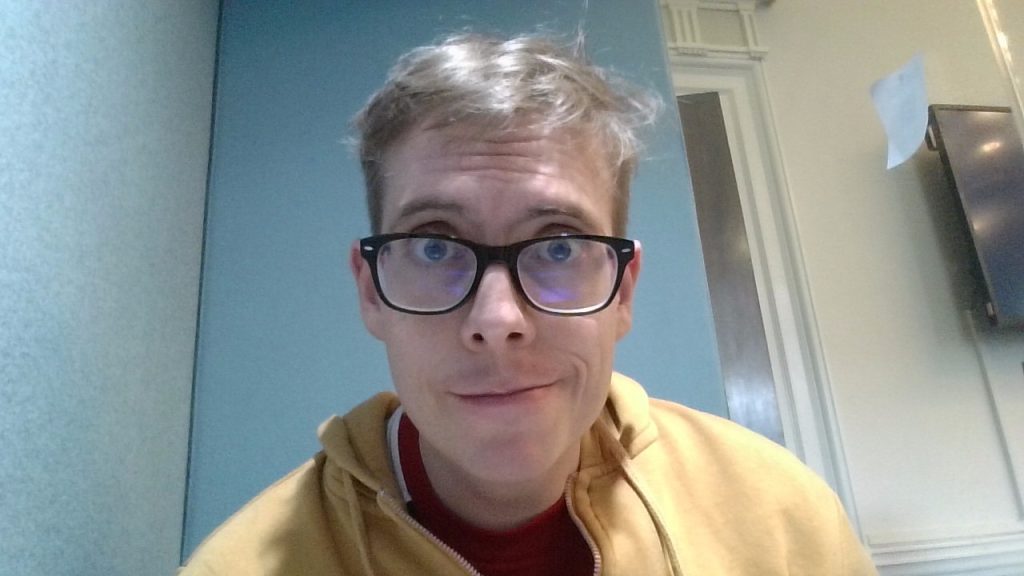
I’m turning 38 this year. I’m an elder of my community.
I know, I don’t look it.
The Legal System as a Tool of Exclusion
This is not about co-occuring learning disabilities either. Autistics with co-occuring learning disabilities are excluded from general learning disabled groups. I know – when I worked in the UK’s National Health Service, the groups I visited were the least autistic group of people I’d ever encountered. Moreover, they are also excluded from the one or two support systems available for autistic people. Of course, the amount of support groups for neurotypical parents of autistic children vastly outnumber any for us. Despite recent moves in the right direction, the UK’s National Autistic Society was set up to be, and remains, a charity by and for those parents.
In 2021, the UK Supreme Court ruled on a case brought by an autistic man with learning disabilities about his right to sex. Could he, as a learning disabled autistic person, legally have sex with people? The High Court said yes, the Supreme Court said no (A Local Authority (Respondent) v JB (by his Litigation Friend, the Official Solicitor) (AP) (Appellant) – UK Supreme Court). Why? Not because his learning disability somehow prevented him from being intimate with another person, but because his autism, specifically, meant he was pathologically incapable of understanding body language and consent. However, somehow, he was completely capable of understanding his own boundaries.
In 2025, the UK Supreme Court has been ruling against queer and trans people’s rights as well and there is finally some pushback from others in my community against them. I’m here, looking like Willy Wonka leaning on his folded arm with a vibe of: ‘good to see you! Where’ve you been?’
I see the suicide rates in our community not as something inherent in us, but a logical consequence of how we are expected to exist in a society that never sees us as part of it, can’t quite understand why it doesn’t, and then blames us for all of that. It’s an imposed social death, for the kind-of-person whose crime was to make neurotypicals feel uncomfortable.
Autism, like schizophrenia in the first half of the 20th century, like personality disorders, is not a reflection of any truths about the reality of our lived experience. Instead, it is built on a set of stories that have very little to do with our actual lived experiences. Instead, we are made to fit existing character tropes. A certain ‘vibe’, a deep fear within the majority neurotype of who they could be, if they were not themselves as human as they fervently believe they are.
That story, of the changeling child, of an inhuman interloper that looks and sounds and talks like a human, but isn’t quite, is a very old one. Autism shows that psychiatry, rather than seeking to cure existing illnesses of the body, is usually more concerned with policing otherness and reaffirming the kinds-of-person that are already dominant. Still, it too often functions as an enforcer, to stop certain kinds-of-person from existing, attempting to codify cultural stereotypes of what it is to be a person into systems, so as to dole out punishment to those it considers non-human for whatever reason. I was born in 1987 and diagnosed with autism in 1996. In Japan, the postwar constitution, which was co-written by American military and diplomatic staff, included a eugenics clause until 1997. This clause justified the involuntary sterilisation of disabled people (Japan sterilisation law victims included nine-year-olds – BBC News). I don’t want to ever have children, but it’s always nice to have a choice. As the late, great Steve Silberman wrote in 2018, the age of crimes against humanity has never ended for disabled people. We’re in hell, and we have been for ages.
Eugenics for the 21st Century
I’ve been dancing around the term ‘eugenics’ for a while now, let’s get into it.
Eugenics was everywhere between the mid-18th century and the 1950s. The intention to improve human breeding and breed “out” criminality and disease was undeniably scientific mainstream. In the mid-1940s it somehow started becoming less popular. For the purpose of the algorithm, I shall not speculate why.
For the length of the post-war history of western society, eugenics has been the madwoman in the attic of disability. Or, rather, the elephant in the room. Or, the emperor with no clothes, and not in the sexy gay communism way that I like. Instead, what we’re facing is a world where the perception of who gets to be classified as human is outside of our control. Eugenics is present in society across the board. From tax policies, to child benefits, to health insurance provision, to education. All social inequalities underwrite the choices made in the allocation of resources to specific groups of people. By that allocation, certain people are deemed more deserving than others, whether or not anyone states that explicitly. Certain people are chosen, based on who they are, to be allowed to exist as a full human. Others are cut out of that capacity based on who they are.
We all know about Maslow’s hierarchy of needs: the basics of life that are required for a human being to exist in a vaguely healthy and ethical way. Politics derives from disagreements about who is responsible for allocating needed resources to others, and who it is that pays for them. Of course, most people are prevented from accessing the basics of life, due to the inequalities built into the societal systems we are born into. Gender, race and sexuality are systems created for the unequal distribution of power and wealth, based on certain presumed characteristics the already-dominant social group has about those others. These presumed characteristics are upheld by culture: racist portrayals of people of colour are necessary to teach and uphold the assumed rightness of racial segregation. Women are presumed to be less capable than men, a presumption which is only ever argued post hoc: the assumption is that women just are lesser-than and sexism works by arguing from a position of having already figured that out and intending to point out the “obvious.” Sexuality and gender identity are defined by certain acts perpetrated by a certain kind-of-person, who acts in ways that do not adhere to their assigned gender identity or otherwise fall outside of the norm of normative (read: binary) gender presentation. Disability works slightly differently. Normative disability discourse assumes that one is a normal kind-of-person, tragically incapable of accessing their full humanity due to a problem with our bodies. This assumes the world is created in ways that already meet the needs of everyone, apart from outliers, who cannot be accommodated without going above and beyond what’s reasonable for anyone who isn’t disabled.
Autism works slightly differently, as I said before. The difference here is intuition. Black, Asian and otherwise non-white people in a white society are still intuitively recognised as people by whites. Dehumanisation presupposes changes through time, even if that is a very short amount of time. We’re talking milliseconds here. First a person-shaped object is recognised as human (humanised), then certain characteristics of that person-shaped object cause that recognition to be changed. Despite what many Afro-pessimists say, anti-Blackness is learned behaviour. Why else do whites need cultural products and political figures reminding us about how evil “they” supposedly are? When you see a racist rally, you’re seeing political education in progress, just not the education we would want.
Women are also intuitively recognised as people, so are queer people. But misogyny has a very particular material and cultural history that has stripped women’s labour of its financial value (for more, read Silvia Federici’s Caliban and the Witch (2004)). Being a woman, and being thought of as a woman in current patriarchy are two very distinct things, and have nothing at all to do with biological imperatives. Queer people, like I said, don’t “become” queer in the eyes of cishet patriarchy until we act in certain ways that qualify us as such. And I don’t mean gay sex or transitioning – others signified me as queer far before I could comprehend the concept. You can be a queer 5 year-old. Just look at any picture of me as a child: there’s, in the words of queer poet Leo Herrera: “that unmistakable softness.” Something about me, in the way I presented myself, broke the rules. I performed my masculinity wrong. A gay child is recognised as human, until he breaks the rules and is dehumanised.
The manufactured and astroturfed backlash against the existence of trans+ people shows the slippage between anti-queer dehumanisation, that hates trans people for daring to challenge institutional gender norms; and a disabling intent to stop trans+ people from accessing medical and administrative changes that allow them to live with a semblance of dignity. Race and misogyny complicate the existence of trans+ existence even further, all of which actually trans+ writers are better than I at unpacking.
Necro-capitalism and Disabled Bodies as Fuel
For autistics, that initial recognition as human never happens, which Noah Sasson’s research shows in painful black-and-white. As autistic people we are as distinct as the planets in the universe, but it isn’t our behaviour that shows us up – all so-called autistic behaviour is commonplace for neurotypicals, especially when they’re under stress. ABA doesn’t “work”, because it’s torture, and because it’s impossible for masking to override another’s lacking intuitive recognition of us as human. It’s not how we look either – there is no “look” to autism. There is no genetic component either: 50+ years and billions of dollars wasted on genetic research to facilitate trait-selective abortions that would otherwise have made their discoverers rich. Look at Andrew Wakefield’s fraud for an example if you need it.
In the United States, the main way of accessing healthcare for autistic people is through ABA provision. Both a brand-name of and precursor to modern conversion therapy, ABA seeks to use operant conditioning, punishments and rewards, against autistic adults and children. For ABA, and its originator Ole Ivar Lovaas, the intent is to change behaviour in autistic children, by force if necessary, which will make them “indistinguishable from their peers.” As we’ve seen, that won’t work. It’s not supposed to. It’s torture. It also creates a circular economy, a self-feeding monstrosity where torture breeds trauma, which can only be treated with more torture, extracting value from the autistic person, until their death means the ABA provider has to move on to someone else. It’s funny, in a mordant, kinda stinky way, that ABA and its derivations PBS, Teamteach, TEACCH and even CBT are now the norm for engaging not just with autistic people but all forms of mental ill health. The reason is simple: mental healthcare is expensive and treatment doesn’t always work, for reasons nobody understands thus far. Therefore, a system that only allows the study and modification of behaviour, rather than an empathetic approach, especially to those mainstream society deems as pathologically unempathetic, is itself deeply, structurally eugenicist. We are the problem, and we are to blame for that. Mainstream therapeutic approaches to autism are a self-perpetuating pyramid scheme where constant value is extracted.
But there’s more. Of course, by definition capitalism exploits human bodies for their energy or life-force, which Foucault called biopolitics. When certain populations are prevented from accessing the workforce, due to disability, living in apartheid states, value isn’t extracted from our labour anymore, but, in John Duncan’s reading of Achille Mbembé, from our deaths. This is necropolitics. ABA and its variants are the best example I can find of necropolitics taking place in plain sight, from the far right to the left. Autism Speaks, a for-profit organisation representing the interests of these conversion therapists, now collaborates with US public broadcasting to shill torture using an autistic muppet, originally cocreated with actually autistic activists (Sesame Street autism controversy: Julia is a great character, but the show must end its partnership with Autism Speaks). After the killing of United Health’s CEO in December last year, Democracy Now even ran a segment – with ProPublica – about how UH was preventing “treatment for thousands of children with autism” – okay that sounds bad, how? By not allowing newly qualified ABA-providers to be covered by United Health. Seriously? Yes (Denied: ProPublica Exposes UnitedHealth Profiteering Off Limiting Care for Children with Autism | Democracy Now!). And this is Democracy Now, on the far left of US news coverage. As of August 2025, neither Democracy Now nor ProPublica have responded to my emails and messages.
ABA-providers are making money hand-over-fist, and the reason they can do so is neurochauvinism. Because “the autism” renders us subhuman, and ABA’s attempts to machete it off always fail, the outcome is always: ‘do it more!’ So they do. Like dairy cows, autistic adults and children are treated as disposable once our value is extracted. This is because of that lack of intuitive recognition of our humanity. Our bodies are mined for other people’s profit, nearly always with the best of intentions and out of love. It’s heartbreaking to see a parent of an autistic child genuinely believe the torture they pay to have others inflict on their child is the only “evidence-based” form of support they can give them. And that’s from people who even believe that autistic people have at least some right to exist.
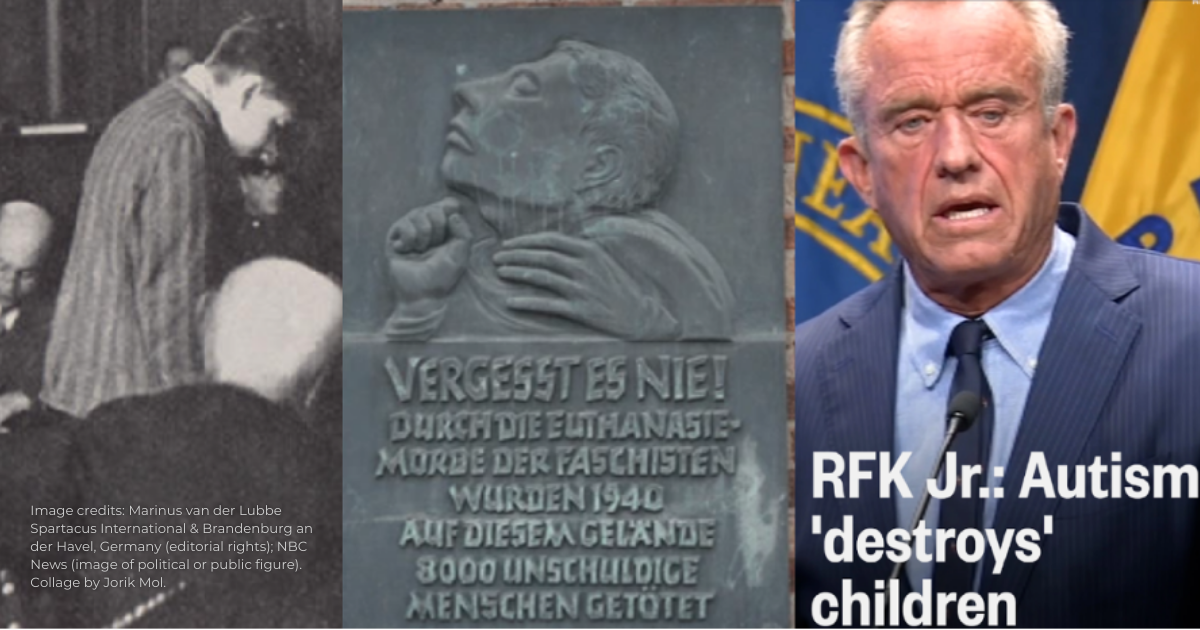
If that is the US left on autism, the US right is showing its true colours. Health secretary Robert F. Kennedy Jr. is a well-known eugenicist who has spoken about his desire to end the “epidemic” of autism. It doesn’t matter that he’s anti-scientific, or that he’s been bought and sold by ABA providers, or the Christian right. What matters for our purposes is that Kennedy is indicative of the unsaid now finally being said openly again, for the first time since the 1930s, when posters about people like us papered the streets of German cities, films in the cinema and advertisements in magazines said: “Erbkranke […] dass ist auch Ihr Geld!” arguing that the lives of people with inherited diseases and disabilities shouldn’t be paid by working German citizens. This was part of the so-called T4 programme, instituted in fascist Germany of the 1930s. T4 stands for a street address, number 4 Tiergartenstrasse, bordering the Tiergarten park in the centre of Berlin. You can go there if you’re ever in Berlin and you should. I went in 2018. The original house where the programme was hatched was destroyed, the Berlin Philharmonic lives there now, with a memento to what had been done in the name of national health and human progress. Instituted not long after the Reichstagfire in 1933, the T4-programme sought to first sterilise, then slowly kill undesirable disabled populations in Germany and later in Nazi-led Europe too. I think it’s deeply ironic that the arsonist, Dutch leftist Marinus van der Lubbe, was evidently autistic. I know, I’ve written a novel with him at its centre, hit me up if you’re interested.
Living with Eugenics
As a society, we haven’t moved a bit when it comes to eugenics, despite the much-publicised horrors of the 20th century. All that’s happened is that what used to be unsaid, now wins votes. Autism, as a concept, was born at the height of the eugenics movement, too. While we as a community have always existed, our pathologisation was a response to a contemporary societal need to either remove us from society, cure us, kill us or a combination of all three. Looking at the strength of the backlash at the feeble progress we have made over the past 80 years, we’ve got our work cut out for us. As long as humans continue to exist (arguably, as long as complex animal minds continue to exist) autistics will be around, whatever we choose to call ourselves. As a kind-of-person, we are created in conflict with those who aren’t willing or able to recognise us as human. Until something fundamentally changes about what does and doesn’t make a ‘person’, a lot more people are going to suffer the consequences of the backlash we’re facing right now.
The views presented in this post are based on the author’s perspective and experiences. The views and perspectives of the author are not necessarily those of the publisher. Our role as a publisher is to ensure many and varied voices are heard openly and unfiltered and that diverse life experiences find expression in our books, blog posts, and other media. We support our authors fiercely, but we do not always share their opinions or perspectives.
About the Author:
Jorik Mol (he/they) is an actually autistic writer, activist and educator who lives in Bath, UK. Jorik’s first book with Lived Places Publishing, about his practice as a lived-experience mentor, is Breaking the Boundaries.
Find out more about his work at: https://www.jorikmol.com.
How can we break the systems excluding autistic people from higher education?
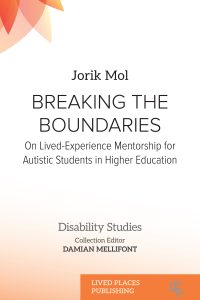
Universities and colleges are built on systems that by nature exclude autistic students, since they’re built on neurotypical foundations. As one of the few actually autistic higher education mentors for autistic students in the U.K., Jorik Mol seeks to improve autistic students’ lives by validating their experience and challenging universities to listen to them.
Drawing from his own lived experience, and building on case studies, working alongside his mentees, Breaking the Boundaries: On Lived-Experience Mentorship for Autistic Students in Higher Education offers guidance on how to best support students, emphasising the need to normalise radical empathy, values-driven motivation and self-advocacy.
Exploring topics including community, boundaries, and burn-out, while pushing hard against the status quo, this book is ideal reading for students of Education, Disability Studies, Sociology, Psychology, and Queer and LGBTQ+ Studies, as well as education practitioners and policymakers.
We want our books to be available to as many people as possible. If you’d like to purchase an individual copy, please email us and we’ll give you a discount code:
IMAGE CREDIT (HEADER): 1) Marinus van der Lubbe Spartacus International (no copyright); 2) Shutterstock Asset ID: 2418114905, Brandenburg an der Havel, Germany – September 21, 2021: Commemorative plaque at the Memorial to the Victims of Euthanasia Murders in Brandenburg an der Havel (editorial use accepted); 3) NBC News (image of political or public figure).
IMAGE CREDIT (HEADSHOT): Jorik Mol, May 2025