When the Pilgrims arrived on Turtle Island, imagine their culture that subjugated women practiced right alongside Indigenous societies in the East that were (and still are) matrilineal and structured on gender complementarity based in respectful co-leadership by women and men. As Onondaga Elder Jean Shenandoah writes “…when we met these white women so long ago, I am sure that our women were probably shocked at the lack of human equality that these other women had to live under…[and] couldn’t understand how not only women, but women and children, were living under this totally oppressive situation.”[i] East of the Mississippi River, from Maine to Florida, Native women not only co-ruled their nations, but did so under the auspices of a divine female creator who recognizes the sanctity of women.
Heresy to the colonists! —and frightening to the power brokers of that era, just as it still is to many groups in the U.S. today.
Indigenous Women Handled Reproductive Issues (and Thomas Jefferson Knew It)
Living in a society that respected everyone’s autonomy within the auspices of community responsibility, to Native American women in the East (and in many nations across the Americas) controlling their biological reproduction was an act of responsibility and common sense. Overpopulation not only placed a strain on resources of food and shelter, but the intellectual, emotional, and psychological needs of children require significant attention from parents and extended family to ensure healthy development. This meant limiting births and spacing them out by several years to ensure children’s needs were fully met. Indigenous peoples knew this 500 years ago without the help of research studies. Thus, in the East as in many Native nations, women had but a few children and used birth control, spacing births through breast feeding, and use of abortifacient plants to bring on menstruation to control reproduction as a way to nurture not only the children they already had, but to sustain their nations and themselves.
Though information about Indigenous women’s controls over their reproductive practices may be surprising news to contemporary non-Native Americans, the American Founders of the United States were well-aware of what was going on in Indian Country in the East in the 1700s. The third American president, Thomas Jefferson, was not only a philosopher and a skilled practitioner of horticulture, but to the astoundingly few historians who write about it, he had a deep curiosity about female reproduction for very obvious reasons. The keys to societal power hinge on it.
With the presence of Indigenous nations flourishing in societies of abundance and gender equality right next door to EuroAmerican neighbors functioning within female subjugation and a brutal class system, the Founders had to clearly differentiate the EuroAmerican colonies from Native peoples to keep their grip on patriarchal power. Women’s leadership had to be cast as fundamentally evil, along with female sexuality and agency over abortion and birth control—not to mention female-initiated marriages and divorce. To even elite colonial women, these practices were out of reach. However, those same elite women knew well of Native women’s agency and respect in their societies and took their lessons in early feminism from the Natives. The late historian Sally Roesch Wagner wrote extensively about the influence of Haudenosaunee (Iroquois) women on the early suffragists, particularly Mathilda Joslyn Gage (1826—1898) who was adopted into the Mohawk nation as a relative.[ii]
European Immigrants Brought Reproductive Oppression
The colonists brought with them primogeniture (names, status and property passed from fathers to sons) and male supremacy, and, to be effective, they both require strict control of female sexuality and reproduction. English Common Law that was instilled in American culture galvanized biblical law into secular law via the writings of Judge Sir William Blackstone (1723—1780). Blackstone wrote that by divine right “a mother has no legal right or authority over her children” and also the legal statute regarding marriage: “The two shall become one and the one is the man.”[iii] Some of the goals from the nation’s founding include ideals specifically related to reproduction, like “commanding men, domestic wives, and grateful, obedient children.”[iv] Free colonial women of European ancestry typically began childbearing every year to eighteen months from their teenaged marriage until they reached menopause, which meant a lifetime of pregnancies and very often an early death because of them. Reproduction in the colonial era was also a means to create child labor[v] to benefit individual working class and poor families. To middle class and wealthy families, having many children was a means for men to demonstrate social status and economic prosperity, along with an expression of their perceived virility. Reproduction from enslaved Indigenous and African families created wealth for EuroAmerican elites.
Female Reproductive Controls Shaped the Founding of America
From abundant historic primary sources, the power of female reproduction was a central issue in the shaping of America. For example, punishments in the colonial era for unwed, free women who became pregnant included not only steep social stigma and ostracism, but also criminal charges. In the 1700s, eight EuroAmerican women were hanged in the state of Pennsylvania for crimes related to “concealment”, i.e. hiding a pregnancy out of wedlock, which alluded to sexually transgressive behavior.[vi] Pregnant, unwed Eurosettler girls and women fled to Indigenous nations for protection from a hostile society and parents. The concept of a human child being “illegitimate” and thus unwanted was appalling to Native people who had no parallel cultural practices. At this time, abortifacient medicines were widely sought and sold on the open market, including in Benjamin Franklin’s newspaper, The Pennsylvania Gazette. At the founding of this country, controlling women and girls went hand-in-hand with the establishment of societal power in American society. Though all Native people were impacted, it was Indigenous women who had the greatest to lose because the European immigrants were stringently anti-female in belief and law.
In the Eastern Woodlands nations, and in many Native nations across Turtle Island, Indigenous women had wide latitude in sexuality and control of their reproduction. The Founders corresponded with one another about this issue that they dubbed the root of barbarous societies, especially calling out French women of their era as an example. Thomas Jefferson wrote “They [Native American women] raise fewer children than we do…it is said, therefore, that they have learnt the practice of procuring abortion by the use of some vegetable; and that it even extends to prevent conception for a considerable time after.”[vii] Working in fields and in government obscured women’s biological reproduction, he surmised, and reproduction is necessary to strengthen nations by increasing the populace (and solidifying males in power). Thus, women had to be kept out of all leadership positions in a society and should be at home, pregnant, and under male rule. If this 18th century perspective sounds like current political rhetoric espoused by some U.S. groups in 2025, you are hearing correctly.
Indigenous Women Fought and Persevered
 Though devastatingly impacted by anti-female policies brought by the settlers, not all, by any means, has been lost for Indigenous women and girls. Coming-of-age ceremonies for Native girls that teach them their responsibility in their nations and how their lives reflect a larger cultural cosmology in which they are a fundamental part remain a pattern across many Indigenous nations in the U.S. and Canada. These ceremonies are a signal with profound messages for Native females about their worth to their people. The settlers saw those cultural signals too, and strategized to disrupt them with ethnic cleansing at the Indian Boarding Schools and with wholesale genocide during the forced sterilization of Native girls and women in the 1970s. But the ceremonies didn’t stop, and the cultural messages from those traditional practices still ring clear and true.
Ensuring this part of American history remains hidden has been an on-going endeavor in the full telling of how the U.S. was shaped in the past around reproductive restrictions, and how that issue is played out in contemporary times. In my forthcoming book Indigenous Women’s Reproductive Traditions, I discuss this history in-depth, along with the sacred stories and coming-of-age rituals of some Native nations that position Native women in widely-varying roles of honor and power. We cannot know who we are as a nation, or why the war against female reproduction is raging as strongly as ever, until we look closely at the culturally-distinct Indigenous nations already in North America, along with the Founders’ philosophies. They remain embedded in the American psyche, and, when looking at the full story of our American history, the presence of Indigenous women’s sovereignty over their own bodies and lives are there as well—still bright as their cultural birthrights.
Today’s U.S. Anti-Female Rhetoric Comes Straight from the 1700s
In the 21st century, we are still battling the legacy of the Founders’ visions when it comes to female reproduction, as birth control and abortion are becoming more restricted and at times outlawed throughout the United States. Many political conversations today analyze the reasons for this resurgence only from a framework of recent politics, not as a pattern in history stemming from the Pilgrims’ arrival and the rise of English Common Law in the 1700s. The historic gaps where Indigenous cultural knowledge should be in K—12 curricula, and in college-level courses, remain alarmingly wide, and that was before measures today at erasure of those histories were enacted. As a type of 18th century tragic parody, contemporary U.S. tradwife culture exemplifies the worst of our American history, as if marrying a man and raising children mandates utter female subjugation. The great irony of the tradwife movement is its blindness to not only the many women leaders today who are wives and mothers, but to the centuries-long history of Native women leaders who were, and still are, wives and mothers while running their nations. Under current trends, Jean Shenandoah’s words about her ancestors’ shock over settler women’s oppression echo ever more strongly into the future, not less.
Indigenous people have been holding the line for their nations for 500 years, and counting, but Native women carry especially heavy burdens and losses because of settler male supremacy. In the most fundamental ways, including agency over reproduction and the right to bear and raise children in a society that respects them, Indigenous women are the exemplars of American liberty and justice for all.
What happens when centuries-old reproductive traditions clash with colonial impositions?
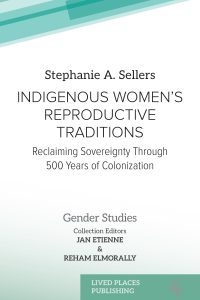 In Indigenous Women’s Reproductive Traditions, Stephanie A. Sellers delves into the rich history of Indigenous women’s reproductive practices before European colonization. The book highlights traditional methods such as birth control, abortion, and child spacing, which were integral to maintaining agency over their bodies. Sellers explores how these practices were disrupted by European patriarchal structures and examines the impact of forced sterilization in the 20th century. Today, Indigenous women are reclaiming their rights through movements for reproductive justice, advocating for a return to their ancestral practices and redefining concepts of womanhood and motherhood on their own tribal terms.
Ideal for courses in Women and Gender Studies, Cultural Anthropology, and Native American Studies, this book offers crucial insights into the intersection of traditional practices and colonial impacts on Indigenous women’s reproductive rights.
We want our books to be available to as many people as possible. If you’d like to purchase an individual copy, please email us and we’ll give you a discount code:
IMAGE CREDITS:
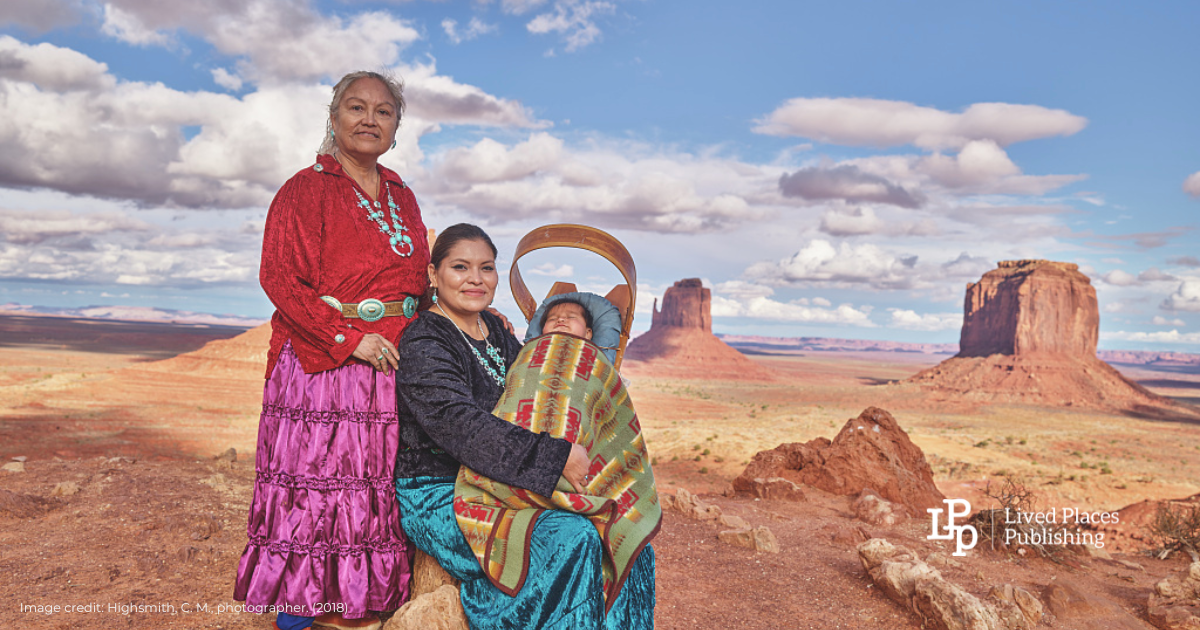
- HEADER: Highsmith, C. M., photographer. (2018) Navajos Loretta Yazzie, Eula M. Atene, and 3-month old boy Leon Clark pose in Monument Valley Navajo Tribal Park, a red-sand desert wonderland on the Arizona-Utah border. United States Arizona Monument Valley, 2018. -10-07. [Photograph] Retrieved from the Library of Congress, https://www.loc.gov/item/2018703311/.
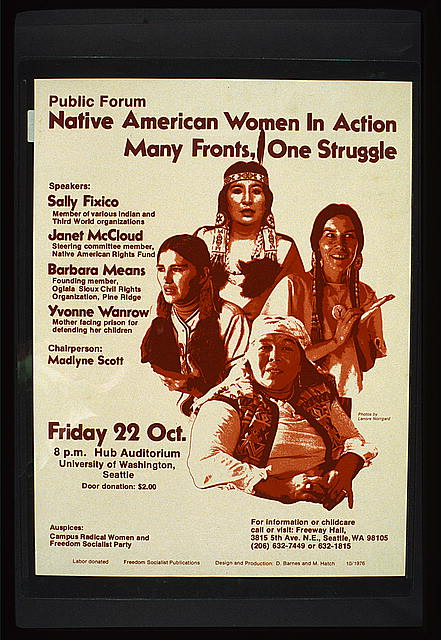
- Public forum Notice: Radical Women, S. & Freedom Socialist Party, U. S., Norrgard, L., photographer. (1976) Public forum: Native American women in action: many fronts, one struggle. Seattle Washington United States Washington State, 1976. [Photograph] Retrieved from the Library of Congress, https://www.loc.gov/item/2016649889/.
- YouTube Video: Jeanne Shenandoah, Onondaga elder, traditional medicine keeper, and home midwife (pictured on right) with the late Sally Roesch Wagner, feminist pioneer and founder of the Mathilda Joslyn Gage Foundation.
REFERENCES:
[i] Wagner, Sisters in Spirit, 10.
[ii] Wagner, Sisters in Spirit, 88.
[iii] Wagner, Sisters in Spirit, 68, 38.
[iv] Ibid, 279.
[v] Ibid, 56.
[vi] Klepp, Revolutionary, 227.
[vii] Jefferson, Notes on the State of Virginia, 186.
The views presented in this post are based on the author’s perspective and experiences. The views and perspectives of the author are not necessarily those of the publisher. Our role as a publisher is to ensure many and varied voices are heard openly and unfiltered and that diverse life experiences find expression in our books, blog posts, and other media. We support our authors fiercely, but we do not always share their opinions or perspectives.