
Approximately one in 20 Americans suffers from severe mental illness. That comes to around 17 million. Multiply that number by three or four to represent each ill person’s closest family members and you begin to get an idea of how many Americans are impacted in life-changing ways by these devastating diseases. Yet for many, mental illness remains the final, unspeakable stain.
I spent much of my early life anticipating and, frankly, dreading the moment when I would assume responsibility for my older sister. But we rarely spoke of it. Although Barb hadn’t been formally diagnosed and wouldn’t be for years, my family realized sometime in her late twenties that she was severely mentally ill. From there, it didn’t take much research to conclude that she suffered from schizophrenia. But my parents were afraid and ashamed, and they didn’t speak openly of it and when she refused their early offers of gentle forms of help, they, already suspicious of the medical and psychiatric establishment, were at a loss for what else to do. So they kept to themselves, kept stiff upper lips, and took care of her at home. She was never treated, never medicated, never hospitalized. My parents were understandably terrified of relinquishing her to the notoriously cruel system that seemed the only recourse of families of the mentally ill in the 1970s. And they didn’t reach out for other kinds of support either. Shame, stigma, and fear kept my parents silent. This went on for over thirty years. I spent decades thinking and worrying about what to do when my turn came.
Then my parents died, first my mother, then, ten years later, my father. Suddenly I was legal guardian to my 63-year-old sister who now lived alone in the crumbling house we’d grown up in, which she refused to leave, even to carry the garbage from the back door to the alley. Nor would she answer the phone or make a call. She had no way of getting groceries and no funds of her own and, even if she had, no inclination to pay the many bills that were piling up. My father had handled all this, and he’d bristled at any suggested changes. Now it was my turn, but without a network of support any change seemed impossible.
My farfetched hope was to get Barb psychiatric help while somehow honoring her wish to stay at home. I’d read about drugs that might alleviate some of her symptoms, symptoms that appeared to torment her and isolate her from even the most rudimentary human interactions. But how to connect her with a psychiatrist and get these drugs prescribed? How to get her to take them? That these things in fact happened still feels like a miracle.
But it’s not a miracle available to most. My sister had a place to stay, an advocate when she couldn’t advocate for herself, and a team of dedicated professionals – social worker Wendy Trafny, psychiatrist Dr. Steven Weinstein, and caregiver Yvonne Flowers – who stepped forward to go beyond and above their conventional duties to help Barb achieve a fuller life. Barb was lucky. People with severe mental illness are among the most marginalized people in America, many of them in prison or otherwise institutionalized and forgotten, others living on the street. All of them deserve care and respect. Shelter, food. It shouldn’t be so difficult to ensure a decent life for these, our neighbors, and it shouldn’t depend on luck.
Creating a Better Future for Those Who Suffer from Severe Mental Illness – and Those Who Care for Them
My book, At Home with Schizophrenia, a revised and updated version of my earlier book, How We Got Barb Back, tells my family’s story, beginning with Barb’s promising early life. Part One takes the reader through the inexplicable changes we observed in Barb, the climate of shame that surrounded mental illness when my sister got ill, and my parents’ fears and hopelessness that resulted in the stasis of their life with Barb over many years. Part Two describes what happened next.
This book is an homage to people everywhere who suffer from severe mental illness, to those who care for and about them, and in particular to those who helped my family. It is also a plea to collectively shuck off the shame, stigma, and silence that surrounds mental illness. It is evidence that help and change are possible.
But much work remains. Families caring for mentally ill loved ones still face terrible choices – medical, financial, and personal. Open discussion, better laws, community mental health care, kinder and more compassionate public policy will all help. Simple respect for our fellow humans is the heart of it. The Netherlands and the UK are light years ahead of the United States in how they handle this particularly human form of illness. Here we valorize independence and individualism, but it’s past time to embrace less selfish values. I have seen that it is possible to reach people who seem to be locked out of the world by this mysterious condition we know as schizophrenia. With a small dose of antipsychotics and the respect and help of many, my sister is living a life my parents could hardly have imagined. It’s still not easy, but it’s possible.
What happens when a loved one lives for decades with untreated schizophrenia, hidden in plain sight within their own home?

What happens when a loved one lives for decades with untreated schizophrenia, hidden in plain sight within their own home?
At Home with Schizophrenia is Margaret Hawkins’ moving account of her sister Barb’s 30-year struggle with undiagnosed severe mental illness, and the extraordinary recovery that began only after their parents’ death.
Hawkins writes with honesty, empathy, and flashes of humor as she explores the secrecy and stigma that silenced her family, the deep love that carried them through, and the dedicated professionals who helped Barb reclaim her life. Her story sheds light on the realities of mental illness while affirming the hope made possible by diagnosis, treatment, and care.
Ideal for students and professionals in social work, psychology, counseling, disability studies, and family studies, as well as families and advocates seeking greater understanding of schizophrenia and recovery.
We want our books to be available to as many people as possible. If you’d like to purchase an individual copy, please email us and we’ll give you a discount code:
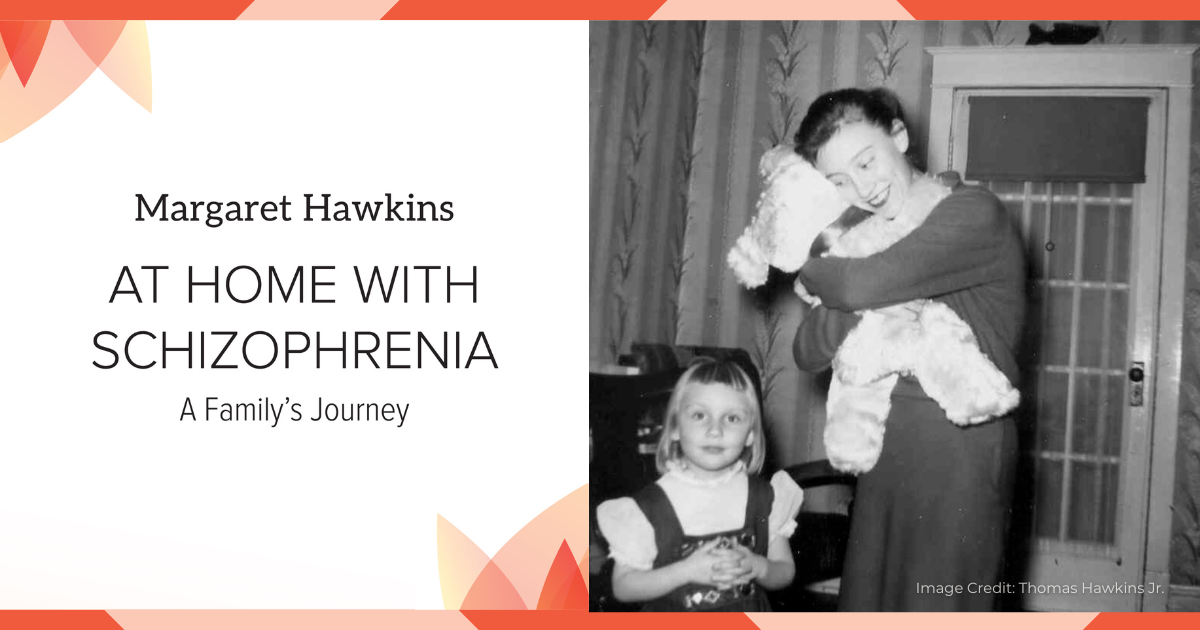
IMAGE CREDIT: “Barb and me, Christmas 1959” by Thomas Hawkins Jr. Used with permission.
The views presented in this post are based on the author’s perspective and experiences. The views and perspectives of the author are not necessarily those of the publisher. Our role as a publisher is to ensure many and varied voices are heard openly and unfiltered and that diverse life experiences find expression in our books, blog posts, and other media. We support our authors fiercely, but we do not always share their opinions or perspectives.