
Book review by Dr. Nicholas Chown
It is an honour to have been invited to review Rachel Winder’s book ‘An Autistic and ADHD Journey’. Great courage must have been required for her to be so honest about the extremely difficult journey she has been on as an AuDHD person. Thankfully, there are neurodivergent people who are willing and able to write about their experiences navigating complex and often difficult lives in this neurotypical world so that the majority population can gain some understanding of what it is like to be neurodivergent or multiply neurodivergent.
A key area of learning for me from reading Winder’s book is to hear from an AuDHD individual what being multiply neurodivergent can be like. Her use of the “two operating systems” metaphor is important. This is not like a “dual boot” computer where only one operating system is in use at any one time, but having a brain ‘in a constant loop of negotiation and renegotiation (the Autism wants routine and the ADHD wants spontaneity) that nobody else can see.’ It can be difficult having one neurodivergent operating system; I cannot begin to imagine how it must be to have two such systems, each seeking to be in control. But, as well as having two competing “operating systems”, Winder is a visual thinker who thinks in pictures. No wonder she felt that writing a book was something that she would never be able to accomplish!
Another key point relates to trauma. Winder points out that ‘if the only observable presentations of Autism and ADHD are entangled with trauma responses, then what has actually been studied may be trauma-expressed neurodivergence’ not autism or ADHD per se. Responses to trauma may be seen as aspects of a neurotype rather than consequences of environments unfriendly to neurodivergence such as those the author has experienced. Winder links this point with the internalised ableism she experienced for many years until she understood that there is a difference between complex neurodivergence and trauma-inducing environments.
There is much other useful content in this book of interest to autistic, ADHD, and AuDHD people and to those in the majority population who want to better understand neurodivergence and multiple neurodivergence. Winder sets out what it was like for her before she learned of her autism and ADHD (her pre-discovery world), what she learned after being diagnosed as AuDHD (her post-discovery world), and what she learned from both worlds. The content has been written in response to a set of learning objectives. A content warning is provided up front.
The pre-discovery years are described as ‘lost years’ during which Winder was denied the opportunity to live an authentic identity. This ‘brought with it a deep period of grief – a mourning for the forty years I spent not living life as me, but as the version of myself that made others comfortable.’ The lost years content is uncomfortable to read; imagine how much more difficult the lost years must have been to live and perhaps, even more so, to relive in memory. But, on the positive side, readers are left with the thought that she has been very fortunate to eventually discover her AuDHD identity as other neurodivergent people have yet to discover theirs.
Dr. Nicholas Chown is a Research Fellow at London South Bank University. He founded the secret Facebook group Autistic Autism Researchers and the Independent Autism Research Group, the latter having developed a framework for participatory and emancipatory autism research and investigated support for autistic university students amongst other topics. His publications include Understanding and Evaluating Autism Theory (author), and Neurodiversity Studies: A New Critical Paradigm (co-editor) as well as numerous articles. He is also an indexer of academic books and in a previous life was an insurance loss adjuster and corporate risk manager in the private and public sectors.
What does it mean to discover later in life an AuDHD identity and what impact does that have on an individual’s sense of self?
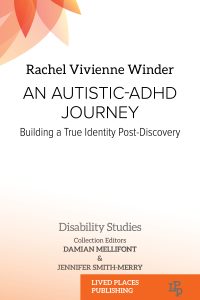 Author Rachel Vivienne Winder explores how 40 years of not knowing her AuDHD identity impacted her life – from Autistic masking (a subconscious survival tactic to camouflage social differences and so avoid unwanted attention and rejection), through to developing complex Post-Traumatic Stress Disorder (cPTSD). Discovering her neurodivergent identity gave her the tools to shed harmful and incorrect labels and to see her life through an AuDHD lens.
An Autistic-ADHD Journey explores a brief history of Autism alongside the author’s unique lived experiences that aim to dispel the many harmful misconceptions surrounding Autism and ADHD. This book takes you one person closer to knowing more about AuDHD.
Through the exploration of a complex and shifting understanding of self, this book is ideal reading for AuDHD folk and allies, anyone wishing to understand Autism and ADHD more, carers, mental health practitioners, Medical Students, and students of Disability Studies, Autism and AuDHD Studies, and Mental Health Studies.
Drawing the readers into the profound depths of human resilience, this book is ideal reading for students of disability studies, writing courses and trauma courses.
We want our books to be available to as many people as possible. If you’d like to purchase an individual copy, please email us and we’ll give you a discount code: