by Arvilla Fee
Elly Katz was only 27-years-old when she underwent an ordinary medical procedure to stabilize her neck and then awoke to an unthinkable nightmare. From Scientist to Stroke Survivor: Life Redacted details her traumatizing experience and the reshaping of her life from that moment forward.
Having lost feeling in the right half of her body from a brainstem stroke, Katz lost her dream of going to Harvard for a doctorate in genetics and has had to find ways to navigate a new normal. By turning to poetry and writing, Katz began sharing her incredibly painful experiences using a combination of science, the anguish of human emotions, and the nuances of poetic devices.
Katz often uses personification to process her losses. “I yearn to know you, darling right side—you and I are torn asunder, but undeniably alive in this aftermath” (Overture 26). In speaking to her body, Katz is also able to address us, the readers, “I am a process, unfinished and unfinishable. We all are. I hope this impresses upon you how incalculably precious you are, irrespective of the state of your physical constitution” (Overture 26). In this way, Katz offers encouragement and hope to others, regardless of where they might find themselves physically in this life.
One of the most crushing disappointments Katz addresses is the age she was when this devastating stroke occurred. In her poem, “Synapse,” Katz writes these haunting lines:
Is 27 really the age of disappearance and demise?
I presumed it was the age of beginning—
the onset of innocence, the buoyant tide of emergence—
not an eruption of the synapse of self… (37)
How one even processes such a catastrophic, life-changing event is almost beyond comprehension, and yet Katz takes readers along on her journey through her heartbreaking, eloquent words. In “We Fall Short of Summation,” she writes:
Show me how to walk through
this world without smacking my shins against touchstones
of trauma (43)
I miss you, my prior variant of being,
my once belonging,
my life minus this brainstem stroke (56).
The most haunting part of Katz’s on-going journey is the ache and longing for what she used to have—who she used to be. The loss of something, whether that be a part of ourselves or the loss of someone we loved is something to which nearly all humans can relate on some level. That ache to reverse time is something many of us grapple with every day.
In her poem, “Grow in Darkness,” we clearly see Katz’s intense desire to return to the past:
Where is that girl I used to be?
where are her passions, hobbies, drive to dive into
everything?I miss the brainstem I never before contemplated.
I miss the sensation I never before thought about sensing.
I miss the easy gait that once flew into my feet innately
with sunrise.
I miss the organism I once inhabited (71).
Home is the life I have—
the horrific, the magnificent—
the not coming to terms with this world
I astonish myself for continuing
to embrace
in spite of everything,
because of everything (78).
There is a remapping of my mind as it learns to dance
again with my now
irreconcilable spinal cord.There is a letting go of anger towards the body that tastes
like betrayal.There is a remarkable fertility of suffering
from which I will sprout
into someone I know not yet,
aside from the bare fact
that she remains grateful
for what still remains (94).
I do not expect myself to ever fully absorb
the shock of my loss—
my zest for biology, for thrusting my hand into the air
to answer academic questions neatly paved with solutions,
for propelling myself through math problems and novels,
for gliding through glistening grass as I observed nature
uncork itself.This girl embarking on her PhD in genetics
is buried beneath the soil in my soul,
and I visit her internally when the blade of grief stabs me.Yet my heart still beats.Yet the grass still grows.Yet the world still happens
with me, without me (104).
There is nothing triumphant in wedging myself against the
edge that confines me.
For, if I am to make something of myself beyond simply
becoming a survivor,
I will not label myself a victim (125).
In her darkest times, Katz has found a way to give voice to her pain and her path forward. She writes in “Pendulum:”
My entire galaxy blinks in the blackest bruise of the sky,
But words are all I have left.
So let us be here together with what remains and be
Grateful for what is so beautiful in this broken world (174-5).
Inside of these words, inside of this bleeding and beating
heart,
I muster resolve to seek self in sentences and permit
language to encircle me,
to expand in my endurability so I may release myself
fleetingly from anxiety and distress as the rush of words
carry me in another direction towards
another world liberated of trauma” (186-87).
Reader, I am splitting hairs as I aim to co-opt my current feelings—To override my despair, to convince myself that I once was something other that this runaway night. This thing I do—hurling words against the white page is idiotically the most terrifying but purposeful task in which I engage…(224-25).
I am still here.Are you? (269)
magazines both nationally and internationally and has three published poetry books: The Human Side, This is Life, and Mosaic: A Million Little Pieces, available at Wipf & Stock or Amazon. Arvilla lives in Ohio with her husband, three of her five children, and two dogs, Max & Scooter. When she’s not writing or editing, Arvilla loves to read, watch true crime documentaries and take every opportunity she can to travel and sit on a beach.
How does the journey of self-discovery unfold in the aftermath of a life-altering stroke?
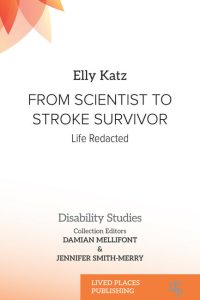
From Scientist to Stroke Survivor is a poignant work of narrative nonfiction, a tapestry woven of prose, poetry, and lyrical essays. Diving deep into the facets of identity and the quest for self-reclamation, Elly Katz navigates the aftermath of a stroke, using the written word as a tool for understanding and articulation.
In her journey of self-discovery, Katz delves into migratory episodes of person-building. Each of these acts serves as a lens through which she explores identity, grapples with disability, and strives to reclaim the center of her life story – despite the eclipse caused by a life-altering stroke. These contemplative encounters exist at the margins shaping her realization of self. This book is an intimate exploration of disability which zigzags across genres, blurring boundaries and troubling the linearity of time. It is a pilgrimage of the soul – a journey that weaves through calamity and emergence, leaving no emotion untouched.
Drawing the readers into the profound depths of human resilience, this book is ideal reading for students of disability studies, writing courses and trauma courses.
We want our books to be available to as many people as possible. If you’d like to purchase an individual copy, please email us and we’ll give you a discount code:
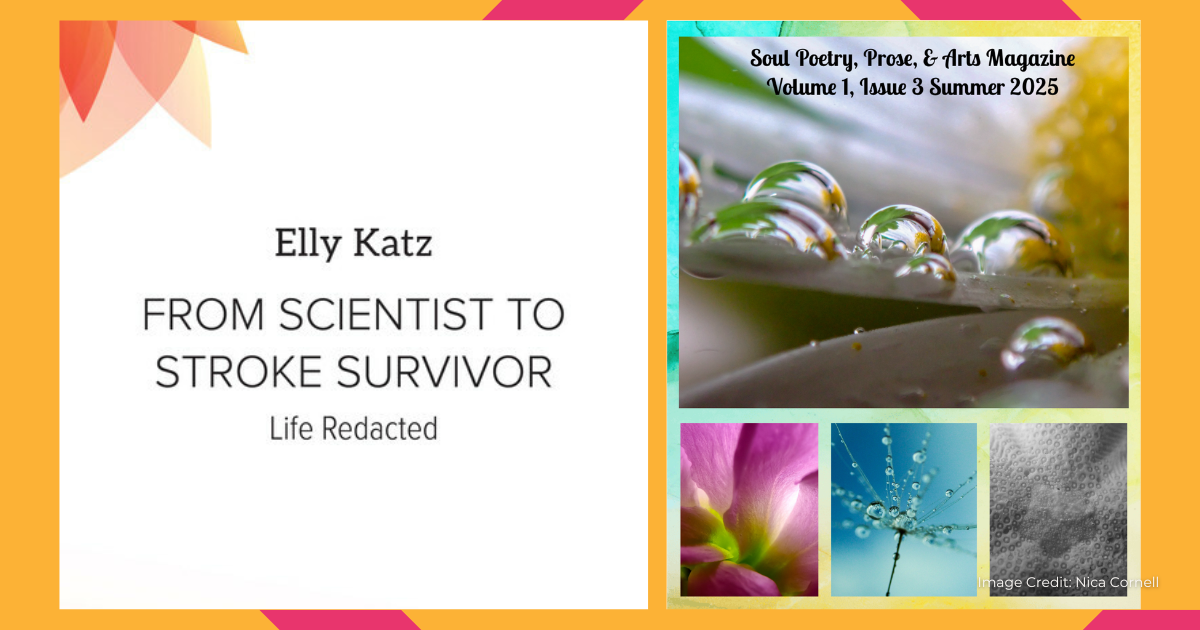
IMAGE CREDIT: Includes cover of Soul Poetry, Prose, & Arts Magazine by Arvilla Fee
Book Review for Elly Katz’s From Scientist to Stroke Survivor: Life Redacted by Arvilla Fee was first published in Soul Poetry, Prose, & Arts Magazine Volume 1, Issue 3 Summer 2025. Syndicated here with permission.