
The Limits of What Institutions Are Willing to Hear
Across higher education, healthcare, and public policy, conversations about inequality have expanded in recent years. Race and gender now appear, albeit unevenly, within institutional discourse. Disability and mental health, however, remain marginal most often framed as individual conditions rather than as structural experiences shaped by power, surveillance, and control.
When disability and mental health are acknowledged, lived experience is frequently positioned as supplementary: Emotional, subjective, or unreliable. It is welcomed only when it aligns with institutional narratives of care, recovery, and resilience. When it exposes harm, challenges professional authority, or resists sanitised accounts of institutional benevolence, it is quietly dismissed.
This silence is not accidental. It reflects a deeper institutional discomfort with forms of knowledge that make harm visible and insist on accountability. When Black disabled women speak about what institutions have done to them, their accounts are routinely reframed as instability, grievance, or misunderstanding. What emerges is not simply exclusion, but institutional erasure.
It is within this context that my book, The Silence They Wrote For Me: A Black Disabled Woman’s Fight Against Institutional Erasure, is situated. It is a hybrid work of critical analysis and lived narrative, written for both academic and public audiences.
Lived Experience as Knowledge, Not Confession
Much existing research on disability and mental health is filtered through clinical, managerial, or policy-driven frameworks. These approaches prioritise outcomes, compliance, and recovery, often at the expense of understanding how harm is produced through everyday institutional practices. Disbelief, surveillance, coercion, and enforced silence rarely register as harm within these frameworks, despite being central to disabled people’s experiences.
This book does not offer lived experience as confession, testimony, or therapeutic disclosure for institutional consumption. Instead, it positions lived experience as evidence: A form of epistemic knowledge capable of revealing how power operates through routine procedures, professional gazes, and supposedly neutral systems of care.
By writing from inside the institution rather than at a distance, the book challenges the assumption that objectivity requires detachment. It insists that proximity to harm is not a weakness, but a site of insight one that institutions systematically refuse to recognise because it destabilises their authority.
Blackness, Disability, and the Politics of Credibility
Disabled people are often required to prove their impairment. Black women are often required to prove their credibility. When these positions intersect, legitimacy becomes extraordinarily difficult to secure.
Expressions of distress are read as pathology. Coherence is read as manipulation. Resistance is reframed as non-compliance. Black disabled women are caught in a double bind: Too articulate to be believed, too distressed to be trusted.
The book examines how institutional authority is sustained through these credibility tests. Silence is imposed not only through overt exclusion, but through bureaucratic delay, professional disbelief, and the quiet rewriting of narratives by those in power. Records are altered, accounts are softened, and harm is reframed as miscommunication or individual failure. What remains is an official story that bears little resemblance to lived reality.
Inclusion Without Accountability
The Silence They Wrote For Me enters the world at a moment when institutions increasingly speak the language of wellbeing, trauma-informed practice, and inclusion. Universities, healthcare systems, and public bodies publish commitments to disability support and mental health awareness, often framed through compassion and care.
Yet for many Black disabled women, these commitments remain largely symbolic. Behind the language of support, systems of assessment, surveillance, and risk management continue to dominate. Complaints processes remain opaque. Disabled testimony is routinely questioned. Institutional responses prioritise liability over repair.
Lived experience is welcomed rhetorically, but resisted in practice particularly when it exposes procedural harm rather than individual vulnerability. The gap between what institutions say and what disabled people experience continues to widen.
This book confronts that gap directly.
Confronting Structural Harm
The Silence They Wrote For Me enters public conversation at a moment when mental health and disability are everywhere and yet rarely understood. Rates of distress, burnout, and long-term absence from work are rising across sectors, while institutional responses continue to rely on individualised explanations, resilience narratives, and surface-level interventions. Disability and mental health are talked about more than ever, but spoken about carefully, selectively, and often without confronting how harm is structurally produced.
Across education, healthcare, and public life, the language of wellbeing has expanded faster than the willingness to reckon with institutional responsibility. Lived experience is increasingly invited into conversation, but only in forms that are manageable, hopeful, and non-disruptive. Accounts that name coercion, disbelief, procedural violence, or long-term damage are still resisted particularly when they come from Black disabled women.
This book insists that we cannot meaningfully address rising levels of mental distress without interrogating the systems people are required to survive within. Without honest, rigorous engagement with how systems produce exhaustion, silence, and exclusion, the cycle will continue: More people unwell, more people disbelieved, and more people pushed out of work without recognition of what has actually happened to them.
The Silence They Wrote For Me responds to this moment by refusing euphemism and premature reassurance. It offers a way of talking about disability and mental health that does not soften harm for institutional comfort, but takes seriously the conditions that make distress predictable and, too often, inevitable.
Refusal as Method
At its core, this book is an act of refusal: Refusal to be reduced to a case file; refusal to perform gratitude for harmful systems; refusal to translate suffering into institutional learning points.
But it is also an insistence on dignity, on memory, and on the right to narrate one’s own experience without correction. It asks what becomes possible when institutions are forced to listen without control, and when silence is understood not as absence, but as something actively produced.
For educators, practitioners, and policymakers, this book offers no comfort. It offers responsibility. For Black disabled readers, it offers recognition: A naming of what happened, even when records were altered and voices ignored.
Listening to lived experience is not an act of empathy alone. It is an ethical obligation and an intellectual necessity.
How What happens when a place meant to heal instead deepens the wounds?
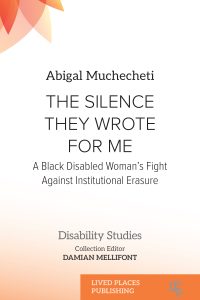
The Silence They Wrote for Me examines how disability, race, and institutional power intersect to produce silencing, misrecognition, and harm. Combining lived experience with critical analysis, the book challenges dominant frameworks in mental health and public institutions that marginalise disabled voices while claiming care.
The book will be of interest to scholars and practitioners in Disability Studies, Mental Health, Sociology, Education, and Critical Race Studies, as well as readers concerned with institutional accountability, epistemic justice, and the ethics of care.
We want our books to be available to as many people as possible. If you’d like to purchase an individual copy, please email us and we’ll give you a discount code:
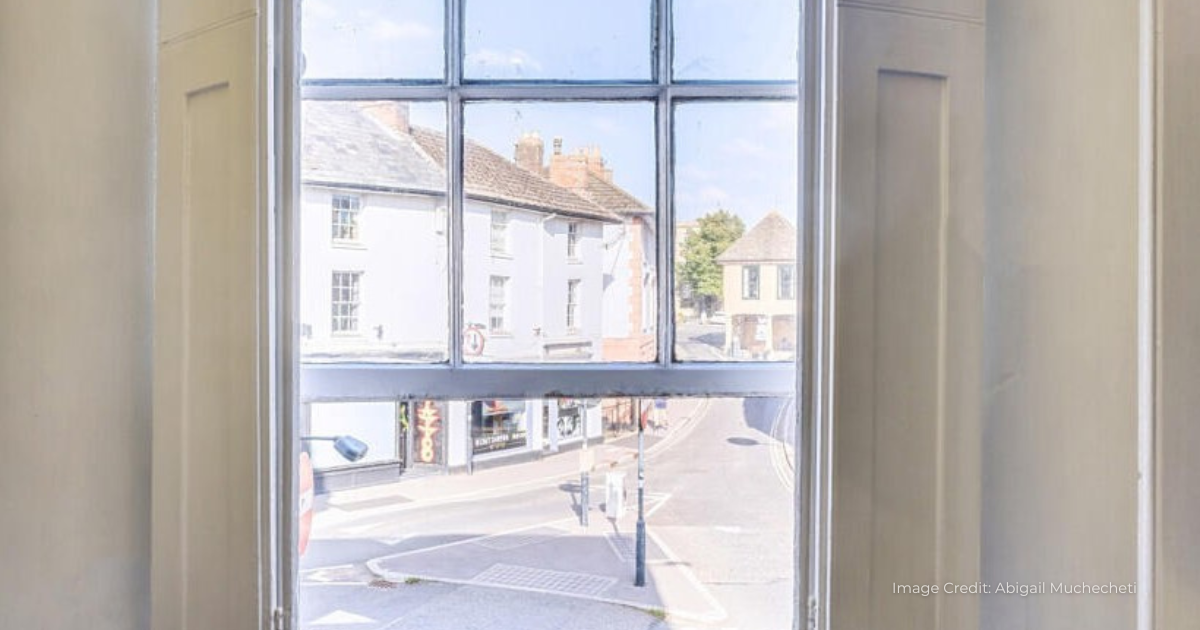
IMAGE CREDIT: Abigail Muchecheti, “Interior Window, Natural Light.” Used with Permission.
The views presented in this post are based on the author’s perspective and experiences. The views and perspectives of the author are not necessarily those of the publisher. Our role as a publisher is to ensure many and varied voices are heard openly and unfiltered and that diverse life experiences find expression in our books, blog posts, and other media. We support our authors fiercely, but we do not always share their opinions or perspectives.