by Haya Al-Dajani, Maysa Baroud and Deema Refai
Displacement and Enterprise in a Fractured World
According to the UNHCR, 2025 is witnessing over 117 million people forcibly displaced from their homes by war, persecution, or environmental crises—of whom around 16.6 million are displaced in the Middle East and North Africa region. This is the highest number ever recorded. For many refugees, the right to work in their host countries remains restricted or entirely denied, and without access to formal employment, business registration, or financial services, countless refugees, and especially women refugees turn to informal entrepreneurship as a means of survival and self-determination.
In fact, women and girls make up roughly half of the world’s refugee population and face distinct barriers that compound the effects of displacement including limited mobility, social stigma, caregiving burdens, and increased vulnerability to exploitation. Despite these challenges, refugee women entrepreneurs have emerged as powerful economic actors in their host nations, and sometimes beyond, creating informal businesses that support their families, employ their relatives and neighbors, and restore their dignity in contexts where few formal opportunities exist. But entrepreneurship for refugee women is not risk free. It often emerges as the only available option, pursued out of necessity rather than choice. Refugee women entrepreneurs often navigate legal ambiguity, exploitative labor markets, unstable incomes, and gendered expectations that can make business ownership precarious. For every refugee woman entrepreneur success story, there are countless others who struggle, and whose ventures collapse under the weight of bureaucracy, discrimination, exploitation, and/or exhaustion.
It is within this complex context that our book, Arab Refugee Women Entrepreneurs: Challenges and Opportunities in Jordan and Lebanon finds its focus. The book examines how Arab refugee women entrepreneurs living in Jordan and Lebanon turn displacement into opportunity; not because the system makes it easy, but because their circumstances demand resilience, creativity, and unyielding perseverance. Through this book, we invite the reader to see entrepreneurship as both a pathway to empowerment and a site of struggle shaped by legal restrictions, fragile economies, cultural challenges, and social hierarchies, which often render entrepreneurship risky, informal, and unsustainable.
Context: Gender, Displacement, and Enterprise
Refugee women frequently face overlapping challenges, including patriarchal norms, displacement related constraints, and exclusion from formal labor markets. In Jordan and Lebanon these barriers are magnified by restrictive laws that often prevent refugees from working formally or accessing credit. While both countries continue to host millions of refugees, they are politically fragile nations with struggling economies. The book highlights how, under these conditions, entrepreneurship becomes a strategy of survival rather than ambition. Many refugee women entrepreneurs operate informally, running home-based businesses that exist outside regulatory frameworks. While these ventures offer short-term autonomy, they rarely guarantee stability or long-term growth. By drawing on frameworks such as Kabeer’s model of empowerment (resources, agency, and achievements), we underscore that empowerment cannot be measured solely through income. Instead, true empowerment involves decision-making power, mobility, and recognition, which are often constrained by the realities of displacement, yet integral to entrepreneurship.
Lebanon and Jordan as Refugee Host Spaces
Empowerment cannot be separated from place. Both Jordan and Lebanon are relatively small, resource-constrained nations and rank among the world’s top hosts of refugees per capita. Hosting large displaced populations places immense pressure on these countries’ fragile infrastructures, labor markets, and public services. Economic stagnation, high youth unemployment, and rising living costs have made it increasingly difficult for these countries to balance national needs with humanitarian commitments. In this environment, refugee women entrepreneurs must navigate scarcity not only within their communities, but within their host states as well. In Jordan, though pilot programs have granted some refugee women the right to work in selected sectors, many still face restrictions on mobility, licensing, and access to capital. In Lebanon, refugee women entrepreneurs often operate in overcrowded urban settlements or unstable informal economies, contending with economic collapse, inflation, and limited legal protection. The case studies presented in the book highlight Arab refugee women’s entrepreneurship as an act of endurance that flourishes despite exclusion, but remains vulnerable to the systems that created displacement in the first place.
Stories of Empowerment and Risk
The case studies in this book bring to life the fragile balance between empowerment and precarity. We meet Mariam, a second-generation Palestinian refugee in Jordan who transformed her family kitchen into a catering business, juggling debt, social pressure, and inconsistent sales. And Fadia, a ‘double refugee’ who fled Syria to Lebanon with nothing but her hairdressing tools, rebuilding her life one client at a time amid restrictive laws and rising living costs. Such accounts capture both the promise and the peril of refugee entrepreneurship. For every refugee woman entrepreneur who manages to sustain a business, many more struggle against several structural barriers. These experiences serve to remind readers that while entrepreneurship can provide agency, it cannot substitute for rights, protection, or systemic inclusion.
Why This Matters Now
In today’s protracted refugee crises from Gaza and Sudan to Iraq, Syria, Yemen, and Ukraine, the humanitarian system increasingly promotes entrepreneurship as a tool for economic independence and self-reliance. Yet, as this book warns, such policies can shift responsibility from states and donors onto displaced individuals, expecting them to thrive in contexts that are neither safe nor fair. This book challenges this narrative and documents the exceptional stories of Arab refugee women entrepreneurs who succeed despite enormous barriers, while also cautioning against over-celebrating entrepreneurship as a universal solution. Empowerment, we suggest, must be collective rather than transactional, and rooted in social justice and equitable access to opportunity.
Toward Sustainable Empowerment
Drawing on the stories shared by Arab refugee women entrepreneurs, we emphasize that genuine empowerment demands more than celebrating entrepreneurial success stories. It requires systemic change: easing legal barriers to refugee work, facilitating access to credit and education, ensuring protection in informal sectors, and involving refugee women entrepreneurs in shaping policies that affect their livelihoods. We call for long-term, collaborative strategies among governments, the humanitarian sector and NGOs, and local communities that see refugee women not as beneficiaries only, but as agents of their own lives and partners in rebuilding economies and societies. Their empowerment should be grounded in structure and not just in spirit, and their sustainable inclusion requires more than resilience, it demands recognition, reform, and responsibility from the global community.
Key Takeaways from the Book
- Entrepreneurship as empowerment and constraint: Refugee women’s ventures can be transformative, but they often arise from necessity and remain precarious.
- Context defines possibility: Legal, cultural, and economic systems shape whether entrepreneurship empowers or exploits.
- Entrepreneurial agency: Despite challenges, many women refugees deny victimization and use entrepreneurship a tool through which they assert their agency, yet their entrepreneurial journeys are not void of struggles and inadequate institutional support.
- Beyond success stories: The majority of refugee women entrepreneurs face marginalization, debt, and burnout. These realities can be hidden beneath narratives of empowerment.
- Policy implications: Lasting empowerment requires structural reform including access to credit and education, labor rights, as well as protection against gender-based violence.
A Call to Action
This book recognizes the tenacity and ingenuity of Arab refugee women entrepreneurs who build their livelihoods under impossible conditions, while also highlighting the systemic inequities that limit their potential. For policymakers, educators, and development practitioners, the book is a timely reminder that empowerment is not about enterprise alone, it’s also about equity. Refugee women deserve not only the means to survive, but the right to thrive within systems that value their labor, ideas, and humanity. Supporting their enterprises is not charity. It is an ethical imperative to build societies that value the empowerment already being forged in exile. As such, we must all support and promote refugee women’s enterprises.
What is the potential transformative power of entrepreneurship for Arab refugee women, and what is their role in rebuilding lives and contributing to host nations?
Drawing on a selection of case studies, Arab Refugee Women Entrepreneurs: Challenges and Opportunities in Jordan and Lebanon explores the entrepreneurial experiences of Arab refugee women located in Jordan and Lebanon and examines how gender intersects with their social identity and refugee status. Authors Haya Al-Dajani, Maysa Baroud, and Deema Refai shed light on the socio-economic barriers, legal hurdles, cultural biases, and place-based constraints faced by refugee women when setting up businesses.
Discussing themes of empowerment, place and entrepreneurship, the authors conclude with a framework of recommendations for supporting refugee women entrepreneurs in Jordan, Lebanon and beyond. As such, this book is ideal reading for students of Entrepreneurship, Gender Studies, Refugee Studies, Sociology, and Cultural Anthropology.
We want our books to be available to as many people as possible. If you’d like to purchase an individual copy, please email us and we’ll give you a discount code:
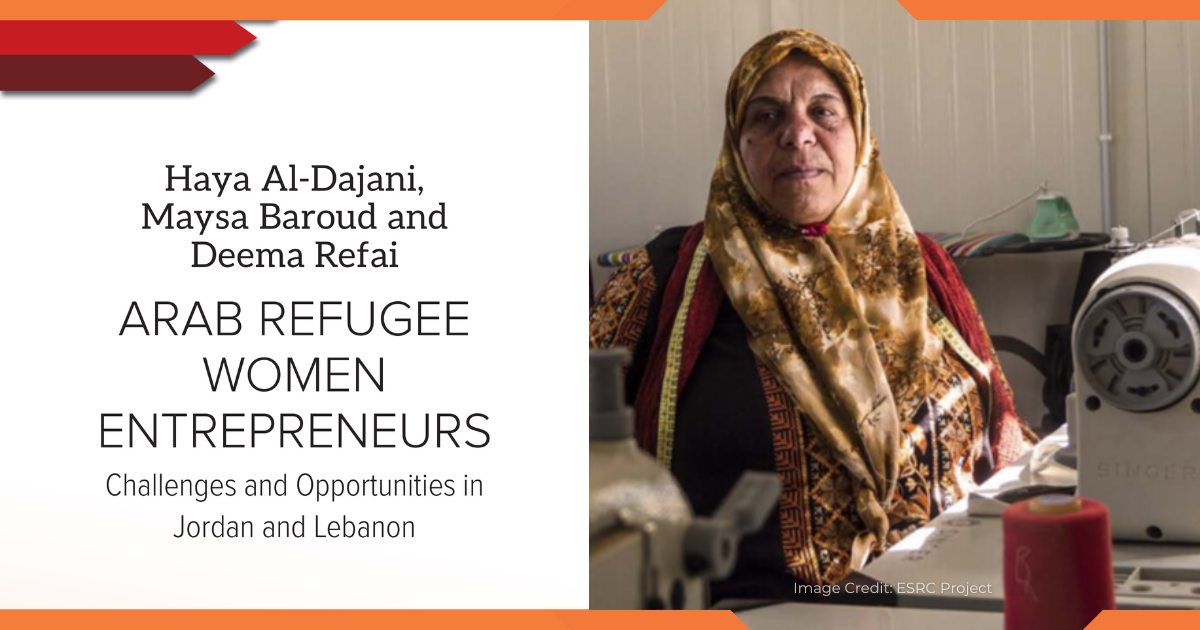
IMAGE CREDIT: “Between Survival and Empowerment” by AISHA: Resilient Refugee Women Project. Typically, in Jordan and Lebanon, refugee women entrepreneurs operate micro and home-based enterprises in the informal economy. Image used with permission.
The views presented in this post are based on the author’s perspective and experiences. The views and perspectives of the author are not necessarily those of the publisher. Our role as a publisher is to ensure many and varied voices are heard openly and unfiltered and that diverse life experiences find expression in our books, blog posts, and other media. We support our authors fiercely, but we do not always share their opinions or perspectives.