On June 27, 2025, Dolores Huerta was interviewed by guest host Diego Luna on Jimmy Kimmel Live. Luna seemed in awe of her. I am too. At 95, this mother of 11 children has been a force for human rights throughout the lifetime of almost everyone alive today.
Diego Luna briefly alluded to her long record of achievements but put the spotlight on the present. Confronted by the cruel and unconstitutional policies and actions of the Trump administration toward refugees and migrants, Dolores Huerta is once again in the vanguard of vocal opposition. Her responses to Luna’s questions were emblematic. First she spoke truth to those in power, as she always does. She summarized the attacks on peaceful, law-abiding working people by US immigration agents (ICE) in raids on schools, churches, workplaces, and courtrooms in its zeal to deport undocumented immigrants with absolutely no due process. Dolores called on Congress, state and local governments, and the courts to stop these illegal deportations. Then she spoke directly to the people, as she always does. She advised people in danger of being targeted by ICE to carry ID, say nothing to the arresting agents, and do everything possible to protect their rights.
As someone who has been active in the human rights movement for over 50 years, I can attest to how many of us learned critically important lessons from Cesar Chavez, Dolores Huerta, and the United Farm Workers’ struggle for justice and dignity. The UFW elevated the power of boycotts, picketing, demonstrations, and other tools of labor organizing through the inspiring and unifying elements of music and charismatic leadership. Its motto: Sí se puede, introduced by Dolores Huerta in the early days of the farm worker struggle, translates as “Yes, it can be done,” a message of faith, confidence, and determination – an uplifting exhortation to keep on pushing ahead.
No message could be more timely today. It is difficult to be optimistic when extremism has gained a stranglehold on all three branches of U.S. government, and while the mainstream media persists in normalizing the political insanity we are witnessing. But because these words are uttered by Dolores Huerta, a human rights leader who has proved the truth of Sí se puede through victory after victory for farm workers and their families, we who believe in democracy and the rule of law should listen, take heart and when possible act on this message. Which means speaking out individually or together in whatever ways we can. Joan Baez, who in 1973 recruited me as a volunteer for Amnesty International, once wrote, “Action is the antidote to despair.” If we act, yes, we can defeat totalitarianism in our own country, and yes, we must.
Dolores Huerta was the main speaker at the first demonstration for economic and social justice I ever attended, in San Francisco in 1972. On the street outside a supermarket parking lot, a striking woman in a straw hat, introduced as a co-founder of the UFW, stepped to the front of a group of farm workers and other activists and spoke through a megaphone. Dolores Huerta’s message was brief and to the point: We are here. We are human beings. We put food on your tables. And we demand only what every human being needs and deserves: equal justice under the law, and a chance to live in dignity. In Delano decades later, marching with the UFW in solidarity with Cesar Chavez during a long hunger strike, I listened again to Dolores speaking simple but powerful words to the people. Not long after, sadly, I was back in Delano again on the solemn occasion of Cesar’s memorial. And again, Dolores led the march.
I reached out to Dolores this spring to ask her permission to include a chapter on her in the memoir I’m preparing for Lived Places Publishing, to be titled The Leadership of Women: More Stories of Solidarity and Struggle in the Human Rights Movement. The book is a collection of stories of women in the leadership of the human rights movement who have inspired me. Dolores is far too busy now, because of Trump’s war on Los Angeles and with the human rights crisis underway for migrants, refugees, women, minorities, and working families. So we agreed on this article. This is what I can do. Dolores is again being heard out there on the front lines, which she has never left. Doing what she can do.
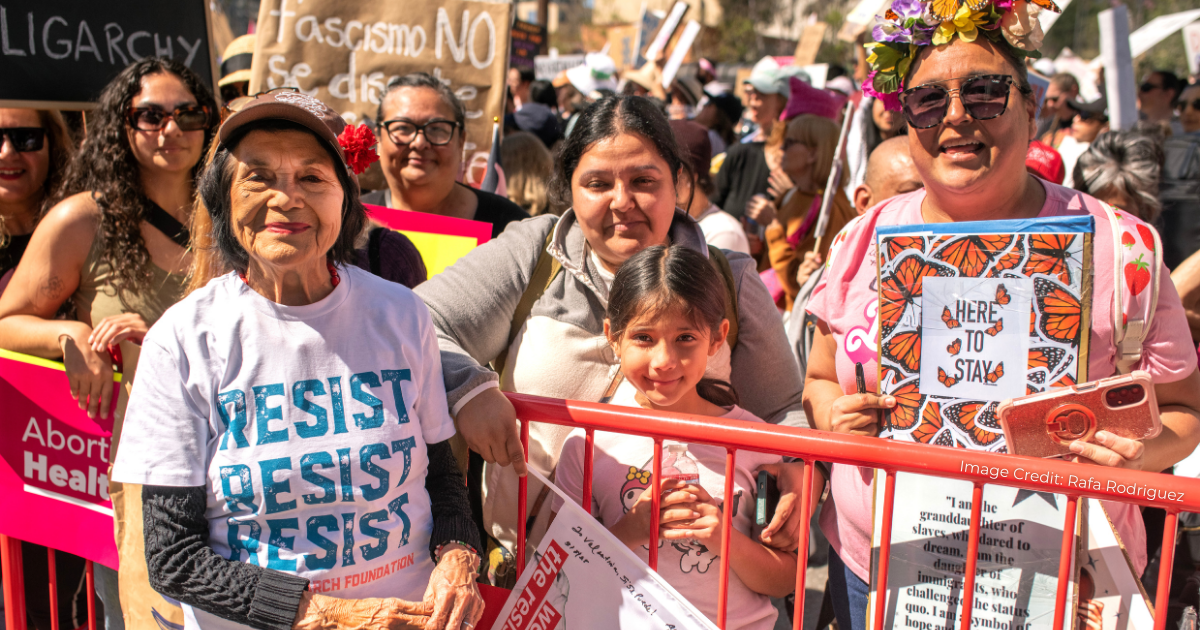
The leadership of women in the movement for human rights today is beautifully embodied by Dolores Huerta here in the “Land of the Free” and by President Claudia Sheinbaum in Mexico. When watching the spectacle of Trump’s grotesque abuse of power becomes too bitter, for relief I look for photos like the one featured above, of Dolores Huerta with the people, smiling, joyful, unafraid. Or for photos of Claudia Sheinbaum singing and dancing with children. Leading with love, not giving in.
At the close of Jimmy Kimmel Live, the audience rose to chant Sí se puede with Diego Luna and Dolores Huerta. It was for me a heartening reminder that we are many, we are here, we won’t surrender to despair, and we will be heard.
—David Hinkley, former chairperson of Amnesty International USA
The Dolores Huerta Foundation (DHF), which Dolores co-founded with Camila Chavez in 2003, empowers grassroots leadership and advocates for educational equity, LGBTQ+ rights, infrastructure improvements, and civic engagement in underserved communities. Through DHF, Dolores helps connect local organizing to statewide and national movements for justice. To learn more please contact the Dolores Huerta Foundation at doloreshuerta.org.
David Hinkley has two books published by LPP:
What can we learn from the women whose leadership has shaped human rights struggles across the globe?
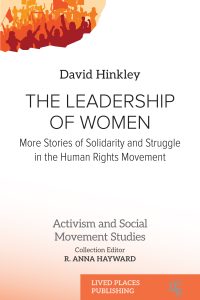 The Leadership of Women is a powerful memoir by David Hinkley that celebrates the remarkable women who inspired his work beyond Amnesty International, spotlighting their groundbreaking contributions to movements for justice. Through vivid stories of collaboration, resilience, and innovation, Hinkley honors these champions while offering lessons for activists today.
This book is both a tribute and a call to action—an invitation to join ongoing struggles for the rights of women, refugees, people in poverty, and victims of abuse worldwide. The Leadership of Women is ideal for students, scholars, and activists seeking to understand and advance human rights in the 21st century.
 Drawing on personal experience and that of towering human rights figures, such as South Korea’s Kim Dae Jung and Sudan’s Mahmoud Mohamed Taha, author David Hinkley takes us on a journey of solidarity and struggle in the cause of human rights. Stories of Solidarity and Struggle offers a unique insider look at the international struggle for human rights, told in prose and poetry by Hinkley, an activist for more than 50 years and still on the ramparts. On display are the methods and strategies used, thrilling victories, tragic defeats, lessons learned, and, poignantly, the benefits to the activist.Drawing on themes of memory, inheritance, and justice, this book is ideal reading for activists, people fighting for human rights, and students of Activism and Social Movement Studies, Cultural Anthropology, Politics, History, and Carceral Studies.
We want our books to be available to as many people as possible. If you’d like to purchase an individual copy, please email us and we’ll give you a discount code:
IMAGE CREDIT: Dolores Huerta, in the foreground at left, at a demonstration for migrant rights. Photo credit: Rafa Rodriguez, used with permission of the photographer.
The views presented in this post are based on the author’s perspective and experiences. The views and perspectives of the author are not necessarily those of the publisher. Our role as a publisher is to ensure many and varied voices are heard openly and unfiltered and that diverse life experiences find expression in our books, blog posts, and other media. We support our authors fiercely, but we do not always share their opinions or perspectives.