
by Damian Mellifont and Jennifer Smith-Merry
The Australian Disability Royal Commission was conducted in early 2019 in response to damning reports about the continuing violence, abuse, neglect, and exploitation experienced by Australians with disability. In this post, we will describe our lived experience-led research and its practical influence towards successfully informing questions raised to witnesses in this particular public hearing. We will also provide a list of five criteria that we believe if met, can improve the likelihood of lived experience-led research informing public hearings and government inquiries more broadly.
About our Lived Experience-led Study
The seeds of our lived experience-led research were first sown at a meeting with National Disability Services (NDS) staff where questions were being developed for the 2021 Workforce Census. At this meeting, the first author of this post who is a neurodivergent researcher with the Centre for Disability Research and Policy (CDRP) at The University of Sydney raised the prospect of including questions about the representations of staff with disability who are employed in Australian disability services. This line of questioning was supported by the second author who is a highly respected researcher, genuine disability ally, and former CDRP Director. Our questions on this topic were included in the Workforce Census, and NDS provided the research team of Damian Mellifont, Jen Smith-Merry and Kim Bulkeley with the survey results to inform our study.
Our Lived Experience-led Research Influence
Our published paper in Social Policy & Administration revealed many Australian disability services reporting that they have no people with lived experience of disability among their staff. Furthermore, disability services tended not to employ people with disability in management roles or to include them on their boards. We widely promoted our troubling research findings in prominent media outlets including The Conversation and The Sydney Morning Herald.
Following promotion of the significant policy issue as revealed by our study, our timely findings were directly raised and used to inform questioning of witnesses at the Royal Commission’s Public Hearing 32. This Hearing was held in Brisbane from 13 to 17 Feb 2023. Our research formed the basis of a series of confronting questions about current gaps in disability employment policy and planning and the pressing need to redress these shortfalls within Australian disability services.
The Five Criteria
Based on our abovementioned experience, we will now discuss five criteria that can assist to assess the likelihood of lived experience-led research informing public hearings and government inquiries. These criteria consist of:
- Study direction is informed by researchers with disability. It is important that the voices of researchers with lived experience of disability are respected and acted upon in the setting of research questions. This was the case in our study.
- Study findings are directly relevant to public hearing and government inquiry interests. Our findings were closely aligned with issues of ‘neglect’ as people with disability experienced a loss of employment and advancement opportunities within Australian disability services.
- Research publications are not hidden. We do not see value in research articles being kept away from reading audiences and locked behind expensive pay-for-access firewalls. We purposefully selected a journal with open access to ensure that our scholarly findings about the policy issue at hand and our messages of inclusion were widely accessible.
- Gain national print media and social media exposure. In addition to publishing our research findings in an accessible scholarly journal, we described our study in popular newspapers (e.g., The Sydney Morning Herald), independent academic media sites (e.g., The Conversation), and social media posts (e.g., LinkedIn).
- Keep the conversation going. Promptly respond to social media comments and look for accessible television, radio and podcast interview opportunities.
If each of these five criteria is carefully addressed, we believe that lived experience-led research is well positioned to inform the questioning of witnesses at public hearings and government inquiries.
How can lived experience of disability influence Australian disability research and policy directions?
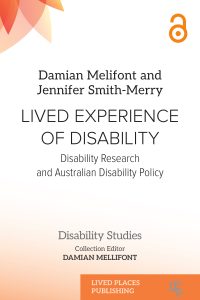
Lived Experience of Disability, edited by Damian Mellifont, brings together voices of people with lived experience and committed allies to explore critical issues in Australian disability policy.
Covering topics from restrictive practices and healthcare disparities to barriers in research participation and academic inclusion, this book examines how policy intentions often fall short of meeting real needs. With insights on linguistic deprivation, rural challenges, sensory impairments, and disability leadership, it not only critiques current systems but also points to evidence-based directions for reform.
This is more than an academic resource—it is a call for genuine inclusion, representation, and systemic change. Lived Experience of Disability is ideal for students, researchers, policymakers, and practitioners in disability studies and policy.
We want our books to be available to as many people as possible. If you’d like to purchase an individual copy, please email us and we’ll give you a discount code:
Image Credit: “Vintage Swatch” by Blaise Mellifont. Used with permission.
The views presented in this post are based on the author’s perspective and experiences. The views and perspectives of the author are not necessarily those of the publisher. Our role as a publisher is to ensure many and varied voices are heard openly and unfiltered and that diverse life experiences find expression in our books, blog posts, and other media. We support our authors fiercely, but we do not always share their opinions or perspectives.