When does a disability begin? How can we define it other than through the prism of the current and conventional classifications? We must give precedence above all else to the day-to-day experience of the disabled individual who reconstructs their relationship with the world in a different way. In order to approach the notion of disability, there are three conceptual spaces that constitute the background against which an individual’s life is lived out: (1) the organic space, examined in relation to the concept of ‘life standard’, (2) the technical space, that of perception and action, analyzed through the concept of affordances, and (3) the social and human space, which we examine starting from the concept of capability.
I wish to highlight the everyday proof of resourcefulness that individuals can deploy within their environment. For this purpose, Transforming a Disability Through Everyday Life Experiences presents situations that include the following: That of a quadriplegic calligrapher who expects of himself the same artistic perfection as he did prior to his accident; that of blind children and teenagers who learn to play soccer and that of an autistic person who manages to carve out a role in society. These narratives challenge our customary way of looking at “disability” and applies my own first-hand experience to broader philosophical issues such as the notion of care.
Redefining Disability
Taking a New Position on the Matter
Disability is the result of a discordance, a sometimes shockingly deep discrepancy between what individuals are capable of doing or being and what they or others expect of themselves. Yet it can also be a chance to advance towards a new order of being more in tune with their abilities, and one that may also influence their environment in return. From then on, several strategies may be used to set up new forms of balance. This leads one to think of fresh ways of considering the very notion of disability that has been so seriously and continuously devalued, even if implicitly.
Norms and Normativity: In Search for Organic Balance
Therefore, the issue is addressed in a totally different way, since disability will be an opportunity to question the “normativity” of an individual, to use the terms of the philosopher Georges Canguilhem: Individuals learning afresh how to use their bodies, the very centre of their being, in a new way, sometimes, it is true, without even being aware of it. In the book, there’s a case of a tetraplegic calligrapher who learnt anew how to perform his art with the same outcome as before the accident that caused the paralysis of his limbs. He now paints using his mouth and his neck. His body has been able to reorganize in order to perform the same task in a different manner.
Affordances: The Balance between Living Organisms and their environment
“Affordances” are whatever is available for a given person to use and there is a deep history of that concept, linked with the subject of disability and the readjustments it calls for. In the book, there’s an account of how a blind football team was formed in Mali in 2021 and this group of young people were able to play football despite being blind – they ended up finding unexpected fulfillment in this activity! Affordance being an invitation to act within a given environment, the individual who is injured at the outset can use other levers of “affordance” over and above what he can do or feel.
Capabilities: The States of Balance and Imbalance in Disabilities
The notion of “capabilities” in this context was coined in the 1980s by Amartya Sen. It is used in the first place to highlight the central fact that the GDP of a country does not measure individuals’ quality of life. It rather applies to the contrasts between whatever a given environment offers and what a given individual in that environment can take advantage of. Disability is the result of a lack of correspondence between the environment and the individual it surrounds. To gain in autonomy, an individual must then act on his environment which to a greater or lesser degree lends oneself to fulfilling their needs. Perhaps there is a way to mitigate a disability so long as it is not a question of acting merely at a local level, but taking account of the entire environmental situation that of which can be acted upon.
Individual and Everyday Lived Experience: An Important and (Still) Innovative Approach
Whereas major legislation is still struggling to come up with a satisfactory definition of disability, my proposed solution is based on wide-ranging references, eclectic reading and original concepts, and inspired by my very own personal experience. I myself live with seriously impaired mobility, as well as other inspirational situations of disability (a tetraplegic painter, blind football players, an autistic engineer). In the end, I come to a new definition of disability in Transforming a Disability Through Everyday Life Experiences to provide others with ideas to counter the current discriminatory views of the non-disabled.
Drawing on individual and everyday experience, even in the humanities and social sciences, remains an innovative approach – perhaps even more so in a field as specific as disability studies. Collective knowledge can be based on people’s experiences, and moreover this methodology enables to develop analyses directly grounded in reality, which represents a sine qua non condition for the emergence of concrete solutions that can be implemented in the real and current world.
How can disability be redefined beyond conventional norms, transforming limitations into new possibilities?
How can disability be redefined beyond conventional norms, transforming limitations into new possibilities?
Transforming a Disability Through Everyday Life Experiences by Anne-Lyse Chabert explores when disability begins and how it can be defined beyond conventions. Using her own experience, she examines metamorphosis as a strategy to overcome physical and environmental constraints. She analyzes disability through normativity, affordance, and capability. Real-life cases— a quadriplegic calligrapher, blind footballers, and an autistic person finding societal inclusion— illustrate how creativity transforms limitations into possibilities.
We want our books to be available to as many people as possible. If you’d like to purchase an individual copy, please email us and we’ll give you a discount code:
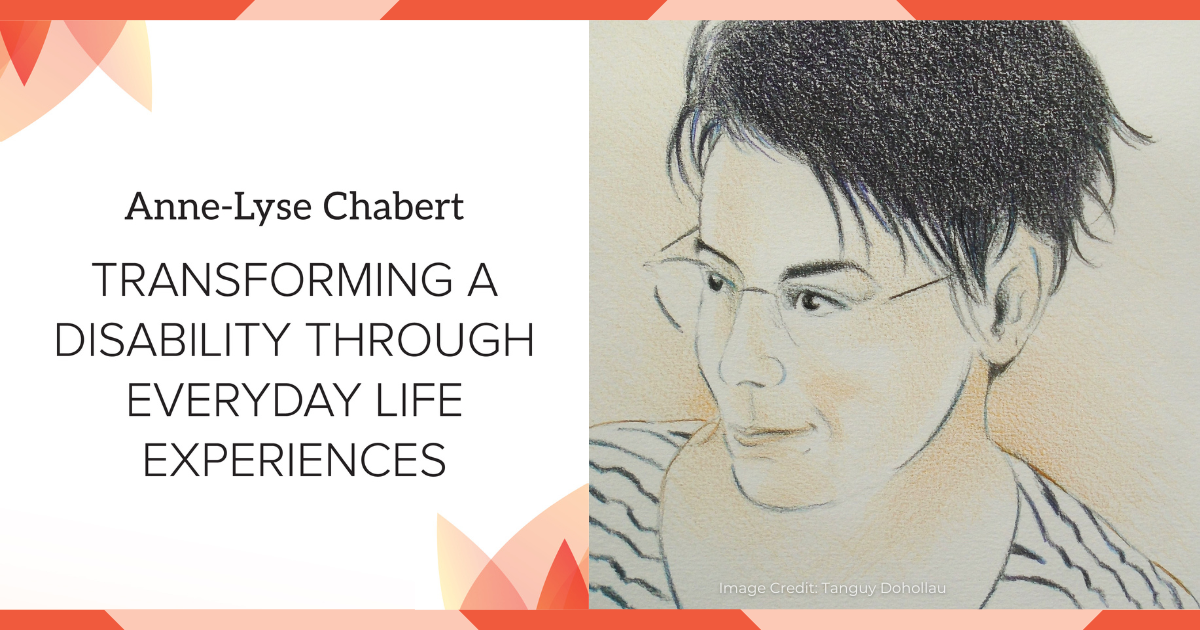
Image Credit: Tanguy Dohollau
The views presented in this post are based on the author’s perspective and experiences. The views and perspectives of the author are not necessarily those of the publisher. Our role as a publisher is to ensure many and varied voices are heard openly and unfiltered and that diverse life experiences find expression in our books, blog posts, and other media. We support our authors fiercely, but we do not always share their opinions or perspectives.