Survival, social recognition and the enduring consequences of violence
Violence is often understood through the moment in which it occurs. Its consequences, however, do not necessarily observe the same boundaries. Long after an immediate threat has passed, the conditions through which harm is experienced may continue to shape everyday life, frequently without public acknowledgement or institutional recognition.
This distinction is particularly important because the consequences of violence are not always immediately observable, readily articulated or easily accommodated within institutional definitions of harm. They may emerge through disruptions to everyday life, altered relationships, diminished economic security, changes in health or the persistent difficulty of negotiating environments once considered familiar. Such experiences complicate conventional distinctions between victimisation and survival, suggesting that the temporal boundaries through which violence is understood may be considerably narrower than those through which its consequences are lived. The social recognition of violence is therefore not simply a matter of establishing whether harm occurred. It also concerns the conditions under which particular experiences become intelligible, credible and deserving of institutional response.
Contemporary discussions of adversity frequently draw upon the language of resilience, recovery and personal transformation. Within public narratives, survival is often presented as evidence of an individual’s capacity to overcome exceptional circumstances and reconstruct a meaningful life. These accounts can provide an important means of expressing agency, particularly when survivors themselves choose to understand their experiences through such terms. Nevertheless, the celebration of resilience becomes problematic when it develops into a normative expectation against which individual experiences are assessed.
The assumption that survival should culminate in recovery risks obscuring the uneven and frequently unpredictable ways in which people live with the consequences of violence. It can also transfer attention from the conditions that produced harm towards the individual’s perceived capacity to overcome it. Where recovery is treated primarily as a personal achievement, the continuing responsibilities of institutions, communities and wider social structures may become less visible.
This is not to suggest that recovery is impossible or that survivors should be understood exclusively through their experiences of harm. Rather, it is to recognise that recovery cannot be reduced to a uniform process, nor can its absence be interpreted as evidence of personal inadequacy. The ability to resume employment, participate in social relationships or maintain an appearance of stability does not necessarily indicate that the consequences of violence have been resolved. Equally, continuing difficulties should not be taken to diminish an individual’s agency or capacity to shape their own life. The problem lies in the tendency to impose a socially acceptable chronology upon experiences that do not necessarily conform to one. Violence is assigned a beginning and an end, while survival is expected to produce a recognisable movement towards restoration. Such assumptions may offer reassurance to observers, but they do not adequately account for the complexity of lived experience.

Institutional recognition and the boundaries of harm
The difficulty of recognising enduring harm becomes particularly significant within institutional settings. Legal, medical, welfare and employment systems frequently depend upon established categories, evidentiary requirements and procedural thresholds through which experiences are assessed and resources allocated. These mechanisms are necessary for institutional decision-making, but they can also privilege forms of harm that are measurable, documented or consistent with existing administrative expectations.
A visible injury may be more readily recognised than a prolonged alteration in an individual’s sense of safety. A discrete incident may be easier to investigate than the cumulative effects of coercion, intimidation or repeated psychological harm. Similarly, institutional responses may concentrate upon immediate protection while providing comparatively limited recognition of the longer-term social and material consequences that follow. These limitations do not operate independently of wider relations of power. Race, gender, disability and socioeconomic position can shape the conditions under which individuals are heard, believed and supported. Those whose experiences already fall outside dominant assumptions of credibility, independence or normative functioning may encounter additional difficulties when attempting to secure recognition of harm.
Consequently, the question of institutional recognition extends beyond whether an individual has experienced violence. It also concerns whether that experience can be expressed in terms that institutions are equipped, or willing, to acknowledge. This distinction has practical implications. Recognition may determine access to healthcare, reasonable adjustments, housing assistance, financial support and legal protection. Where institutional frameworks privilege immediate or visible manifestations of harm, individuals experiencing enduring consequences may find themselves required to repeatedly explain, document or justify circumstances that remain integral to their everyday lives.
The resulting difficulty is not necessarily an absence of suffering, but an absence of adequate institutional language and responsiveness through which that suffering can be understood. The expectation that survivors must make their experiences legible to others introduces a further dimension to the politics of recognition. Public and institutional responses frequently depend upon assumptions about how someone who has experienced violence should behave, communicate or present themselves.
Individuals may be expected to provide coherent accounts, demonstrate appropriate emotional responses and maintain consistency across repeated encounters with professionals or authorities. Yet experiences of violence do not necessarily produce forms of expression that correspond to these expectations. Some individuals may speak openly, while others may remain silent, communicate with difficulty or choose not to disclose particular aspects of their experiences. Neither disclosure nor silence provides a straightforward measure of the seriousness of harm.
The demand for recognisable evidence can therefore create a paradox in which those seeking acknowledgement must perform their suffering in ways that satisfy external expectations. Visible distress may be interpreted as evidence of vulnerability, but it may also expose individuals to judgements concerning their reliability or capacity. Conversely, composure, professional achievement or apparent independence may be taken as indications that the consequences of violence are no longer significant.
Such contradictions demonstrate the inadequacy of evaluating harm through assumptions about outward presentation. An individual’s capacity to participate in everyday life should not be confused with the absence of continuing consequences. Nor should recognition depend upon the ability to produce a particular narrative of suffering, resilience or recovery. The challenge is to develop forms of social and institutional understanding that do not require survivors to continually establish their credibility through the repetition or performance of painful experiences.
Rethinking responsibility beyond survival
A more comprehensive understanding of violence requires attention not only to the circumstances in which harm occurs, but also to the social conditions through which its consequences are subsequently managed, recognised or neglected. This involves reconsidering the temporal assumptions embedded within institutional responses. Immediate intervention remains essential, but protection from further violence cannot constitute the entirety of an adequate response. Longer-term access to healthcare, economic security, appropriate accommodation and supportive social environments may be equally important to the conditions in which individuals are able to rebuild their lives.
It also requires a critical examination of the distinction between individual resilience and collective responsibility. When survival is understood primarily as a demonstration of personal strength, the structural conditions that shape the possibilities of recovery can become obscured. The capacity to reconstruct everyday life is not simply a matter of determination; it is also influenced by material resources, social relationships, institutional practices and the distribution of opportunities. Recognising these dimensions does not diminish the agency of survivors. Instead, it situates that agency within the wider circumstances through which choices become possible or constrained.
The enduring consequences of violence should therefore be understood neither as inevitable nor as exclusively individual. They are shaped by the interaction between personal experience and the social environments within which that experience continues to unfold. To acknowledge this complexity is to move beyond an understanding of justice concerned solely with the identification of wrongdoing or the conclusion of immediate danger. It is to ask whether the institutions and communities that respond to violence are also prepared to recognise the conditions necessary for sustained dignity, participation and security.
The invisibility of harm should not be mistaken for its absence. Nor should the passage of time be treated as sufficient evidence that its consequences have diminished. What remains unrecognised may continue to shape everyday life, even where there is no visible indication of suffering. A more adequate public understanding of violence must therefore resist the assumption that survival provides a definitive conclusion. It must recognise that the consequences of harm may extend beyond the circumstances in which violence occurred, and that institutional responsibility cannot be confined to the moment of crisis.
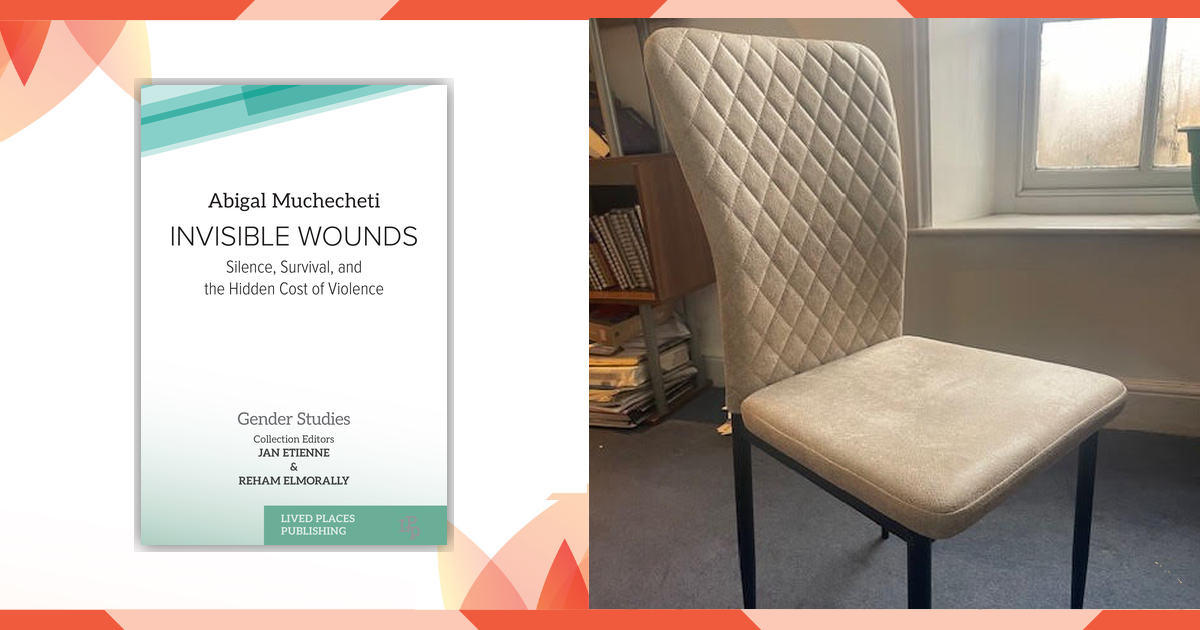
These concerns inform the wider intellectual conversation to which my recently published book, Invisible Wounds: Silence, Survival, and the Hidden Cost of Violence, contributes. Published by Lived Places Publishing, the book invites critical engagement with questions of violence, survival and the forms of suffering that remain insufficiently recognised within social and institutional life. The central challenge is not simply to acknowledge that individuals survive violence, but to consider the conditions under which their subsequent experiences are recognised, supported and understood.
The end of violence should never be confused with the end of its consequences. A society that recognises survival but overlooks its enduring costs has not fully confronted the harm it claims to condemn.
More about Abigal Muchecheti’s book published by LPP:
 How do emotional and psychological wounds of domestic violence shape women’s dignity, identity, and survival?
In Invisible Wounds: Silence, Survival, and the Hidden Cost of Violence, Dr Abigal Muchecheti confronts the often-unseen realities of domestic violence, insisting that abuse extends far beyond physical harm. Through her deeply personal feminist autoethnography, Dr Abigal Muchecheti examines how betrayal, humiliation, enforced silence, and exposure to sexual risk inflict profound and lasting damage. Drawing on her lived experience, she explores how stigma, family silencing, and religious expectations intensified that harm, while reflecting on the double vulnerability created by disability. By weaving together personal narrative, anonymised survivor testimonies, and African and global feminist scholarship, Muchecheti bridges intimate experience with broader structural analysis, engaging the works of influential feminist thinkers to illuminate the intersections of violence, gender, disability, and power.
Accessible yet academically rigorous, this book reframes domestic violence not as a private tragedy but as a collective social responsibility. It calls for cultural, institutional, and systemic transformation while offering survivors recognition and advocates a powerful framework for challenging the silences surrounding emotional and psychological abuse. Ideal for survivors, gender studies scholars, disability studies researchers, advocates, social workers, and students of African feminist thought seeking deeper insight into domestic violence, stigma, and women’s dignity.
IMAGE CREDIT: Abigal Muchecheti
We want our books to be available to as many people as possible. If you’d like to purchase an individual copy, please email us and we’ll give you a discount code: