
by Michael Kane
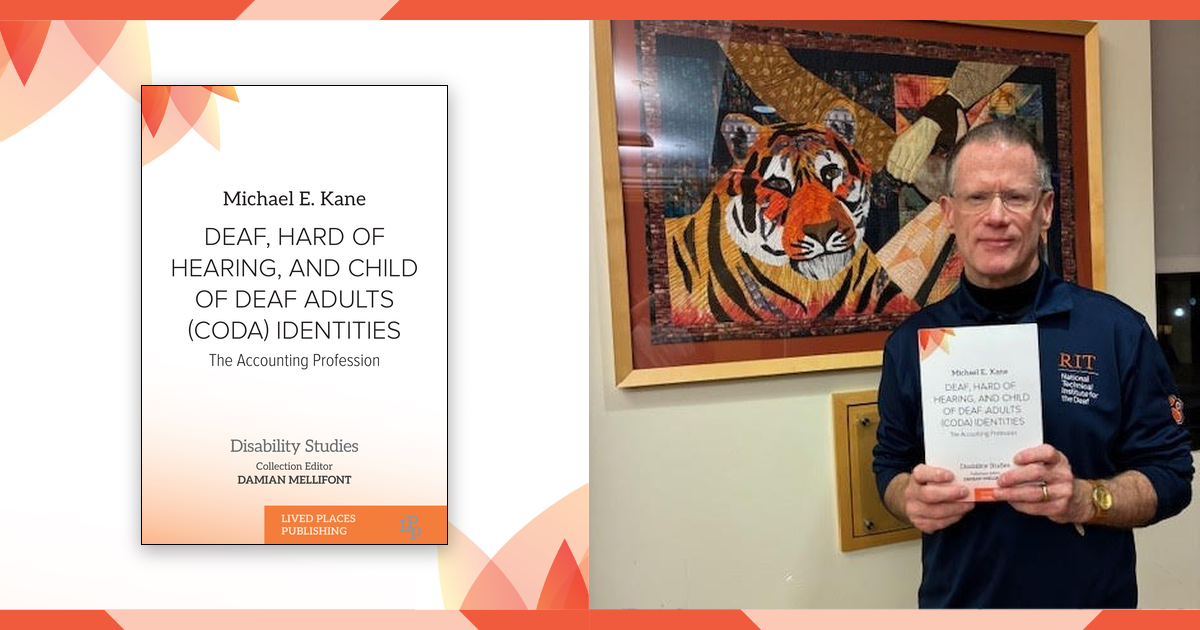
The Deaf, Hard of Hearing, and Child of Deaf Adults (CODA) Identities: The Accounting Profession book is a collection of interviews compiled by Michael E. Kane, who has been deaf since birth. This book explores deafness through a cultural-linguistic lens, not as a medical condition with limits.
Earning a certified public accountant (CPA) license or a chartered accountant (CA) qualification is an exceptionally rigorous professional milestone. Oftentimes, one imagines a CPA or CA as a hearing professional navigating the worlds of auditing and taxation. However, through these 18 interviews, this book shows that deaf and hard of hearing accountants can achieve these goals with the same determination as their hearing peers.
MY DEAF IDENTITY
I have never viewed my deafness as a physical limitation. Deafness, to me, was just a natural piece of my life. Gone are the long-ago days of negative portrayals of deaf people as helpless, uneducated, and lacking in ability. Deaf people were often seen and perceived as a burden. The Johnny Belinda movie, released by Hollywood in1948, perpetrated the negative portrayal of deafness as a tragedy that can only be “cured” by the intervention of a hearing person. Jane Wyman, a hearing actress, won an Oscar for her role as the deaf woman in that movie. Thankfully, this negative stereotype is being dismantled by deaf individuals. How? By winning Oscars, passing laws, protesting positively, advocating for laws, and celebrating unique linguistic aspects of American Sign Language (ASL).
While reminiscing over my academic journey as a deaf undergraduate at the Rochester Institute of Technology/National Technical Institute for the Deaf (RIT/NTID) during the mid-1980’s, I’d like to share three meaningful moments that occurred to me on the RIT/NTID campus.
FINDING A COMMUNITY OF ADVOCACY
While leaving the campus dining hall one afternoon, I discovered a stack of The NAD Broadcaster, published by the National Association of the Deaf (NAD). I devoured that issue word-for-word. I became a member at once, and that periodical became my monthly window into the pressing issues facing our deaf national community.
Little did I know this curiosity would lead to my first “real” job after graduation. I eventually served as the Director of Business Affairs at the NAD in Washington, D.C., for over nine years. There, I met thousands of deaf and hard-of-hearing individuals and took part in national conferences across the country. A personal highlight was representing the NAD at the U.S. Capitol, where I provided testimony on the critical need for voting accessibility for deaf and hard of hearing Americans.
A MILESTONE OF REPRESENTATION
With great anticipation, I saw Marlee Matlin, a deaf actress, win her Oscar on television, live, at the 59th Annual Academy Awards in April 1987. Matlin was the first deaf performer and the youngest Best Actress winner to get this honor for her role in the Children of a Lesser God movie. Her winning the Oscar, at age 21, was an inspiration to me. She was, after all, just slightly younger than me! Before and after her Matlin’s Oscar win, numerous deaf people were successful in the media. Linda Bove of PBS Sesame Street fame; Troy Kotsur (another Oscar winner) with the CODA movie; and Nyle DiMarco, the first-place winner of the America’s Next Top Model and Dancing with the Stars television shows are just a few of noted deaf media stars.
THE DEAF PRESIDENT NOW (DPN) PROTEST
Before I graduated with my undergraduate degree in May 1988, with great interest, I followed the Deaf President Now (DPN) protest on the Gallaudet University in Washington, DC. The DPN protest attracted national attention on news programs on television and written in newspapers and magazines. The protest ultimately resulted in the selection of a first-ever deaf president on campus. The DPN protest resonated with me as a deaf person; I rooted for the students. I vividly recall watching Greg Hlibok, one of the deaf DPN student leaders, being interviewed by Ted Koppel by the ABC Nightline moderator. He forcefully articulated his “it’s time for a deaf president, no more delays” advocacy on behalf of his fellow students (and future generations). The successful DPN protest propelled the U.S. Congress to pass several significant laws: the Americans with Disabilities Act (ADA) (1990), Television Decoder Circuitry Act (1990) and the Twenty-First Century Communications and Video Accessibility Act (2010) which improved accessibility of deaf and hard of hearing people in areas of employment, technology and communication in the United States.
After college, Through Deaf Eyes, a documentary produced by PBS (Public Broadcasting Service) in 2007, made a significant impact on me. The television documentary explored over 200 years of Deaf life in the U.S. Among the interviewees were Marlee Matlin and I. King Jordan, the first deaf Gallaudet University president. This documentary is the opposite of the Johnny Belinda movie, accentuating the strengths of the deaf community in the U.S.
THE NEXT GENERATION
After 18 years as an accounting executive, I returned to RIT/NTID as a collegiate faculty member. The last two decades on campus, I’ve taught accounting to deaf and hard of hearing students in my classroom. They are curious about the accounting field and often ask me about the CPA designation. I tell them that reaching the license is possible. And then I show them this book. I hope this book – featuring deaf and hard of hearing CPAs, deaf and hard of hearing international chartered accountants (CAs) and CPAs who are CODAs – adds another nod to the resilience and professional brilliance of the deaf and hard of hearing community in the U.S. and the world.
More about Michael Kane’s book published by LPP:
How can aspiring finance professionals overcome sensory barriers to reach the absolute pinnacle of the accounting world?

We want our books to be available to as many people as possible. If you’d like to purchase an individual copy, please email us and we’ll give you a discount code: