by Son of Khoi
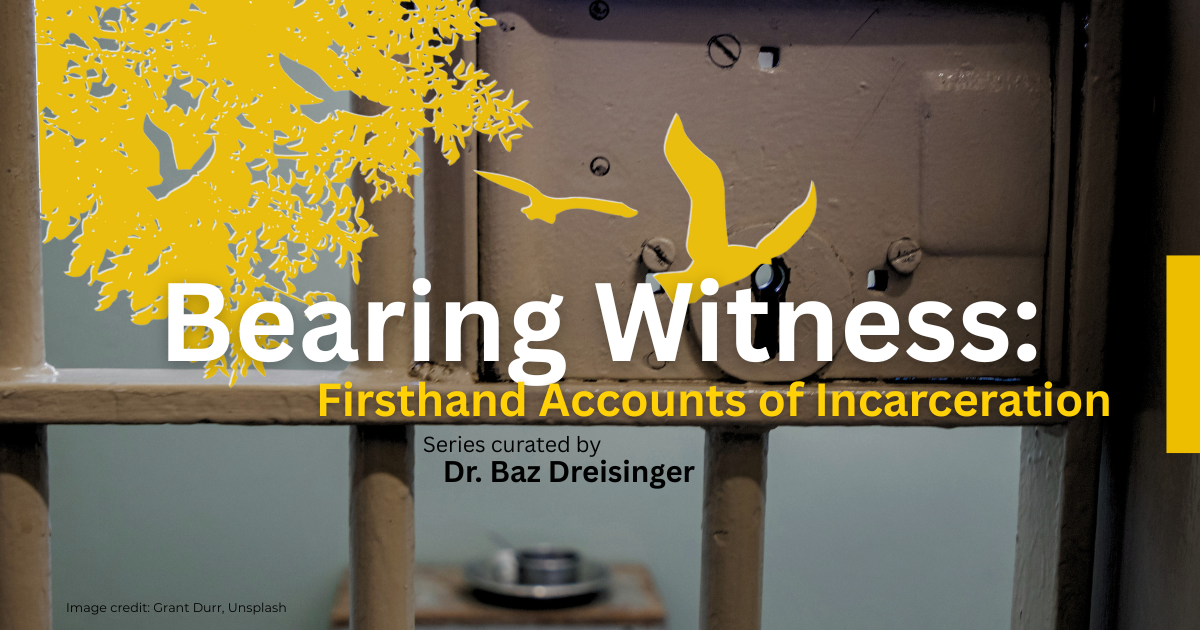
Part 4 of Bearing Witness: Firsthand Accounts of Incarceration
Series curated by Dr. Baz Dreisinger
I am always saying that we shouldn’t look at and judge others, but I’m contradicting myself daily. I cannot help observing things—situations and other insignificant matters.
In my room/cell the guys planted a green pepper tree in a pot. Then others in the room started planting their own green pepper trees as well; in pots, of course. These trees were nurtured from seeds. I saw them: How they took the bird’s manure to fertilise the poor soil. These plants grew stronger and stronger. And one day the Section Head of the prison came into the cell and said that plants pose a security risk if they stand in the window. The plant needs its sunlight to photosynthesise. So, we were told the plants must be outside of the cell, where other prisoners can destroy it.
Be that as it may, when the counting parade was conducted, we took the plants off the window shelves and, when they locked us up, we put the plants back. But they did not get enough sunlight to produce food for growth. We fed them with filtered bird manure but they still needed sunlight. Eventually we just defied their orders and let the plants be.
The Section Head also started to say nothing; he just left the plants where they are. We learned a little secret about him. Gardening is his hobby at home and he is responsible for the landscaping of the church that he attends.
The plants grew from strength to strength. And those small pots formed their own little ecosystem. I saw little mushrooms pop up underneath the trees in their most minute form. Different types of small bugs were attracted to the plant—not to harm it but to benefit from the plants.
It wasn’t long then there were little flowers on the trees and because there were no bees around someone came up with the idea to artificially pollinate the plants. The guy took another plant of the same species and shook it over our plants and vice versa. But one day, while taking a smoke break in the window, I came across a struggling bee. At first, instinct kicked in: “Kill it! It’s going to sting you.” A voice in my head immediately replied, “Hey, you idiot—the bee is here to pollenate.” And I left the little insect alone.
The time progressed and soon we saw two tiny little green peppers on one of the trees. The Section Head saw them as well. We harvested the two peppers and shared them among the ten of us. We put our green peppers in the mayonnaise to give the mayonnaise some exotic flavour. It was awesome.
The trees are getting bigger and bigger now. Soon we will have to let them go and plant them in the ground where they can be free trees. Not in a pot but in the ground, where their roots can grow deep into the Earth. And where they can live their purpose: To produce food for humanity.
From this experience I realized that we as incarcerated persons are really at the bottom of the food chain. And being locked up, taken out of society, is really taking its toll on us. We needed to grow something beautiful, to experience the process of the seed evolving into a plant, the plant to a small tree, and eventually to bearing fruit. I looked back at my journey, from rewriting my matric to obtain better marks, to qualifying for university and registering as a university student. This signifies growth.
I am the plant in the pot. Eventually I will be big enough and the pot can no longer sustain me – it will have too little soil. If the tree stays in the pot too long, it will eventually die. I hope I do not get bigger than my current pot. I do not want to die here. I need to get my roots planted; I need to bear fruit so that the next generation can eat. We all need to become trees that feed others.
Which brings me to another point. People on the outside need to appreciate even the smallest things in life. In a maximum-security facility even growing an innocent plant is a security risk. Why? I do not know. Maybe because the system looks at everything a prisoner does as a means to commit mischief. The other day I was eating a piece of bread in the hallway on my way to the section. The kitchen official walked past me and confronted me as to where did I get the bread. The official who escorted me responded, telling his colleague that he gave the bread to me.
I guess trees that stop growing begin to feel frustrated because they are confined all the time. Their roots are not free to grow. The same counts for correctional officials, especially those who were trained by the former regime. They never grew. It’s sad. Those who did grow left the service and are living successful lives in different careers.
To the justice-affected person and to the custodians of justice: Never stop growing. A person who is incarcerated is like the plant in the pot. It cannot move itself towards the sun. So, the system plays a critical role in moving the prisoner towards the sun – which is access to educational facilities. Eventually the plants grow bigger and bear fruit: The justice-affected person succeeds in studies, with the assistance of a system without prejudice. Knowledge grows, better decision-making skills are acquired and a world of possibilities has been opened. The plant has now grown beyond the pot. The system needs to let the justice-affected person go or it will die from the inside out because it has grown even bigger than the system itself.
There are no words that can describe my gratitude to all the people who have sown manure in my pot. You know who you are. For “security” reasons I cannot reveal your names know. Let us grow like the tree.
About the Series:
Bearing Witness: Firsthand Accounts of Incarceration, is intended to highlight first-person accounts of those who have experienced incarceration. It is curated by Dr. Baz Dreisinger, Founder and Executive Director of Incarceration Nations Network, a global prison reform and justice reimagining organization.
About the Collection:
 Lived Places Publishing is proud to partner with Dr. Baz Dreisinger’s organization to bring you a collection that aims to broaden the scope of real people’s storytelling in Carceral Studies.
The most knowledgeable experts on any government’s justice system are the people who have endured it. The Incarceration Nations Network Collection (LPP/INN) delivers the stories of and by people who have experienced prison firsthand and worldwide and are thus living witnesses to the global catastrophe known as mass incarceration.
Recognizing that the act of bearing witness can take many forms this collection seeks academic memoirs, essay collections, poetry collections, and other forms of ethnographic and autoethnographic tellings that expose the intersection of identity and place. Recognizing, too, that mass incarceration is a global phenomenon, the collection welcomes writers from across the globe and seeks to publish in multiple languages through translation rights and emerging tools.
Dr. Baz Dreisinger is Founder and Executive Director of Incarceration Nations Network, a global prison reform and justice reimagining organization. She is also a Professor at John Jay College of Criminal Justice, City University of New York; author of the critically acclaimed book Incarceration Nations: A Journey to Justice in Prisons Around the World (published in translation in China, Japan, Taiwan, Italy and in Spanish); founder of John Jay’s groundbreaking Prison-to-College Pipeline program; 2018 Global Fulbright Scholar and current Fulbright Scholar Specialist. Dr. Baz speaks regularly about justice issues on international media and in myriad settings around the world.
We want our books to be available to as many people as possible. If you’d like to purchase an individual copy, please email us and we’ll give you a discount code: