I spent the majority of 2020 working 10+ hour days, seven days a week, leading the Ebook Central team at ProQuest. The pandemic pushed demand for ebooks for online education to crazy levels almost overnight. Along with the surging demand for ebooks came calls from students, faculty, and librarians for more information about the authors. Over time, we came to call this requested information author identity metadata (AIM). Working groups formed to explore how this information could be acquired and shared, and what the risks were in sharing such data.
The social and political contexts of the 2020 pandemic were fueling this demand for AIM. George Floyd was murdered by a police officer in May, and the pandemic’s impact on the economy exposed very clearly who bore the brunt of the burden in terms of access to virtual work, health care, and education. It was a watershed year that pushed even the stodgiest corporate types to consider where their organizations stood on diversity, equity, inclusion, and accessibility (DEIA). Our customers at ProQuest Ebook Central, that is, library patrons, wanted to know, for example, if a book about disability was written by a person with a disability.
Long before I began working at ProQuest, I was a publisher. I had spent 14 years in book sales, book acquisitions, editorial management, and as the founder of a specialty business curriculum publisher. As 2020 ended, an idea had germinated between me and my friend from graduate school, who had become a leading professor at UC Santa Barbara in the Black Studies department. Could we launch a new sort of publishing company, committed to developing course readings that explore how real people experience their identity in the context of place? Could this project focus on core principles like “nothing about us without us” and develop library-responsive attributes like AIM?
Fast forward to 2026, and Lived Places Publishing is launching the first phase of our AIM project: A facet to search by author place of origin. What did we learn between 2021 and today about developing AIM? After many surveys, focus groups, conference presentations, and lengthy, soul-searching discussions, we learned that:
- Authors must provide the metadata. It cannot be derived or discerned by well-meaning publishers or librarians.
- Authors must be able to amend and, if desired, remove the metadata from public consumption.
- Authors must know that information put into the digital ecosystem is “out there,” which means a lack of control.
During our research, we identified nine distinct categories of AIM that people want to search. The most in demand (and frankly the “easiest” to develop, although by no means has this been easy) was author place of origin. Here is an example from one such survey we ran:
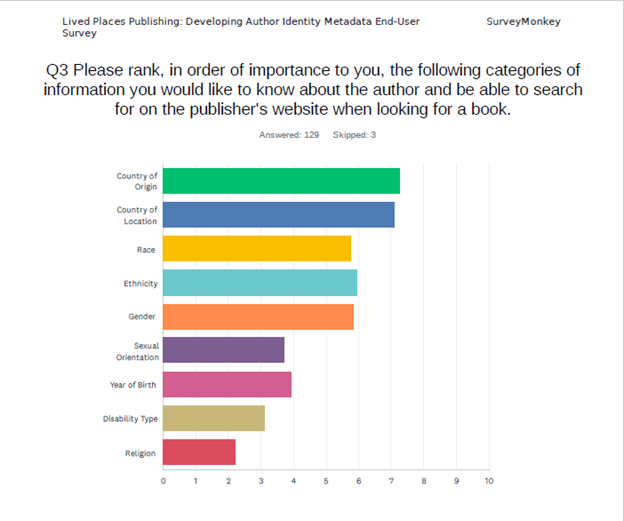
Our intention is to launch this first facet on our library ebook platform and our consumer-facing website this spring and then conduct a new round of end-user and author research over the following six months. We want to see how this new author place of origin facet is received; what challenges, problems, opportunities, and insights it generates; and then understand how we can more fully develop the categories of AIM that readers and researchers want to explore.
I am fascinated by efforts to expand readership and representation, and I am driven to push boundaries that will increase empathy and understanding. There are so many people, organizations, and companies doing compelling work in this space around content and metadata development in support of DEIA. In future blog posts for Toward Inclusive Excellence, I will introduce readers to these information champions.
This article first appeared on Toward Inclusive Excellence (TIE), a DEIA-focused content vertical from Choice, which is a publishing unit of the American Library Association. The original post can be read here. To receive regular updates from TIE regarding DEIA news in higher education and academic publishing, sign up for the TIE newsletter.