The Western academy, like the culture it upholds, places individualism as a central organizing principle. Yet, anyone who has completed a Phd, or a major research project or written a book knows that these kinds of works cannot be claimed by a single person. I want to thank all of the people at Lived Places Publishing for helping to conceptualize, guide and edit this project. Writing schedules are notorious for going left! Mine did – partly because this book was competing with my health for attention and partly because two handed reading takes time and attention. Two handed reading is a slow food in a microwave age!
It is as I say on page 14-5:
Two hand reading is engaged. It is an approach to rereading history and available material. It is reading beyond a mechanical process – a book in hand becomes time travel. With a pencils, sticky notes and highlighters reading becomes healing. It is not reading to cite a pas sage or prove a point but pensive and supplicant reading. Two hand reading refutes binary ways of knowing and understanding the world. Two hand reading creates enough space for multiple approaches to gender performances, political performances and the wider human existence – to want to explore living in ways that do not demand an outcome of right or wrong.
That’s heavy stuff!
I am happy that this project has finally come to fruition. It can be more. It needs to be more The work focusses on the Commonwealth Caribbean (CC) and I hope it spurs interest in the connections with the other the Caribbeans – Spanish, French (these two being very important because University of Puerto Rico, Rio Piedras served as a repository for the CC before University of the West Indies and the importance of the Haitian revolution) and the Dutch. In a lot of ways this project is still nascent work but it was more important to me to start the conversation than it was to prove I was an expert or knew it all. That is leading with vulnerability in research. I can do that because I am serious about being an intellectual and not an academic.
I take seriously the Gramscian wisdom that there is a difference between an academic and an intellectual. The first distinction is one of personal purpose and of a willingness to be vulnerable with and in research. Putting out a project to start a conversation is being vulnerable with research. Identifying myself as a motherless child who lives with the afterlives of trauma on a daily basis is being vulnerable in research. There are also institutional differences – while academics are interested in riding corporate ladders and prioritizing personal gain and aggrandizement, intellectuals feel responsibility for conceptualizing, theorizing and documenting the challenges of a current time as well as different possibilities that do less harm. Where academics often share public funds and stage with politicians, intellectuals find themselves popular with students and social justice architects but in curious and contentious positioning with status quo and academe.
The work of intellectuals puts pressure on traditional and received ways of approaching epistemology and knowledge making. The gaps and tensions result in a generative power and process that births new research traditions and nations. This books seeks to consider this process in the context of the Commonwealth Caribbean as well as my understanding of the value of that process and my place in it as an intellectual trained in the tradition. Chapter two is where I try to unfold this. More thick stuff:
Colonization was enabled by storytelling, which was reified as ‘natural’ and ‘right’. As Susan Buck- Morss explains, Western theory is a series of stories that have become important to the world and to European colonizers for their legitimating ability (Buck- Morss, 2009, pp. 22– 4). This caucasity has underpinned centuries of Indigenous and African death and destruction. Many can make a linear connection between police brutality and the prison industrial complex as purveyors of racial violence and adverse outcomes for Black and Brown communities. Fewer people make the important connection that knowledge hegemony and the plantation university have a role in preserving, legitimating, and propagating the logics that drive carceral and many other colonial systems. (76)
This book does another thing – runs all that hard epistemological, philosophical, political iteration up against my life which is deeply shaped by my personal story of being a Black Caribbean woman affected by the trauma that is too familiar and present in our community. There is no knowledge that is disembodied and even as I reflect on what knowledge making means in the context of the organization of the academy, this work also makes a point to engage with me, the human. Research is deeply human:
Some of us take it for granted – as a priori – that we will have people who satisfy our needs or see value in loving us and being with us. Some of us expect to be listened to and hired for the value of our research, and others of us know not to expect that. Where we sit on the spectrum of expectations about having our needs met or not or being able to feel supported as we live our lives or not affects The fourth research tradition 113 our view and understanding of the world. Put differently, per sonal experience is the genesis and foundation of our view of the world and the (meta)theory we make. That the Western intellect ual tradition does not reflect that is not surprising. Pedigree and hierarchies depend on degradation and half- stories to maintain themselves (112-3).
I have written this book for Black Caribbean people and their descendants everywhere but I also hope it can be of use to any person who wants to make Western academies better and more inlcusive.
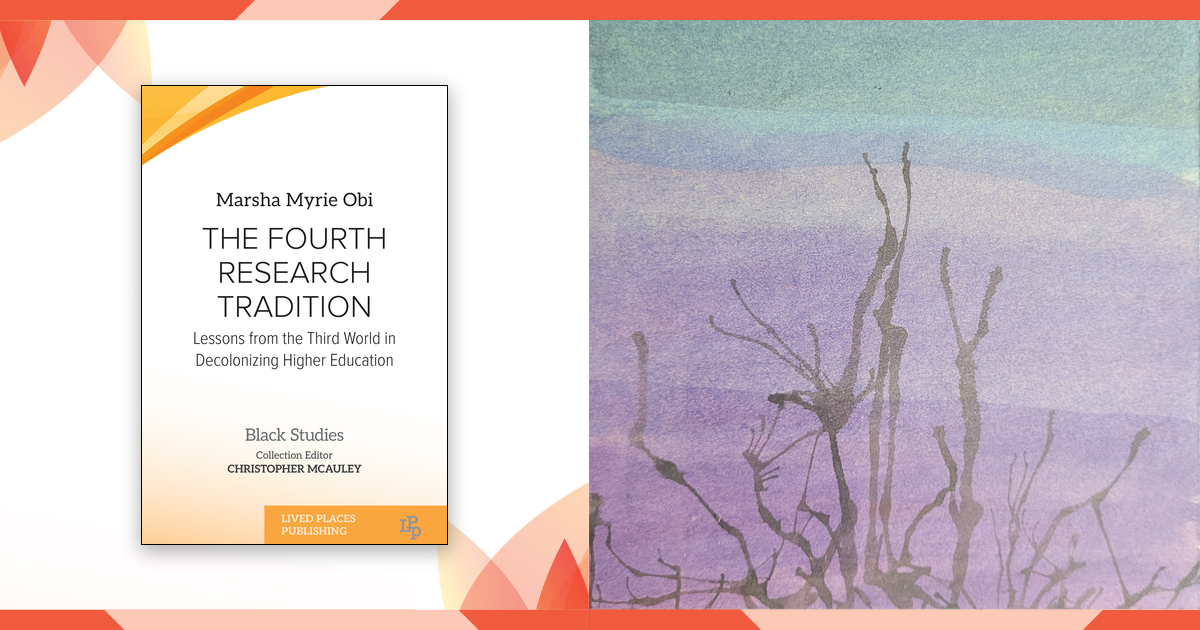
More about Marsha Myrie Obi’s book published by LPP:
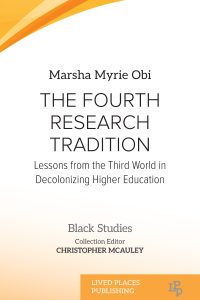
How can universities in the Global North truly decolonize knowledge and dismantle the hierarchies that continue to shape their classrooms and institutions?
The Fourth Research Tradition: Lessons from the Third World in Decolonizing Higher Education by Marsha Myrie Obi challenges the dominance of Western epistemologies by turning to the Caribbean intellectual tradition—a model born out of resistance, reconstruction, and radical inclusivity. Drawing on the legacy of Commonwealth Caribbean universities, this book explores how transplanted peoples redefined identity, knowledge, and pedagogy by rejecting colonial hierarchies and embracing transdisciplinary, anti-oppressive practices.
Through a compelling synthesis of critical theory, lived experience, and educational practice, Marsha Myrie Obi offers a roadmap for reimagining universities as spaces of liberation, empathy, and equity. Ideal for early and mid-career faculty, educational developers, and scholars in critical pedagogy, Caribbean Studies, and equity-driven higher education reform, as well as readers in the Caribbean diaspora seeking models of transformative learning.
We want our books to be available to as many people as possible. If you’d like to purchase an individual copy, please email us and we’ll give you a discount code: