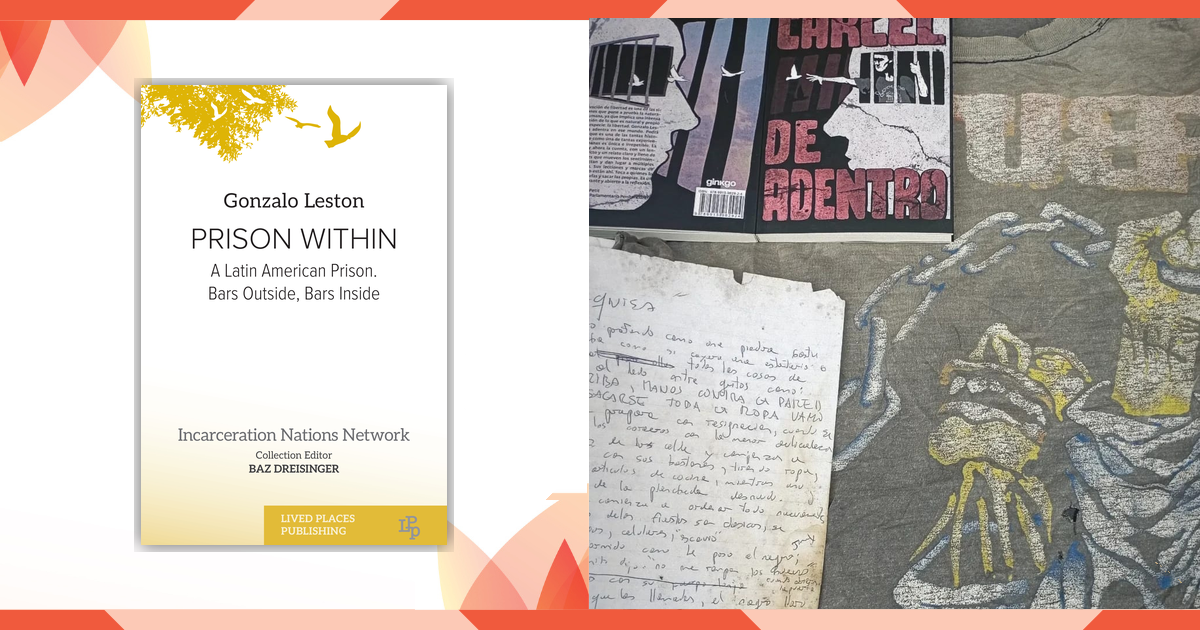
At night, when regular programming ended, I turned down the volume on the tiny black-and-white television and used the light of the static to write. Five of us slept in a cell measuring roughly six and a half by ten feet, without running water, defecating in plastic bags and throwing them into an empty yard. Amid the sound of breathing, the occasional distant cry of “Let me go, judge!” and the clang of metal, I filled pages torn from the middle of a notebook.
“Hey, what are you writing?” Johnny asked me one night. He was the leader of our cell.
“Things, Johnny… I don’t know,” I answered.
“There’s a lot to tell in here, but prison stories stay in prison.”
I swallowed and said nothing. He went on:
“It’s good to let it out, however it comes. Imagine when you tell your friends about being locked up—when you tell someone cooking, ‘Hey, don’t make rancho.’”
Rancho is what we called the food cooked in large pots in prison.
I still did not quite know what I was doing, or that those pages would become a book many years later: Prison Within.
More than a decade ago, I was imprisoned alongside my brother in Comcar, Uruguay’s most dangerous prison. I had intervened in a fight to separate him from a neighbour who had attacked him. Then came the statements, the holding cells and a judicial machinery I could not understand.
“I was trying to break it up,” I repeated endlessly, to no avail.
Eventually, we found ourselves behind an impenetrable iron door.
Prison had its own language. A window was a “fan”; milk was “cow”; bread was “marroco”. There were unwritten rules you needed to learn quickly: how to behave during visits, what to share, when to speak, where to look. How to talk with your hands so the guards could not overhear you. You arrived without knowing those rules, but the consequences of getting them wrong could be very concrete: death.
In our cell, we took turns sleeping in the different spots. There was a bunk, a concrete bed and mattresses on the floor. In the worst spot, your feet rested on the toilet. There was not an inch of floor to spare. The prolonged water shortage forced us to fill bottles for cooking, drinking, washing ourselves and cleaning.
That democratic harmony was unusual. As in life itself, we had been lucky—or blessed, rather—to end up in a peaceful cell. Our middle-class background was obvious in a setting of extreme marginalisation. Here, prison was clearly for the poor. It seemed like a social sewer system.
Violence was visible in the badly stitched scars across the bellies of many of the men who walked along the “planchada”, the prison corridor, and in the fights we witnessed with homemade weapons resembling oversized samurai swords. Until we, too, had to make a knife.
Nobody wanted any trouble, Johnny would say. But if something happened, we needed something to defend ourselves with. That was where the chapter “Right to Survive” began, as we cut through an iron window bar with a small saw and Johnny sharpened the long knife, which looked like a sword.
We also shared food, jokes and conversations. We assembled the bunk together. We made crafts from bones, wire and paper. We argued over the music on the radio: one day it was cumbia; the next, anything but cumbia. Over time, our tastes began to blend.
My father came every Tuesday, bringing us “packages”: food, tobacco and other supplies. Sometimes I felt that, in some way, he was imprisoned alongside us.
Before my incarceration, I had spent months living inside my own head, almost in a depression I could not escape. I was free to walk, work, see friends and play the guitar. Yet I was paralysed by fear, a lack of motivation and an exhausting need to understand everything. The night before we were arrested, I had slept on the rooftop beneath the stars—something I often did—trying to recover a sense of wonder, without success.
Later, looking at a single star through the cell window, the “fan”, felt like holding the entire night sky in my chest.
It did not happen all at once. Neither the fear nor our living conditions disappeared. But I began to recognise the bars that had surrounded me before I entered prison: the prison within. Freedom stopped being an abstract idea. It was beyond a door I could not open, in a visit coming to an end, in the possibility of spending a few minutes alone in the yard’s bathroom, amid the smell of shit and undiluted bleach.
I wrote to remember. To pay attention to the people with whom I shared confinement, to their lives and what they taught me. Lives as hard as asphalt, childhoods spent begging for coins in the streets, traces of names amid the prison’s overcrowding. I also learned that you can have your material needs met and still be mentally and emotionally imprisoned. I learned that life is complex, simple and mysterious all at once. I learned to always be grateful.
I do not believe anyone needs to go to prison to learn how to live. It was simply what happened to me. Writing allowed me to compost the experience.
To those reading these words in a prison in Australia, I am writing from far away. I do not know your cells or your stories. I do not know how long you have left to serve or what awaits you outside. But I am reaching across with a bridge of words and encouragement.
I do remember what it meant to receive a visit, to hear my name from the other side of a door, or to find someone I could talk to without being constantly on my guard.
I have no formula for getting through imprisonment. What helped me was my brother, the visits, some of the people I met there, music and those handwritten pages I kept among my clothes, which later became Prison Within. Perhaps you, too, have something to tell, even if you do not know it yet.
When we got out, I bent down to touch the grass. Then we boarded a bus. People kindly moved aside to let us pass, and that small gesture seemed extraordinary to me. Beautiful.
We want our books to be available to as many people as possible. If you’d like to purchase an individual copy, please email us and we’ll give you a discount code: